How to Generate a Transcript From a YouTube Video



YouTube is more than a video-sharing platform and is the primary medium for millions of people across geographies to consume content. They use it to learn new skills, research products or topics, and explore other ideas that matter. In fact, 42.8% of all global internet users access YouTube each month.
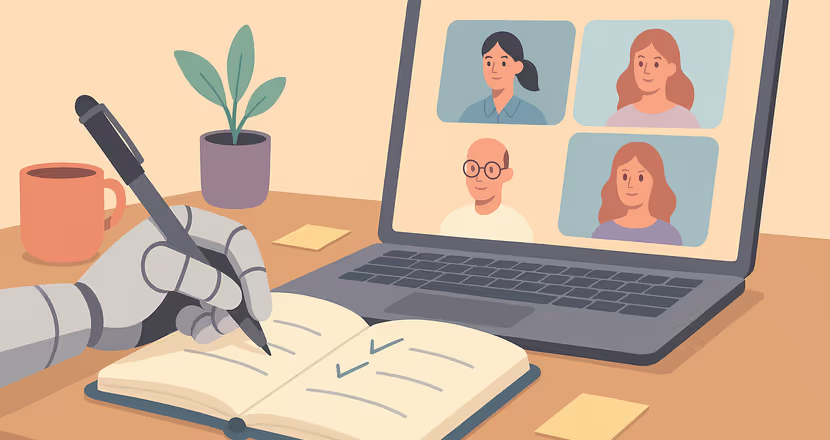
Watching a video and actually retaining what was said in it are two different things. The moment playback ends, the details you wanted (a quote or a step) are back inside the audio where you can't search for them. A transcript fixes that. It turns spoken video into text you can scan, copy, search, reuse, and even chat with. This article covers how to generate a transcript from a YouTube video.
The Short on Time Version
- The fastest path is YouTube itself. On desktop, expand the video description and click "Show transcript" to open a timestamped panel you can read, click through, or copy into a document.
- Mobile works, but desktop is better for copying. The YouTube app shows the transcript, but selecting the full text is easier in a browser, especially for long videos.
- When captions are missing or messy, transcribe the audio instead. If "Show transcript" isn't there or auto-captions are full of errors, download the video's audio and run it through a speech-to-text tool. Otter.ai can transcribe an imported MP3 or MP4, separate speakers, and make the result searchable.
- A transcript is worth more than a copy of the video. It makes videos scannable, accessible, and SEO-friendly, and it turns one recording into raw material for notes, quotes, blog posts, and social clips.
How to Get a YouTube Transcript on Desktop
Use YouTube in your browser to open the transcript from the expanded video description.
- Open the video. Go to YouTube in your web browser and pull up the video you want a transcript of.
- Expand the description. Below the video title, click "...more" to reveal the full description.
- Click "Show transcript." Scroll to the bottom of the expanded description and click "Show transcript." The transcript opens in a panel on the right side of your screen (or below the video on smaller windows), with timestamps down the left edge.
- Follow along or jump around. As the video plays, the transcript scrolls to the current line. Click any line to jump straight to that moment.
The transcript reflects the video's available captions, so it will match the language and caption track the creator uploaded or YouTube generated.
How to Remove Timestamps for Clean Text
By default, the transcript includes a timestamp on every line, which makes it awkward to paste into a document. You can turn them off in two clicks.
At the top of the transcript panel, click the three vertical dots and select "Toggle timestamps." The timestamps disappear and the text collapses into cleaner paragraphs. From there, highlight the transcript, copy it, and paste it into your document or notes app.
To move the text into a file, copy and paste it from the built-in panel.
How to Get a YouTube Transcript on Mobile
You can view a transcript in the YouTube app on iPhone or Android, but pulling the full text is harder than on desktop when you need quotes on the go.
- Open the video. Launch the YouTube app and tap the video you want.
- Tap the description. Tap "More" or the description area below the video title.
- Tap "Show transcript." Scroll down and tap "Show transcript" to open the transcript below the video.
- Tap to navigate or select text. Tap any line to jump to that part of the video. You can select and copy short passages, but grabbing the entire transcript is usually easier on desktop.
If you need the full transcript, switch to a desktop browser, where the copy-and-paste steps above work. For anything longer, it's usually faster to pull it on a desktop later.
How to Download a Transcript as SRT, TXT, or VTT
YouTube's built-in panel only lets you copy plain text, but many projects need a specific file format. If you're re-uploading captions or feeding text into another tool, choose the format based on where the transcript is going:
- TXT for plain text you'll paste into a document, post, or other notes.
- SRT or VTT for subtitle files you can upload back to YouTube or import into a video editor. Both formats carry timing data, so captions stay synced to the footage.
- JSON for developer workflows that need structured, timestamped data to process programmatically.
Free web-based transcript generators handle this well. You copy the video URL, paste it into the tool, and download the result in your chosen format. If you own the video, you can also manage caption files directly in YouTube Studio by uploading an SRT or VTT file, or by editing captions line by line in the built-in editor.
What to Do When a YouTube Video Has No Transcript
Many videos have captions, but not all. If the "Show transcript" option is missing, the creator may have disabled captions, or the video may be too new for auto-captioning to finish processing. Private and age-restricted videos may also limit access through third-party tools.
When captions genuinely don't exist, extractors have nothing to pull from. In that case, you need a speech-to-text tool that generates a transcript from scratch.
How Otter Helps You Generate The Best Transcripts From Videos
A dedicated tool can generate a fresh transcript when captions are missing or inaccurate. Otter.ai captures spoken content and turns it into searchable conversation records with meeting summaries and action items. The platform organizes the content and next steps, so you can work from the record instead of relying on memory.
For a video without usable captions, import the file. Download the MP3 or MP4, open Otter, click "Import," and drag the file in. Otter produces a searchable transcript you can mark up and search by keyword. It also applies speaker recognition, which native YouTube captions don't do. Uploading the audio file directly gives you the cleanest result because it avoids playback interruptions.
Once the file is processed, you can also ask Otter AI Chat a direct question about the content. Ask "What were the three steps the presenter recommended?" and it returns the answer pulled from the transcript, with speaker attribution, instead of making you scrub back through the video.
Why Create a YouTube Transcript?
A transcript is worth the two minutes it takes because it helps viewers search videos faster and helps creators make videos more accessible and findable.
How Viewers Use Transcripts to Search and Take Notes
A transcript makes an hour-long video scannable in seconds. Search for a keyword and jump straight to the section you need, using the timestamps to find the exact moment. This matters more as videos get longer: long-form viewing time rose 63.6% to 67.7% between January 2024 and December 2025.
A transcript also takes notes for you. Instead of pausing and rewinding to catch a detail, you watch, then pull what you need from the text afterward. You stay present with the video rather than splitting your attention between listening and typing.
How Creators Use Transcripts for Accessibility and SEO
A written record makes your content usable by more people. It also supports accessibility needs for people who are Deaf, are hard of hearing, have difficulty processing auditory information, and others.
Publishing that text can help people find your content, too. Adding headings and links can make it more usable and helps with SEO. A descriptive text transcript can also be accessed by search engines and assistive technologies. A clean version on your site, with headings and links, gives search engines material to index that video alone can't provide.
Other Ways to Transcribe a YouTube Video
You can use services and tools besides YouTube's auto-captions. The right path depends on how much accuracy and control you need.
Human-Powered Transcription
Before speech recognition matured, professional transcriptionists were the standard, and they still catch accents and industry jargon that software can miss. Automatic captions can require review, especially when audio is noisy or speech is specialized.
Professional work can cost more and take longer than automated transcription, and turnaround depends on availability. When you need absolute precision for legal or medical use, a human transcriptionist is still the safest choice.
Automated Transcription Tools
Automated transcription tools convert audio to text in minutes rather than hours, and most are affordable or free. They handle common formats like WAV, MP3, and MP4 and export to text or SRT. Automated output can still miss context, so review anything you plan to publish.
Browser Extensions
If you want a transcript without leaving the video page, a Chrome extension can pull it directly from YouTube's caption data and let you copy or download it in one click. Caption-extraction extensions are convenient for one-off jobs, but they depend on captions already existing. Audio-transcription extensions, however, can generate a version from the video's audio even when no caption track is available.
Troubleshooting Common Transcript Problems
Most transcript issues come from missing captions, caption errors, restricted videos, language tracks, or live-stream processing.
- "Show transcript" isn't there. The creator may have disabled captions, or the video may still be processing auto-captions. Wait a few hours, or use a speech-to-text tool that transcribes the audio directly.
- The transcript is full of errors. Auto-captions can struggle with technical terms or background noise. Import the audio into a dedicated tool for a cleaner result, then edit as needed.
- Private or age-restricted videos. Third-party extractors may not be able to reach these. If you own the video, manage captions in YouTube Studio. Otherwise, transcribe the downloaded audio directly.
- Non-English videos. YouTube's caption panel lets you switch languages if multiple tracks exist. For accurate cross-language work, a tool built for the source language will outperform a rough auto-translation.
- Live stream recordings. Captions on a saved live stream can lag or drop. Once the recording is processed, treat it like any other video, or transcribe the exported audio for a complete record.
If YouTube's panel can't give you clean text, use the audio file itself as the source and generate a fresh version.
Turn Any YouTube Video Into a Searchable Transcript With Otter
Once you have clean text, you can pull quotes from an interview, turn a long tutorial into a blog post, or draft show notes for a podcast episode in a fraction of the time it would take to re-watch the video.
Otter is built for exactly this. A journalist can import a recorded livestream and pull the exact pricing quote in seconds. A marketing team can extract customer objections from a webinar and use Otter AI Chat to turn each one into a social post. A student can drop a two-hour lecture into Otter, then ask Otter AI Chat "What did the professor say about the second midterm?" and get the answer with a timestamp attached.
Try Otter free on your next video import, or get a demo to see how it works across a full team.
FAQs About How To Transcribe a YouTube Video
Does YouTube Have a Built-in Transcript Feature?
Yes. You can see the full transcript of any video that has captions, which is useful if you want to read along with the video, or if you want to find a specific part of the video. On desktop, expand the video description and click "Show transcript" to open a timestamped panel on the right side of the screen. Note that the built-in transcript is only available when the creator has uploaded captions or YouTube has auto-generated them.
How Accurate are YouTube's Auto-Generated Transcripts?
Accuracy varies significantly based on audio quality, accents, background noise, and specialized vocabulary. YouTube's transcript is auto-generated from speech recognition, which means no real punctuation, no capitalization, frequent errors on names and technical terms, and one long run-on block of text.
How do I Get a Transcript from a YouTube video That Has no Captions?
If a video has no captions, the "Show transcript" option won't appear and third-party caption extractors have nothing to pull from. In that case, you need to transcribe the audio directly. Download the video's MP3 or MP4 file, then import it into a speech-to-text tool like Otter.ai.
Can I Download a YouTube Transcript as a File?
YouTube's built-in panel only lets you copy plain text and doesn't offer a one-click download. To save the transcript as a TXT, SRT, VTT, or JSON file, use a free web-based transcript generator by pasting the video URL, or, if you own the video, upload and manage caption files directly in YouTube Studio.
Related posts