How to Use AI to Summarize Transcripts




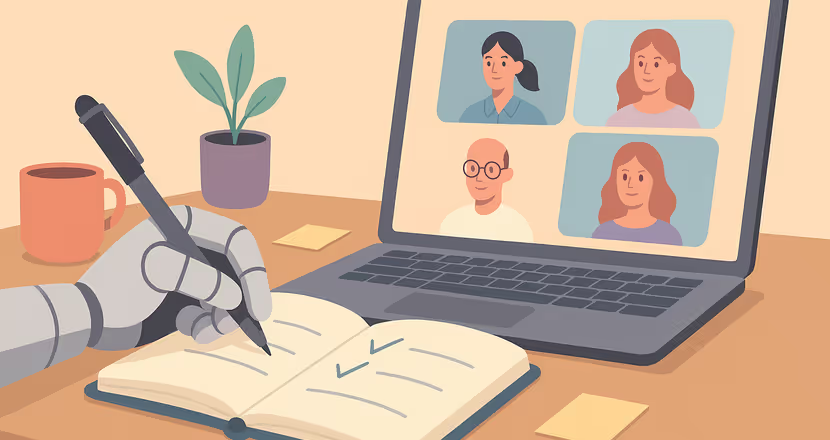
More often than not, a one-hour meeting can produce a long transcript of spoken dialogue. Reading the full transcript can take nearly as long as sitting through the meeting itself. A transcript summarizer condenses the full record into decisions and the context needed for follow-up, including action items.
35% of business meetings are unproductive, and 68% of employees say they lack enough uninterrupted focus time, with inefficient meetings cited as the top productivity barrier. The administrative work that follows meetings, including writing up notes and distributing action items, compounds the problem.
The Short on Time Version
- AI transcript summarizers condense full meeting transcripts into the decisions, action items, and context that actually need follow-up. You don't have to reread word-for-word records or rely on manual notes.
- The right output format depends on the audience: bullet points for team distribution, paragraph summaries for executive recaps, gist summaries for async catch-up, and custom prompts for workflow-specific extractions like action items or decisions only.
- AI summaries are not infallible. Common failure modes include hallucinations, dropped qualifiers, swapped owners or dates, and smoothed-over nuance, so always review automated summaries.
- Otter.ai uses Conversation Intelligence to summarize conversations and then turns them into action items and a searchable record your team can reference across meetings.
What Is Summarized Transcription?
Summarized transcription turns a full, word-for-word transcript into a shorter version that captures the key points, decisions, and action items. AI tools handle this using the core techniques, and understanding the difference helps you evaluate the quality of what you get back.
How AI Transcript Summarization Works
AI transcript summarizers commonly follow a three-stage workflow to turn audio input into a written summary, and the quality of each stage shapes the final output. Otter.ai handles that summarization well, but it does more than summarize. The tool captures the full conversation and turns it into action items, answers, and a searchable record your team can use.
That said, the quality of each stage affects the final output, including the following:
1. Speech-to-text conversion. An automatic speech recognition (ASR) model converts acoustic signals into written words. Accuracy at this stage depends on audio quality, speaker overlap, accents, and background noise. ASR accuracy also varies with accent, gender, speaker age, overlapping speakers, and recording conditions.
2. Natural language processing (NLP) analysis. Once the transcript exists as text, NLP models identify the structural elements: who said what, which statements represent decisions, where action items were assigned, and which topics received the most discussion time. Speaker recognition may also happen at this stage, depending on the system.
3. Summary generation. The system produces a condensed version using extractive, abstractive, or hybrid methods. Depending on the tool, the output may appear in a single format or as bullet points, paragraph summaries, action-item lists, or other forms.
How to Summarize Transcripts With Otter.ai
Otter’s AI notetaker captures conversations, turns them into summaries and action items, and makes conversation records searchable for your team. It starts with transcription, then adds conversation intelligence across meetings so teams can understand what was said, what matters, and what to do next. The process takes five steps.
- Record or upload the conversation. Record live conversations directly in Otter's desktop app, mobile, or web app. For virtual meetings, Otter can be configured to join scheduled calls on major video conferencing platforms and start capturing immediately. To summarize an earlier recording, upload an audio or video file.
- Let Otter transcribe. Otter uses proprietary ASR and speaker recognition technology to convert speech to text in real time. The text appears as the conversation unfolds, attributed to individual speakers.
- Open the summary tab. Once the conversation ends, Otter generates a summary organized by topic. Head to the summary tab for a condensed version with bullet points and action items. Otter also lets you customize summaries with templates: tell it whether the call was a sales meeting, one-on-one, team sync, or candidate interview, and the summary highlights the most relevant information for that context. You can also build custom templates with your own prompts.
- Skim chapter titles. Otter breaks longer conversations into chapters, each with a descriptive title. Scan these to locate specific sections without reading the full transcript. Edit chapter titles to improve accuracy, and Otter adapts to your preferences over time.
- Use timestamps for deeper context. Click any topic in the summary to jump to that exact moment in the transcript. You get full context on a specific discussion point without replaying the entire recording.
Then there’s Otter AI Chat which can answer questions from past meetings and broader meeting history rather than just a single transcript. Ask "What did the customer say about implementation timelines last quarter?" and it will respond with an answer including speaker attribution and timestamps. Otter also creates a conversation intelligence layer across your meeting history.
Glacier Media, an integrated media company reaching millions of readers across Canada and the U.S., shows what this workflow looks like under real deadline pressure. With an editorial team of roughly 150 staff filing under constant deadlines, reporters were recording and transcribing interviews manually, a slow, friction-heavy process that pulled them away from the story itself. After adopting Otter, reporters began using it for phone interviews, field recordings, and government press conferences.
How to Choose the Right Summary Output Format
Different audiences need different summary formats. The right output depends on who will read it and what they need to do with it. Here are some summary output formats to choose from:
- Bullet points work best for team distribution and quick reference. Each point captures a single decision, action item, or key insight. Most useful when multiple people need to scan for relevance.
- Paragraph summaries suit executive briefings and formal meeting recaps where context and narrative flow matter more than speed.
- Headline or gist summaries give a two-to-three-sentence overview for async catch-up. When someone misses the meeting and has 30 seconds, this is the format.
- Custom prompt outputs let you define exactly what the summary should extract: action items only, decisions only, open questions, or anything specific to your workflow.
Who Uses Transcript Summarizers
Transcript summarization applies differently depending on the industry. Each vertical has distinct accuracy requirements, compliance obligations, and output needs.
Accuracy Limitations to Watch For
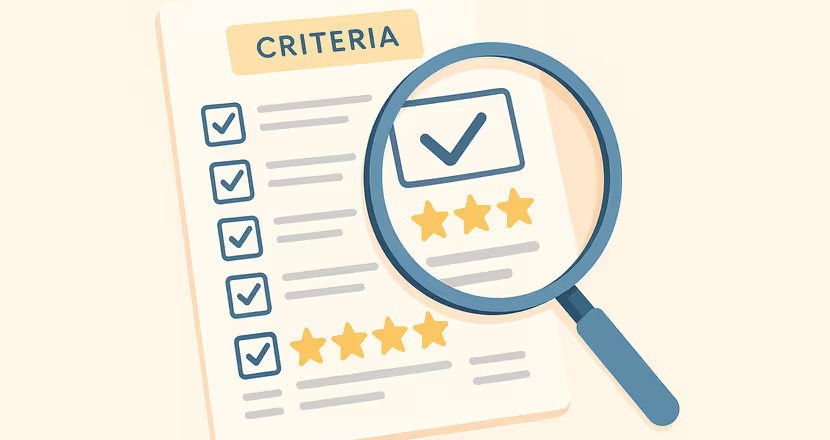
AI summaries are useful, but they are not infallible. LLM benchmark scores for summarization may reflect dataset-specific pattern matching rather than genuine summarization capability. Here are five failure modes appear most often in AI-generated summaries:
- Hallucination: The summary asserts something that was never said in the source conversation.
- Dropping qualifiers: A tentative statement like "we may expand to Europe" becomes "we will expand to Europe."
- Missing dissenting views: The summary captures the majority position but omits a key objection or alternative raised during the discussion.
- Swapping owners or dates: Action items get attributed to the wrong person, or deadlines are transposed.
- Smoothing nuance: Complex or conditional decisions get flattened into simple, unconditional statements.
Always review automated summaries before sharing them as a record of the meeting, especially for high-stakes decisions, compliance-sensitive conversations, and anything involving specific commitments.
What to Evaluate for Privacy and Security
Transcript data is sensitive by nature. It can contain customer information, financial details, personnel discussions, and strategic plans. Before adopting any transcript summarizer, evaluate the following:
- Data training opt-out: Some AI transcription services may use recordings to train AI models without attendee consent. Verify whether the tool uses your data for model training, and confirm you can opt out.
- Data retention and deletion: Understand how long recordings and transcripts are stored, who can access them, and whether you can delete them on demand. Data retention policies are an important evaluation factor when assessing AI transcription and workplace AI tools.
- Regulatory compliance: Depending on the use case, organizations may need HIPAA compliance, GDPR compliance, or audit trails. Look for SOC 2 Type II certification as a baseline security signal.
- Recording consent: Recording requirements vary by jurisdiction, so organizations should confirm what consent and notice practices apply before using AI transcription in meetings. Clear policies around when and how AI transcription tools are used in meetings are important.
- Attorney-client privilege: Ethical obligations for attorneys using AI to record, transcribe, and summarize client conversations include informed consent requirements and data handling standards, as outlined in the NYC Bar Association's Formal Opinion 2025-6.
For teams evaluating transcript summarizers, getting answers to these five questions before a pilot begins saves significant time later.
Start Summarizing Your Conversations
Every meeting contains decisions and commitments worth preserving, with context that matters later. A transcript summarizer captures that value without asking anyone to take notes or sit through a replay. With Otter, those conversations also become searchable conversation records and conversation intelligence your team can use across meetings.
Get a demo to see how Otter works for your team.
Frequently Asked Questions About Using AI to Summarize Transcripts
How Do You Summarize a Transcript?
To summarize a transcript, pull out the central message, flag the action items and decisions, and arrange the content in a structure that matches how the summary will be used (briefing, recap, action list). The fastest path is to let an AI summarizer do the first pass on the full transcript, then review and refine the output for accuracy, nuance, and tone before sharing it.
How Do I Get AI to Summarize a Document?
Upload the file or paste the text into an AI summarizer, then prompt it for what you want: a short overview, key decisions, action items with owners, or a custom format tailored to your workflow. For meeting transcripts specifically, tools like Otter generate the summary automatically once the conversation ends, so there's no separate upload or prompt step. The summary, action items, and chapter titles are ready to review in the same workspace as the transcript.
What Is a Transcript Summary?
A transcript summary is a shortened, structured version of a full transcript that surfaces the most important parts of a conversation, interview, meeting, or lecture. Instead of reading every word, you get the core themes, decisions, action items, and outcomes in a format that's quick to scan and easy to share, typically as bullet points, a short paragraph, or a custom layout built around what the reader needs to do next.
Related posts