A Guide to Enterprise AI Governance



You're on a customer call when a bot you don't recognize joins; nobody invited it. The trail leads back to last week, when a sales rep on another team signed up for a free AI notetaker and linked it to their calendar. Now it's quietly recording every meeting they're on, including this one, where a prospect just asked how your company handles their data.
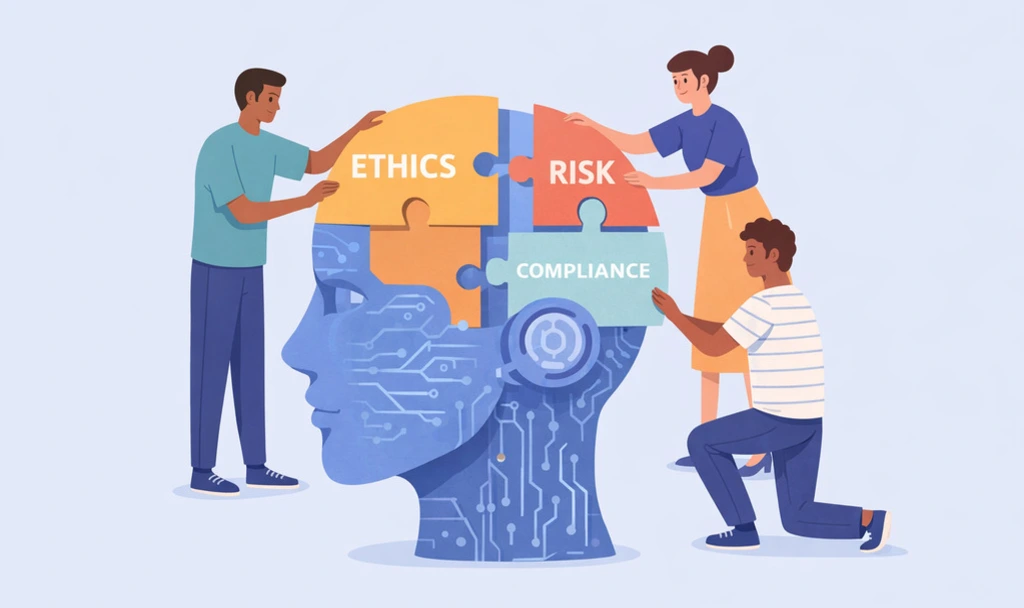
Free AI tools are spreading through invite chains and personal accounts faster than IT can review them, and most enterprise AI governance programs weren't built for that pace. This guide walks through what enterprise AI governance covers, the pillars and phases that make it work, and how to bring the conversation layer under the same controls as the rest of your AI stack.
The Short On Time Version
- Enterprise AI governance is the discipline of inventorying, controlling, monitoring, and documenting every AI tool an organization uses across its full lifecycle.
- The core challenges to enterprise AI governance are widespread shadow AI use, shadow-AI-linked breaches, EU AI Act penalties, and an inability to produce governance evidence on demand.
- A working program depends on five core pillars and six build phases that progress from tool inventory to documented controls.
- Otter.ai brings the conversation layer under IT control with SOC 2 Type II, HIPAA, SSO/SAML, SCIM, audit trails, and MCP governance, consolidating scattered notetakers into a single searchable system for conversation records, decisions, and action items.
What Is Enterprise AI Governance?
Enterprise AI governance helps organizations manage AI risk from deployment to decommissioning.. The core difference from traditional IT governance is that traditional systems generally produce predictable outputs. In contrast, AI systems often produce probabilistic outputs that are not guaranteed to be fully predictable or identical from the same inputs.
This single difference breaks the assumption behind most existing governance controls. In practice, ownership is distributed across IT/Engineering, Data/AI teams, Legal/Compliance, and business units. In fact, 20% of executives cite a lack of clarity on ownership as a barrier to operationalizing responsible AI.
Why Enterprise AI Governance Is Now a Board-Level Priority
AI governance now sits inside the board's fiduciary duty to oversee material risk. Shadow AI breaches, EU AI Act penalties, and the inability to produce governance evidence on demand are disclosable exposures for which the board is accountable. Shadow AI, the use of AI tools by employees outside of IT review, is the through-line across all three.
Shadow AI Breaches Are a Direct Financial Hit
One in five organizations has already experienced a breach linked to a shadow AI, and each one adds USD $670,000 to the average breach cost. That's a number large enough to land in board meetingsas a discrete line of exposure, tied directly to AI tools the organization didn't formally approve.
EU AI Act Penalties Have Crossed Into Material Risk
The EU AI Act's ban on unacceptable-risk practices is already enforceable, with full high-risk obligations and penalties of €35 million or 7% of global annual turnover taking effect in August 2026. The NIST AI RMF and ISO/IEC 42001 raise the bar further by establishing a documented standard for AI management, which auditors and insurers increasingly expect to see.
Contractual Obligations Require Governance Documentation
More than 70% of organizations say regulatory compliance is among their top three challenges to widespread GenAI deployment, and security and governance practices lag the pace of rollout. The result is the question boards can't yet answer: when a regulator, auditor, or insurer asks how AI is being managed, there isn't sufficient documentation to support the answer.
Responsible AI Investment Correlates With Higher Returns
Organizations investing $25 million or more in responsible AI report meaningfully higher maturity scores and are far more likely to see EBIT impact above 5%. Governance spending shows up on the income statement, which is why boards are increasingly treating it as a value lever rather than a compliance line item.
The Five Pillars Every Enterprise AI Governance Program Has to Cover
A governance program that misses the following key pillars can create the appearance of control without delivering complete coverage.
- Data Governance. Classification must precede any AI ingestion decision. Map each tool's data-processing geography against sovereignty laws, and build retention schedules that address AI-generated outputs and conversation records.
- Model Governance. Training opt-outs should be contractual commitments in the Data Processing Agreement, not product settings that a vendor can change unilaterally.
- Identity and Access. AI tools should ideally be integrated with the organization's identity provider via SAML 2.0 or, where supported, OIDC, as an enterprise SSO best practice. SCIM automates lifecycle management, so deprovisioning is not manual.
- Audit and Observability. Logs must capture user identity, timestamp, AI tool, and model version, input, output, and data sources accessed. Per-user attribution is essential for audit-usable logs.
- Integration Risk. MCP (Model Context Protocol) enables AI agents to discover and invoke tools as needed. Unlike static APIs, the set of tools an AI can access is not fixed ahead of time.. Per-user authorization and logging at the MCP layer are required.
These pillars do more than reduce risk. They also make AI-generated outputs usable over time by keeping conversation records governed, attributable, searchable, and available when teams need to review what was said, what was decided, and what needs to happen next.
How to Build an Enterprise AI Governance Framework, Step by Step
These six phases move a governance program from discovery to documented evidence.
- Step 1: Inventory Every AI Tool Already in Use. Run CASB tools, network monitoring, and employee surveys to identify AI-related domains and API calls. Match each tool to the business units and data elements involved.
- Step 2: Set Acceptable-Use and Approved-Vendor Policies. Define an AI request path (approve, restrict, or block), mandate SSO logins while prohibiting personal accounts for work data, and set minimum human oversight requirements for AI-assisted decisions.
- Step 3: Establish the Identity Baseline. Make SSO enrollment a prerequisite for approval. Implement SCIM for lifecycle management. Build and test a deprovisioning procedure where each step produces a log entry.
- Step 4: Stand Up Audit Logging and Retention Rules. Put protections in place against audit log tampering, and map logging to CIS Controls v8.1.
- Step 5: Govern Bidirectional Data Flows. Build an MCP server registry where every server is a documented asset. Enforce per-user authorization at the MCP layer, and log all MCP tool invocations as a distinct category.
- Step 6: Document the Program. Create a framework crosswalk that maps controls to COBIT, ISO/IEC 42001, and NIST AI RMF simultaneously.
When these phases are in place, teams can answer governance questions with evidence instead of reconstruction. That matters for audits, and it also matters for preserving decision continuity and making conversation history useful across the organization.
What to Look for When Evaluating AI Tools Against Your Enterprise AI Governance Standards
Before approving any AI tool, IT and security teams should validate these six requirements. The goal is to keep conversation records and other AI-generated outputs governed, searchable, and accountable over time.
- SOC 2 Type II and HIPAA Are Common Baseline Requirements: SOC 2 Type II and HIPAA compliance are standard requirements for tools that handle sensitive enterprise data. ISO 27001 certification can add international credibility.
- Data Residency Must Be Documented and Specific: Require documented data-processing geographies that specify where data is stored and processed, not just the cloud provider name.
- Training Opt-Outs Belong in the DPA: Training opt-outs should be contractual commitments in the DPA, not product toggles that vendors can change unilaterally. Verify whether the vendor itself uses customer data for training, even in de-identified form.
- SSO and SCIM Are Non-Negotiable for Enterprise Approval: Require SAML/OIDC SSO, SCIM provisioning, and domain capture as minimum standards.
- Audit Trails Must Be Immutable and Per-User Attributed: Require immutable, per-user-attributed audit trails with configurable retention periods.
- MCP Integrations Require Per-User Authorization and Logging: Require per-tool access permissions, token scoping, and audit logging for any MCP or agent integration. Org-level access grants without per-user authorization are not effective governance.
Treat these six points as non-negotiable. Any tool that can't meet them shouldn't move past procurement. Each one maps to a control that auditors, regulators, or insurers will eventually ask about, and the gaps are easier to close before approval than after a tool is already in use across the organization.
Why Enterprise AI Governance Often Overlooks Meeting AI
Most enterprise AI governance programs are built around the AI tools IT already knows about: chatbots, copilots, model APIs, and approved SaaS. Conversation AI rarely sits on that list, even though it's often the highest-volume, most sensitive AI surface in the organization. The category that captures the most decisions, the most customer context, and the most regulated conversations ends up with the fewest controls.
Three things make this blind spot worse than it looks on a vendor list:
- The tools work against data minimization. AI notetakers capture everything, turning conversations that were never meant to be memorialized into permanent records. Those records are unstructured, cross-functional, and mix sensitivity levels within a single document, making them harder to classify, retain, and review than almost any other data type IT manages.
- Meetings are where organizational context lives. Customer conversations, internal decisions, action items, and follow-ups all flow through meetings. When those records sit in tools IT hasn't reviewed, the organization loses both governance and the ability to retrieve what was actually said and decided.
- The scale compounds quickly. In large organizations, thousands of employees, each using personal meeting notetakers, exponentially increase the surface area for tools that need to be governed. Platform-native admin controls didn't help: they govern the platform's own AI features and can't block third-party bots from joining meetings as participants.
Stax, a management consulting firm that runs four- to six-week engagements, encountered this pattern firsthand. Employees spun up personal notetaker accounts to keep pace with expert interviews. When those employees left, the data left with them, scattering confidential client information across accounts the firm didn't control.
Moving to Otter gave IT leader Miguel Patino centralized control over subscriptions and data. Rogue accounts went away, client information was consolidated into a governed repository, and real-time transcription saved one to two days on tight timelines, so governance didn't come at the cost of the workflow.
How Otter Brings Enterprise AI Governance to the Conversation Layer
Otter, a conversation intelligence platform for meeting records, decisions, action items, and insights, brings meeting AI under IT governance with its Enterprise plan, which includes SSO, SCIM, audit logging, and admin-controlled recording policies.
Having already captured more than 1 billion meetings, Otter serves 35 million users, tracks 59 million action items per month, and saves approximately 1 FTE per 20 users by consolidating meeting records into a single governed platform rather than multiple ungoverned free tools.
- SOC 2 Type II Certified and HIPAA Compliant. Otter is SOC 2 Type II certified and HIPAA compliant, with BAA availability. Enterprise customers are the data controllers; Otter's third-party AI providers do not use customer data for training, and Otter de-identifies user data before any model training.
- SSO/SAML, SCIM Provisioning, Domain Capture, and Admin Controls. Otter supports SAML-based SSO with Okta and Microsoft Entra ID, SCIM directory sync for provisioning and deprovisioning, Domain Capture to route company emails into the governed workspace, and workspace-wide 2FA enforcement.
- Audit Trails, MCP Governance, and Consolidation Value. Otter’s Enterprise plan includes audit trails and logging for compliance reporting, plus admin controls to configure settings such as pre-meeting notifications. And their MCP Server lets external AI models securely query meeting data, and Otter is an approved MCP connector in ChatGPT's App Store.
IT buyers should request governance documentation from their account executive to confirm per-tool permissions, token scoping, and audit logging. Replacing multiple ungoverned tools with one governed platform reduces vendor management and compliance overhead.
Bringing the Conversation Layer Under One Governed Roof
Skipping the conversation layer leaves one of the organization's most sensitive data surfaces ungoverned. Customer conversations, strategy discussions, HR reviews, and deal negotiations all flow through meetings. When unreviewed tools capture those records, the governance program has a gap, and the organization loses a searchable record of what was said and decided.
Bring meeting AI under the same controls as every other AI tool in your stack. This visibility helps you keep an inventory of what's being recorded. Consolidate onto a platform with SSO, SCIM, audit logging, and recording policies. Document the controls. Produce the evidence.
Otter gives IT a single, governed platform for the conversation layer and gives the business a searchable system of conversation intelligence: one place for records, decisions, action items, and insights, centrally governed rather than scattered across free tools.
Get a demo to see Otter’s admin console and security documentation, or try it free to experience governed meeting AI in practice.
Frequently Asked Questions About Enterprise AI Governance
What Is the Enterprise AI Governance Model?
An enterprise AI governance model outlines how AI systems are approved, rolled out, monitored, and eventually retired across the company. It spells out who owns what, who's accountable for which decisions, and how data, models, and outputs are managed, with responsibility shared among IT and engineering, legal and compliance, data and AI teams, and the business units that actually use the tools.
What Is the AI Governance Framework for Enterprise?
An enterprise AI governance framework brings together the policies, roles, and controls that manage AI risk from the moment a tool is considered through to its decommissioning. Most programs map to recognized standards, and they cover data governance, model governance, identity and access, audit and observability, and integration risk.
What Are the Three Pillars of AI Governance?
AI governance usually rests on three pillars: people, process, and technology. The people dimension is about ownership, roles, and who's accountable when something goes wrong. The process covers the policies, request paths, and review workflows that determine how AI tools are adopted. The technology layer that enforces policy at runtime, including SSO, SCIM, audit logging, and per-user authorization for tool integrations.
What Is AI Governance in Simple Terms?
AI governance is how an organization decides which AI tools are allowed, who can use them, what data those tools can touch, and how that usage gets reviewed. It's the set of policies and controls that keep AI safe, accountable, and aligned with the organization's standards for security, privacy, and decision quality.
Related posts