Claude Can’t Help With Your Work if it Doesn’t Know What Happened in Your Meetings



There's a version of AI adoption that looks successful on paper. Usage is up. Licenses are deployed. Your team opens Claude multiple times a day. But something still feels off, because even though the outputs are polished, they're generic. Missing the texture of what your organization actually knows.
Here's the culprit: Claude is smart, but it doesn't know what happened in your meetings.
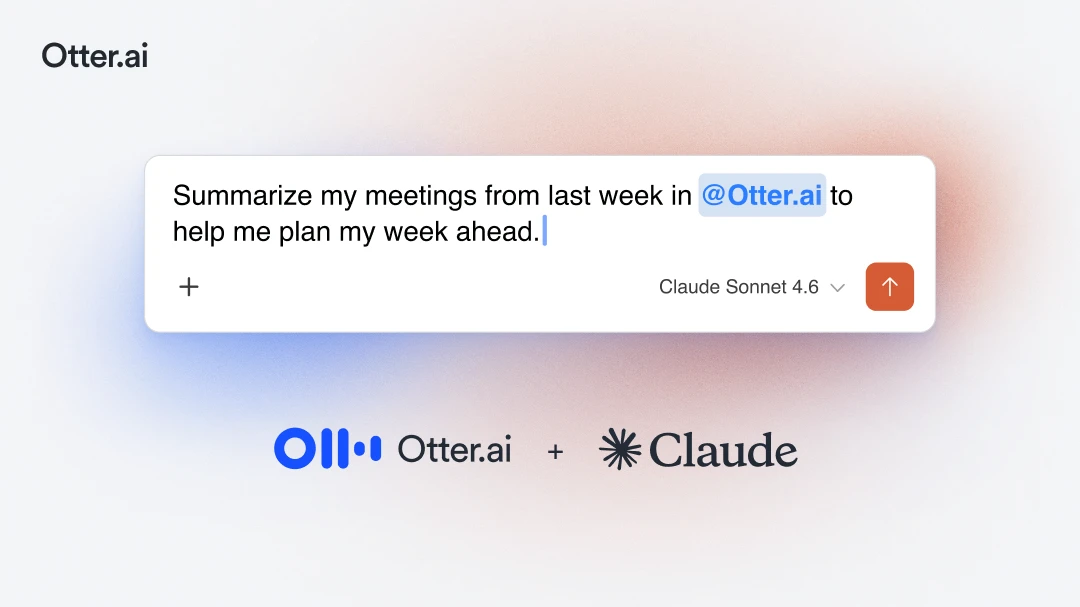
That changes today. Otter now integrates directly with Claude via MCP, making your meeting transcripts, summaries, and action items available to Claude as live, queryable context, without manual uploads, copy-pasting, or extra steps.
Why meetings, specifically?
Think about where your organization's most consequential knowledge actually lives. Not in your cleaned-up, after-the-fact documentation. The real signal is in the conversations: the sales call where a customer said exactly what they were worried about, the engineering sync where someone spotted the flaw in the roadmap, the leadership offsite where strategy quietly shifted.
All of that has been sitting in Otter. And until now, Claude couldn't reach it.
What this makes possible
The 45-minute post-call grind, condensed to seconds
After a meaningful meeting, someone has to do the follow-up. Emails to draft. A CRM to update. Risks to flag. Notes to distribute. That's anywhere from 30 to 45 minutes of work per call, done from memory, hours later.
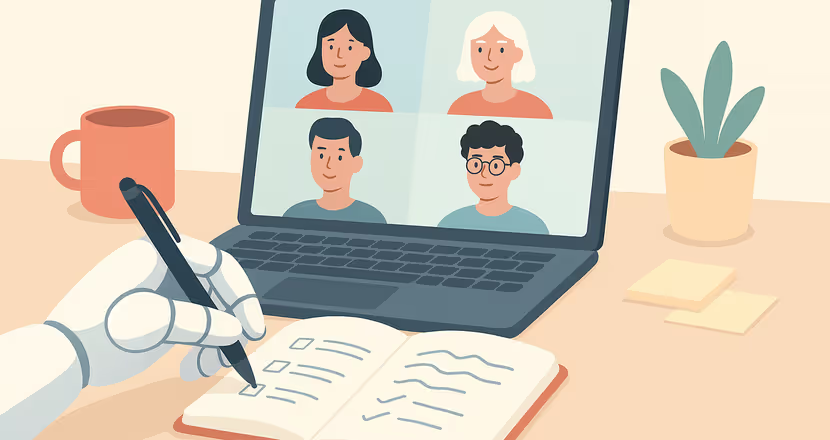
With Claude and Otter connected, that changes dramatically. Open Claude right after a call, describe what you need:"draft the follow-up, summarize the customer concerns, flag anything that needs escalation",and Claude pulls the Otter transcript and runs with it. The whole thing takes a minute, not an hour.
Cross-referencing what was said against what was written
Organizations generate two kinds of records: what people said in meetings, and what ended up in official documentation. Keeping them in sync has always required a human in the middle, manually updating spaces like Confluence or Notion after every call.
Claude with Otter connected can bridge that gap on demand. "How do the commitments we made on last month's calls compare to what's in the account record?" is now a question Claude can actually answer.And not because someone maintained perfect notes, but because the transcripts are right there.
Leadership-level synthesis without the filter
When information travels up through an organization, it gets summarized, softened, and shaped. Leaders rarely hear the raw version of what's happening.
With Otter connected, Claude can synthesize directly from the source. Ask it to surface recurring themes across a month of leadership calls, or identify risks that were raised verbally but never made it into a formal document. The result is closer to what actually happened than what got written up about it afterward.
Connecting Otter to Claude doesn't add a new tool to your stack. It gives the tool you already use something real to work with.
The setup, in plain terms
Connect Otter to your Claude workspace in four steps:
- In Claude, find the integrations panel and search for Otter.ai,it's listed as a verified MCP connector.
- Sign in via OAuth and grant the access scope that makes sense for your use case.
- Enterprise IT teams can configure integration permissions, define what Claude can query, and access a full audit log of data requests.
- That's it. Claude now works with your meeting history the same way it works with everything else you bring to it.
A note for security and compliance teams
Otter's MCP implementation uses OAuth authentication scoped to individual user permissions. No new data pipelines run outside your existing security boundary. All access is logged. Transcripts stay in their source systems — they're not copied into Claude or stored elsewhere.
Otter is SOC 2 Type II certified and HIPAA-compliant. For most enterprise security reviews, that's the box check you need.
Related posts