Can You Record a Job Interview? Here's What the Law Says

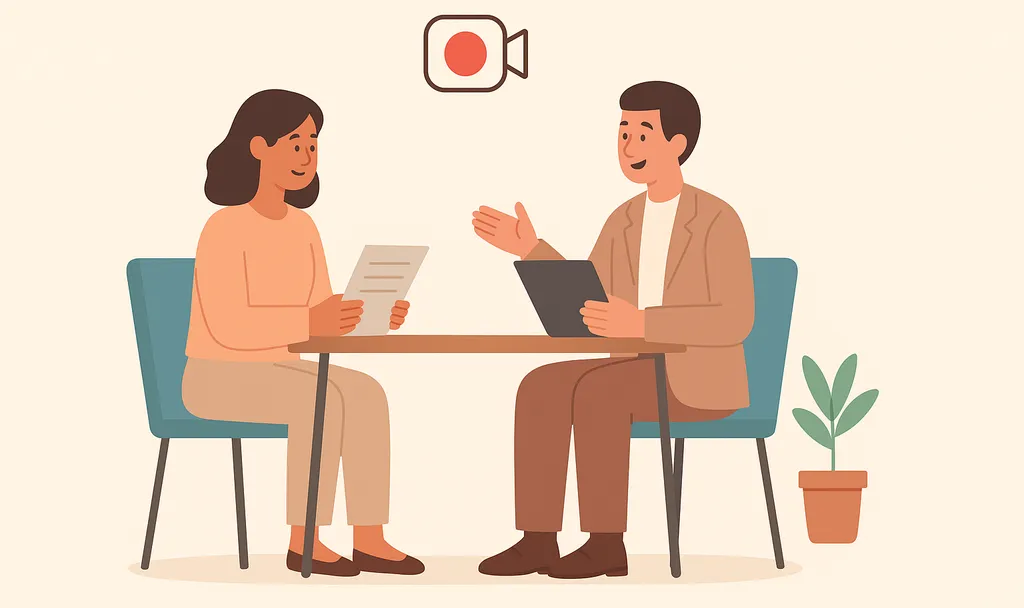


Recording a job interview can save recruiters from relying on memory or scribbled notes, but the answer to whether you can record one is jurisdictional. In most of the US, yes, with permission first, though the permission rules vary by state and, for candidates based overseas, by country.
Which rule applies depends on each participant's location and, for EU or UK candidates, whether you can prove permission afterward.
This article is informational, not legal advice. Confirm requirements with your legal or HR compliance team before recording candidates.
The Short on Time Version
- In most of the US, federal law (18 U.S.C. § 2511) lets you record a conversation you take part in, but at least 11 states require every participant's permission.
- When a remote interview crosses state lines, follow the stricter state's law, a principle California's Supreme Court applied in Kearney v. Salomon Smith Barney.
- Interview recordings of EU and UK candidates are personal data under GDPR, and candidates can request deletion, with a one-month response deadline.
- Once you have written and verbal permission, an AI notetaker such as Otter.ai can turn the interview into a searchable transcript the whole hiring team can review.
Can You Record a Job Interview? The Short Answer
Yes. In the US, you can generally record a job interview you take part in. Federal law follows one-party permission: the recruiter is a party to the conversation, so their own permission satisfies it. But at least 11 states require permission from everyone on the call, and a remote interview can pull in a stricter state's law even if your company sits in a permissive one. The same rules apply if a candidate wants to record the interview.
What the Law Says About One-Party vs. All-Party Permission
Two layers apply at once: a federal floor, and a state rule that can sit well above it.
Federal Law Sets a One-Party Permission Floor
Under 18 U.S.C. § 2511(2)(d), it is not unlawful to record a communication "where such person is a party to the communication," provided the recording isn't made for a criminal or tortious purpose. Most states follow this one-party permission model. Under 18 U.S.C. § 2520, the federal Wiretap Act's civil action provision, statutory damages are the greater of $100 per day or $10,000 per violation.
All-Party Permission States and Why the Count Varies
Published counts vary because state statutes, case law, and privacy context do not line up neatly. A quick reference:
State-by-state lists often reach at least 11 states once Nevada is added, and the count can rise to 12 or 13 depending on how mixed-permission states are classified. Penalties can be serious: in Pennsylvania, illegal recording is a third-degree felony. For the full state-by-state breakdown, see Otter.ai's guide to state recording laws.
Cross-State Interviews Pull in the Stricter Law
When interviewer and candidate are in different states, the stricter law can reach you. In Kearney v. Salomon Smith Barney, 39 Cal.4th 95 (2006), the California Supreme Court held that calls between California clients and a Georgia office needed both parties' permission. For calls with parties in multiple states, the safest approach is to comply with the strictest law that may apply.
Can You Record a Job Interview Under GDPR?
If your hiring stays inside the US, the sections above cover you. But when a US recruiter interviews a candidate sitting in Berlin or Manchester, the candidate's local law travels with them, and permission stops being the whole question.
GDPR Adds Rules for EU-Based Candidates
An interview recording of an EU-based candidate is personal data under GDPR Article 4(1), which applies to US employers processing that data. Under Article 7, permission must be demonstrable, clearly presented, and as easy to withdraw as to give.
For employers, relying on permission alone is risky because the power imbalance can make it unlikely to be freely given. Guidelines 05/2020 deem it "problematic for employers to process personal data of current or future employees on the basis of consent as it is unlikely to be freely given." Recruiters interviewing EU candidates therefore usually rely on legitimate interests or contract performance as their lawful basis, with transparent notice to the candidate.
EU candidates can also request erasure under Article 17, and Article 12(3) requires a response within one month.
UK Retention Guidance for UK-Based Candidates
For UK-based candidates, retention needs to match the hiring purpose. Under UK storage limitation guidance, specific time limits are not set by UK GDPR; retention is the employer's call, tied to purpose. A practical benchmark for unsuccessful candidates' interview notes, reflected in recruitment retention guidance from the CIPD, is six months to a year. If you're interviewing overseas candidates regularly, loop in counsel who handles cross-border data.
Is It Legal to Secretly Record an Interview?
Secret recording is a bad idea even where one-party permission rules make it technically legal. In all-party states it's a crime: California's Penal Code § 632 carries fines up to $2,500 per violation for a first offense, and under § 632(d) an illegally recorded confidential conversation is not admissible in court. A candidate who secretly records a badly run interview can also damage the employer's brand. Otter.ai's article on recording without permission goes deeper.
How to Record a Job Interview Legally
Recording programs often get sloppy on storage and retention, so set the rules before recruiters start recording. The steps below cover the full lifecycle, from booking the interview to deleting the file.
Step 1: Disclose the Recording at Scheduling
Put the disclosure in the scheduling confirmation, not the meeting invite five minutes before the call. The written notice should name four things: that the interview will be recorded, why you're recording it, who will have access, and how long you'll keep the file. Ask the candidate to reply confirming they've read it, so you have a written record before anyone joins the call.
Step 2: Prepare a Fallback for Candidates Who Decline
Decide the alternative before you need it, so the recruiter isn't improvising when a candidate says no. Options can include alternative interview formats or reverting to written notes, and the alternative should never affect the hiring decision. Add a declined-permission flag to the candidate record so the panel has a defensible artifact that respects the candidate's preference.
Step 3: Confirm Verbal Permission at the Start of the Call
Get permission a second time out loud, at the start of the call, so the agreement is captured on the recording itself. A short script recruiters can read verbatim:
"I'd like to record this interview so the hiring team can hear your answers directly and I can stay focused on the conversation. Only [names/roles] will see the recording, and we'll delete it after the hiring decision. Is that okay with you?"
Wait for a clear "yes" before starting. If the candidate hesitates or asks questions, answer them first; a recorded "I guess so" is not the same as informed permission.
Step 4: Restrict Access to the Hiring Panel
Once the file exists, lock it down. Set role-based access on your storage system and share by link only to the hiring panel; avoid forwarding files by email or dropping them into general team channels. Every additional viewer is a data-protection risk and a harder deletion request to fulfill later.
Step 5: Store the File Securely and Set a Retention Date
Save files on company-approved systems with encryption at rest and access logging enabled, then attach a retention date to each recording. Private employers covered by the rule need to keep EEOC hiring records for at least one year. If AI analyzes recorded video interviews of Illinois candidates, the state's AI Video Interview Act adds written notice, permission, and 30-day deletion duties. Because those duties can conflict with the EEOC's one-year floor, have counsel reconcile them.
Step 6: Respond to Deletion and Access Requests
Candidates may ask to see the recording, correct information, or have the file deleted. EU candidates can request erasure under GDPR Article 17, and you have one month to respond. Build a lightweight intake process so requests don't sit in someone's inbox: a shared address, a named owner, and a log of what was deleted and when. Answering fast beats answering perfectly.
Use a Tool That Records Transparently
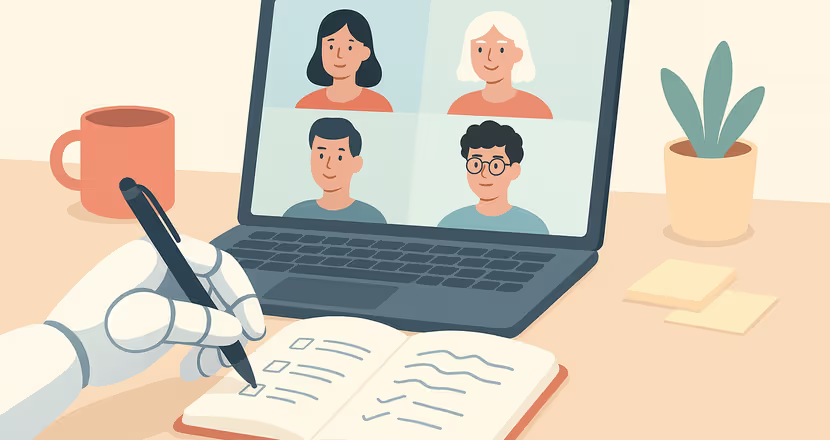
Once the six steps above are in place, the tool should reinforce them, not fight them. Otter.ai is an AI notetaker and Conversation Intelligence Platform that captures and organizes interview context into documentation the hiring team can review, building a searchable record of decisions, action items, and context across every interview. Configure it to join the Zoom, Google Meet, or Microsoft Teams scheduled interviews your team already runs. It joins as a named guest participant in the meeting list and posts a message in chat when recording begins.
Otter also supports 30+ integrations, including Slack and Notion for panel debriefs and ATS-adjacent tools. Automated updates to external applications are available via MCP or via open API, so interview notes flow into the systems your hiring team already uses. Otter is visible in the meeting; obtaining valid permission remains the recruiter's responsibility.
Benefits of Recording Job Interviews
Once permission and storage are handled, the recording starts earning its keep:
- Full presence in the room: the interviewer can drop the notepad and actually listen, ask sharper follow-ups, and read the candidate's cues instead of splitting attention between the conversation and the transcript.
- Async panel review: hiring managers, cross-functional interviewers, and the recruiter can review the same answers on their own time, cutting the debrief calls the panel would otherwise schedule.
- Consistent, comparable scoring: every panelist evaluates the same answers in the same words, so scorecards reflect what the candidate actually said instead of what each interviewer remembers.
- Faster, better-informed decisions: searchable transcripts let the panel jump straight to the answers that matter for a specific competency, so debriefs focus on evidence instead of recollection.
- Defensible hiring record: a timestamped transcript of what was asked and answered gives HR and legal a clean artifact if a rejected candidate later challenges the decision.
- Stronger candidate experience: interviewers who aren't buried in notes make the conversation feel like a conversation, and candidates get a more accurate read of the role and the team.
With permission in hand, Otter transcribes the interview with 95%+ accuracy and produces a searchable, speaker-labeled record of what each candidate said, with summaries and action items tied to the hiring context the panel can act on later.
Let Otter Document the Interview Legally
Recording job interviews is legal in most US jurisdictions when you do it in the open: written permission at scheduling, verbal permission on the recording, the stricter state's rule for cross-state calls, secure storage, and a retention limit your legal team signs off on. Get that right, and the record earns its keep as a searchable transcript the whole hiring team can review, ready when the panel debriefs. Confirm specifics with counsel; recording permission law varies by jurisdiction.
Once the candidate has agreed, Try Otter free on your next interview, or Get a demo to see how hiring teams use it.
Frequently Asked Questions About Recording Job Interviews
Can You Legally Record a Job Interview?
In most of the US you can record an interview you're part of under federal one-party permission rules (18 U.S.C. § 2511), but at least 11 states require every participant to give permission first. Wherever you are, tell the candidate you're recording and get their agreement before you start.
Do You Have to Tell a Candidate You're Recording?
In all-party permission states, yes, it's legally required. Everywhere else it's still best practice, because disclosure keeps the recording defensible if a decision is later questioned. Get permission in writing at scheduling and again verbally on the call.
Can a Candidate Record Their Own Job Interview?
The same permission rules apply to candidates: in one-party states they can record a conversation they're in, and in all-party states they need the interviewer's permission too. Either way, asking first is safer.
Which States Require Everyone's Permission to Record?
At least 11 states require permission from everyone on the call, and the count can reach 12 or 13 depending on how mixed-permission states are classified; examples include California, Florida, Illinois, Pennsylvania, and Washington. When a remote interview crosses state lines, follow the stricter state's rule.
How Do You Record a Job Interview Legally?
Get permission twice, in writing when you schedule and verbally at the start of the recording, state why, store the file securely, set a retention limit, and honor deletion requests. If a candidate declines, flag it so later interviewers know and proceed without recording. Once you have permission, an AI notetaker like Otter configured to join the scheduled interview can record and transcribe it.
What's a Good Tool to Record and Document Job Interviews?
Once you have participants' permission, Otter can be configured to join the Zoom, Google Meet, or Microsoft Teams interviews you schedule, transcribes them with up to 95% accuracy, and turns each into a searchable record your hiring team can review. Participants can see it in the meeting, though the recruiter remains responsible for obtaining valid permission.
Related posts