From AI Notetaker to $100B Category: Otter’s Conversational Knowledge Engine



When we started Otter.ai a decade ago, my co-founder Yun Fu and I started with a simple question: people have been talking for hundreds of thousands of years, but almost all the conversations are lost; what if we capture and organize all the conversations in the world? It turned out to be a popular product with over 35 million users, over a billion meetings transcribed, and by our estimate more than $1.5 billion in time saved for the people and organizations who use us.
But notes were never the destination.
We always believed that capturing conversation was only the first step. The real question was: what happens to all of that knowledge? Where does it go? Who can access it? What does it actually change about how an organization operates?
For most companies, the answer has been: nothing. Meetings end. Knowledge evaporates. The same decisions get relitigated in next week's meeting because no one remembers or can find what was agreed to last month. Companies suffer from being all talk, no action. That's the problem we're solving now.
Every company has a system of record. Except for the most important one.
Enterprise software has done a remarkable job of capturing certain kinds of organizational knowledge. CRM for customer relationships. HRIS for people data. ERP for financials. These systems exist because someone decided that a particular type of institutional knowledge was too valuable to lose, and built infrastructure around preserving it.
But there has never been a system of record for what people actually say.
That is a strange gap when you think about it. A company's most consequential knowledge, the strategic debates, the customer commitments, the product decisions, the competitive intelligence, doesn't live in a database. It lives in conversations. And until now, the moment a conversation ended, that knowledge was essentially gone.
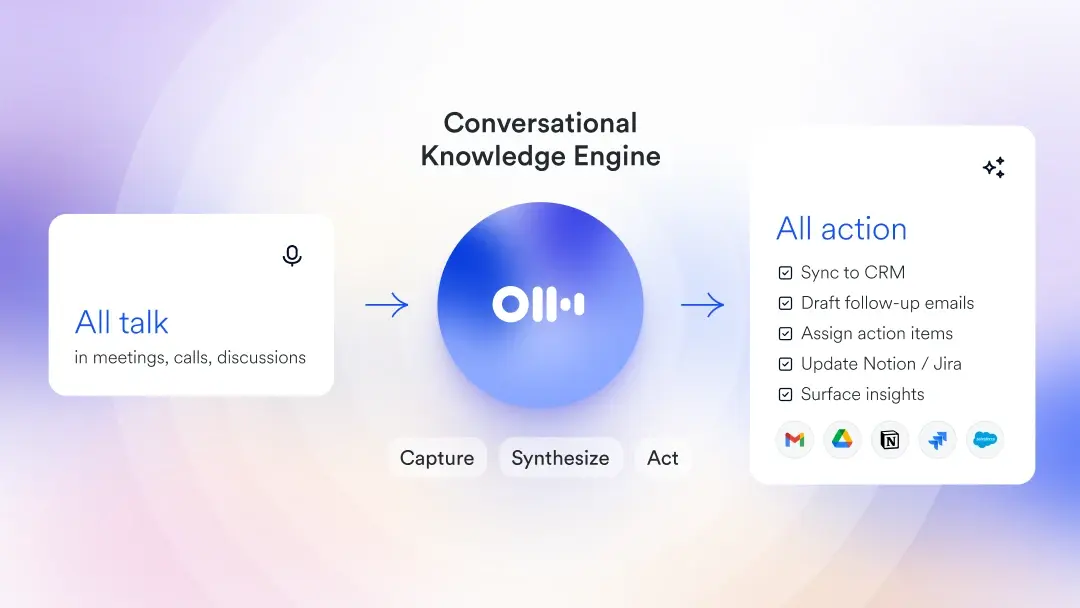
That's what the Conversational Knowledge Engine changes. Every meeting, every call, every discussion becomes something your organization can actually use: searchable, cross-referenced, connected to your existing tools, and available to the AI systems you're already deploying. It is not a better notetaker. It is a new category of enterprise infrastructure.
Why this is a $100 billion market built from the ground up
I want to be direct about something, because I think the honest argument is more compelling than the inflated one.
Analysts don't size this market yet. That's not a weakness in our position, it's the definition of category creation. Gartner didn't have a CRM Magic Quadrant before Salesforce invented the category. Marc Benioff made the case from first principles: if every customer relationship in every company could be captured and activated, what would that be worth?
We're making the same argument about organizational voice.
Here's how the math works. The global CRM market is valued at approximately $80 to $100 billion today, heading toward $163 billion by 2030, according to Grand View Research. Conversational AI was valued at $11.6 billion in 2024 and is projected to reach $41 billion by 2030 at a nearly 24% compound annual growth rate. Together, those two established markets alone represent well over $100 billion in annual software spend today.
The Conversational Knowledge Engine doesn't compete inside any one of those categories. It's the intelligence layer that connects and feeds all three by capturing the spoken organizational knowledge that every CRM, knowledge base, and AI agent depends on, but none of them currently holds. A platform that sits above three $50-plus billion markets and makes each one meaningfully more valuable warrants a $100 billion category estimate. That's a conservative framing, not an aggressive one.
To put it differently: IDC reports that 68% of enterprise data goes unleveraged. Workers spend roughly 30% of their workday in unnecessary meetings, costing U.S. companies an estimated millions, if not billions, annually, according to our own report. McKinsey & Company found that data silos cost businesses an average of $3.1 trillion annually in lost revenue and productivity. These are enormous inefficiencies sitting at exactly the layer we're addressing.
.png)
And that's before accounting for the 80% of the global workforce that doesn't work at a desk, whose conversations happen in the field, on job sites, in stores, in transit, and whose spoken knowledge has been almost entirely invisible to enterprise software until now. That population is larger than Zoom, Google Meet, and Microsoft Teams combined. The CKE will reach them.
The data moat is real
Market estimates are only credible if the company making them is positioned to capture the market. Here’s why I believe we are. Truly.
To date, Otter.ai has transcribed over a billion meetings and has accumulated over 35 million users. No competitor is close to that foundation. The models we train, the patterns we recognize, the organizational intelligence we can surface, all of it compounds on a data advantage that took ten years to build and can't be replicated.
That's what makes this a genuine platform opportunity rather than a feature. We're not adding CKE capabilities to a meeting tool. We're building the infrastructure layer that organizational AI will run on and it’s something we've been quietly building since the beginning.
What this looks like in practice
Here's the concrete version. With our new AI Chat Connectors, the moment a call ends, Otter can push summaries and action items to Notion, draft a follow-up in Gmail, or update any connected tool automatically, without anyone managing it. In Otter, you can pull live data from Gmail, Google Drive, Jira, Salesforce, and other tools into Otter’s AI Chat in real time. Cross-reference what a customer said last week against their Salesforce record. Verify that an action item actually made it into Jira. Surface a relevant document without leaving the conversation.
.png)
And because Otter acts as an MCP server, external AI tools like Claude and ChatGPT can now securely access your meeting history as live context. Ask Claude to draft a proposal drawing on your last five sales calls. Have an AI agent prep you for tomorrow's meeting with full knowledge of what was promised and what remains open. Your conversational knowledge isn't locked inside Otter. It becomes the intelligence layer that powers everything else.
In sales, reps arrive at every follow-up call knowing the full history of the deal, what was said, what was committed to, what changed, and all with a clear picture of what to do next. In recruiting, feedback from a multi-round interview loop gets synthesized instantly: where interviewers align, where they diverge, what's still unresolved. In product, every feature request and customer signal from across calls and research sessions gets automatically tracked and prioritized. Roadmaps built from what customers actually said, not what someone remembered to write down.
The most valuable knowledge in any organization has always lived in conversations, and until now, almost none of it was captured or used. The Conversational Knowledge Engine becomes the living data layer underneath every AI tool an organization runs on. It’s a continuously updated, spoken-to-system knowledge and data system that makes every tool smarter the moment a conversation ends.
The enterprises that build on this foundation won't just have better tools. They'll have a memory that breathes and compounds in a way their competitors can't replicate.
That's the Conversational Knowledge Engine. And we're just getting started. Reach out to our team to learn more.
Related posts