How to Run Effective Cross-Functional Meetings



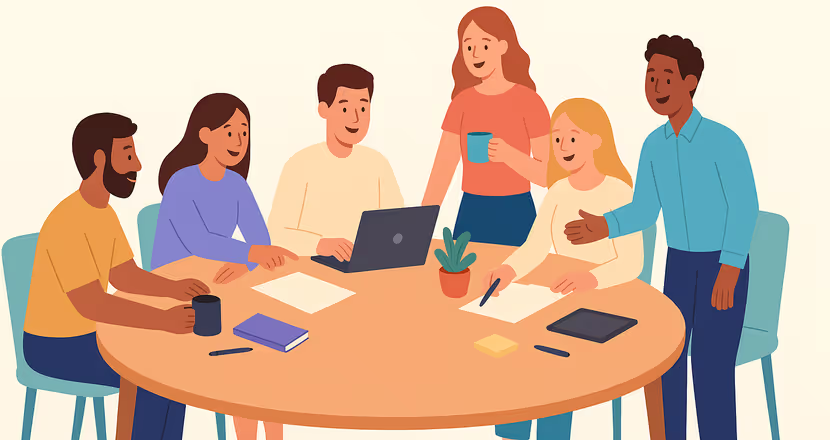
A cross-functional meeting pulls product, engineering, marketing, and finance into one room to make decisions no single team can make alone. Done well, the format creates alignment. But one study found 75% of cross-functional teams are dysfunctional, and more than one third of business meetings are unproductive. The total waste comes to $259 billion a year in the U.S.
Three criteria separate the meetings that move work forward from the ones that spawn another meeting: preparation, live discussion, and follow-through. Most advice covers the first two, but cross-functional meetings compound their value through follow-through, because decisions made across teams have to land somewhere the whole group can find later.
The Short on Time Version
- A cross-functional meeting earns its slot only when it has a defined purpose and a clear meeting type, plus an outcome a shared document couldn't deliver asynchronously.
- Keep attendance to one representative per function with a named decision owner. The productive ceiling is five to eight people.
- Capture every decision and action item during the meeting itself, then send a recap with a single owner and deadline for each item.
- A searchable record of past meetings, whether in a shared wiki or an AI notetaker like Otter.ai, keeps decisions available between meetings.
What Makes Cross-Functional Meetings Different (and Hard)
Cross-functional alignment means teams across marketing, sales, product, operations, and customer experience work toward shared business outcomes using common metrics and agreed priorities rather than prioritizing functional goals alone. That mix is the point: when the right people are already in the room, teams can evaluate tradeoffs together instead of waiting on sequential reviews, and diverse knowledge produces better ideas.
The same mix is what makes these meetings fragile. Each department carries its own vocabulary and may use team-specific lingo differently. Ownership blurs when tasks lack a clear area of responsibility, and priorities conflict across departments. Context spreads across meetings, chat threads, documents, and project tools until teams spend their time searching for updates instead of executing.
How to Run an Effective Cross-Functional Meeting, Step by Step
The gaps where cross-functional meetings break are familiar: a fuzzy purpose, an oversized room, a topic-list agenda, undisciplined discussion, ownerless action items, and decisions that vanish before the next session. Each stage feeds the next, so a weak purpose produces a bloated invite list, and a bloated invite list produces a shallow discussion no one owns.
Define the Meeting's Purpose and Desired Outcome
Everything downstream, from the invite list to the agenda, follows from why the meeting exists.
Clarify the Goal and Meeting Type
Decision meetings follow different rules than brainstorms or status updates. Decision-making meetings need people with sufficient background and the authority to decide in the room. Brainstorms run best when they are short enough to preserve energy and structured enough to keep ideas moving. Status updates are usually better handled asynchronously in a shared doc, since real-time debate rarely changes the outcome. Naming the meeting type up front sets the right expectation for how attendees should show up and what kind of thinking to bring.
Define What a Successful Outcome Looks Like
Write the finish line before you schedule the meeting. Once the group has a decision or clear next steps, the meeting is over. Name the outcome in writing before sending the invite. If you can't say whether the meeting is meant to produce a decision or alignment around a plan, you're not ready to meet.
Question Whether a Meeting Is Even Needed
Some outcomes don't need a room. Weekly updates, project documentation, process changes, and routine announcements often move through a shared Google Doc or Notion page with a comment deadline instead. If a wrong call would be cheap to reverse in the next two weeks, decide it asynchronously and save live time for decisions where real-time debate changes the outcome.
Invite the Right People and Clarify Roles
The invite list is where cross-functional meetings quietly overreach. Every team wants a seat, and the room grows past the point where real decisions happen.
Choose One Representative per Function
Each department the goal touches needs a voice, but one voice is usually enough. A single representative can speak for their team's constraints and carry decisions back. When one person owns each initiative, everyone knows who is driving it.
Keep the Room as Small as the Goal Allows
Among the most productive meetings are those that contain only five to eight people, because past that point the quality of conversation begins to erode. Anyone with no input to give and no action to take can read the recap instead.
Clarify Roles and Who Owns the Decision
A RACI matrix uses RACI statuses to define stakeholder involvement. Assign one person accountable for the result, name the people doing the work, consult subject-matter experts, and inform affected stakeholders. The matrix helps ensure one accountable owner per task to avoid confusion.
Build and Share an Agenda in Advance
A shared agenda is what turns a room of specialists into a group working from the same picture; without one, the first ten minutes get spent negotiating what the meeting is even about.
Structure the Agenda Around Decisions
A stronger agenda uses questions rather than topics: replace "Budget Problems" with "How will we reduce our spending by $100,000 by the end of the fiscal year?" A question tells you who needs to attend and when the discussion is done. Anything longer than the agenda allows belongs in a separate meeting.
Assign Time and an Owner to Each Item
For a one-hour meeting, give each topic a clear time box, and assign each item an owner so the person with the most expertise leads that discussion. A timed agenda also lets people relevant to only one item attend that piece and excuse themselves.
Send the Agenda and Pre-Reads Early
Send the agenda and supporting materials early enough for attendees to review documents before they arrive. One version takes this furthest: meetings open with roughly 30 minutes of silent reading of a six-page memo before discussion begins. Borrow the principle: meeting time should focus on decisions instead of presenting information people could have read.
Run the Meeting for Alignment and Decisions
Preparation gets the right people to the right conversation; the live hour is where that setup either turns into decisions or dissolves into discussion no one can act on.
Keep the Discussion on the Agenda
Good tangents need a home that isn't now. Put ideas outside the meeting's scope in a parking lot on a whiteboard or shared page, then make a plan to follow up. Name a timekeeper to signal when an item is running long and a gatekeeper to flag when certain voices are dominating.
Bridge Different Departmental Languages
Teams align around the shared goal, which turns differing perspectives into an asset. When a term means different things to marketing and engineering, the meeting lead's job is to pause and translate before the misunderstanding compounds. Otter's Live Coaching feature can surface prompts and reminders to the meeting lead in real time.
Create Space for Honest Input
Cross-functional teams need psychological safety: the conditions that let people speak honestly without fear of punishment or embarrassment. Invite voices explicitly by asking "What do you think?" to make it safe to speak up. In a cross-functional room, where junior people from one function sit across from senior people from another, that invitation rarely happens on its own.
Capture Decisions and Action Items Live
A designated meeting lead plus a recorder frees participants to focus on the content, but a human recorder costs you a participant. Otter.ai is an AI notetaker and Conversational Knowledge Engine that handles that job instead. It turns the live conversation into a transcript and summary with action items and speaker attribution, connects to Zoom, Google Meet, and Microsoft Teams, and can answer questions or draft action items mid-call through its Live AI features.
Before closing, the group can review the captured decisions with owners and deadlines together so there's no ambiguity about what happens next.
Turn Decisions Into Tracked Action Items
A decision made in the room only creates value once someone outside the room acts on it, and cross-functional follow-through has a specific enemy: fuzzy ownership across team boundaries.
Send a Recap With Owners and Deadlines
Every item needs one person responsible for a specific outcome by a real deadline. Replace vague prompts like "We should think about pricing" with specific commitments like "John will present three pricing models by Thursday." Send the recap while the details are still fresh.
Track Action Items Across Departments
In Otter's dashboard, Action Items are collected, surfacing commitments from every meeting into one view. Cross-functional follow-through compounds when that intelligence flows both directions through MCP (Model Context Protocol), the open standard that lets AI assistants connect directly to the tools where your data lives. Otter uses MCP to make its meeting record queryable from AI assistants and to push meeting outputs into the apps teams already work in:
- Claude, ChatGPT, or any MCP-compatible app can query Otter's meeting record directly, so a functional lead can ask their assistant what was decided last week and get a grounded answer.
- Otter AI Chat can write action items and summaries out to Notion, Jira, Slack, Salesforce, and HubSpot, without anyone switching tabs.
- For teams that track work in project management tools like Asana, Jira, or monday.com, that tracker stays the single source of truth. Otter pushes action items into it rather than replacing it, so ownership and status live where the team already works.
Follow Through Before the Next Meeting
Make "review outstanding action items" the first agenda item of every follow-up meeting, and run round-robin: "Alex, where are we with the budget proposal? Any blockers?" When owners know their item opens the next session, items get done between sessions.
Build Organizational Memory Across Meetings
Action tracking keeps the next set of tasks moving. Long-running cross-functional work needs something more: a consistent place where decisions live, so meeting knowledge becomes infrastructure the next team can build on.
Keep a Searchable Record of Every Meeting
Without a searchable record, U.S. knowledge workers waste 5.3 hours every week waiting for information or recreating knowledge that already exists somewhere in the organization. Otter builds the record automatically. Every captured meeting becomes part of a searchable conversation intelligence layer, a connected memory where summaries, decisions, action items, and cross-meeting search all live together.
MRI Software is a real estate software provider that serves more than 45,000 clients. Its sales cycles run one to two years and pull in dozens of stakeholders. The 26-person sales engineering team had to demonstrate 165 products, write debriefs from memory after multi-hour demos, onboard new staff, and help late-stage stakeholders catch up on months of requirements.
Otter AI Chat let the team query their entire meeting history for context. During live demos, reps could pull answers from past calls with subject matter experts instead of pausing to track someone down. Managers could point Otter AI Chat at specific transcript moments to coach newer reps on how a top performer handled a similar objection. The results:
- $150,000 in annual savings
- 20 minutes saved per meeting
- ROI within 2.5 weeks of the pilot
- Onboarding that previously took hours now taking minutes
Preserve Decision History Everyone Can Find
In recurring meetings, the decision may survive while the reasoning disappears. A conversation record keeps the reasoning attached to the decision, and makes both findable by anyone who wasn't in the room.
Otter's Channels feature groups meetings by team, project, or topic, so a recurring cross-functional sync accumulates connected history. Otter AI Chat then lets a marketing lead ask what engineering committed to on a call she never attended, and get the answer back with the timestamp and speaker attribution.
A new participant in a long-running initiative can read the decision history instead of scheduling catch-up calls.
Try Otter on Your Next Cross-Functional Meeting
A well-run cross-functional meeting pays off twice. The first payoff is the decision itself, which comes from a clear purpose, a tight agenda, and one named owner for every call. The second payoff shows up later, every time someone finds that decision instead of re-deciding it, and that only happens when the conversation is captured and kept searchable.
Otter joins the Zoom, Google Meet, and Microsoft Teams calls you choose, turns each one into a summary with action items and speaker attribution, and builds a searchable conversation intelligence layer so any team can revisit what was decided.
Try Otter on your next cross-functional meeting and get your first 300 minutes free, or get a demo to see how a shared meeting record works across an entire organization.
Frequently Asked Questions About Cross-Functional Meetings
What is a cross-functional meeting?
A cross-functional meeting brings together people from different departments, like product, marketing, engineering, and finance, to collaborate toward a shared goal. It combines expertise that no single team has on its own, which makes clear goals, defined roles, and good documentation essential.
Who should attend a cross-functional meeting?
Invite one representative from each function the goal touches, plus whoever owns the decision being made. Keep the group as small as the objective allows; the most productive meetings contain only five to eight people. If someone has no input to give and no action to take, they can read the recap instead of attending.
How do you keep track of decisions made in cross-functional meetings?
Capture every decision and action item during the meeting, assign each task to an owner with a due date, and store them somewhere the whole group can find later. An AI notetaker and conversation intelligence layer like Otter records the meeting, drafts a summary with action items, and keeps a searchable archive so any team can revisit what was decided.
What is the best tool for cross-functional meeting notes?
Otter is a strong fit for cross-functional meeting notes in a searchable conversation record. It connects to Zoom, Google Meet, and Microsoft Teams, transcribes with 95%+ accuracy, and turns each meeting into a shared summary with action items. It also builds a searchable conversation intelligence layer across all your meetings. Through MCP, Claude, ChatGPT, and other MCP-compatible assistants can query Otter's meeting record directly, and Otter can push action items and summaries into the tools each team already uses.
Related posts