7 Ways to Build Agentic AI Workflows for Sales



Think about the last quarter of any sales team. An AE runs a tight renewal call with a long-time customer who signals interest in expansion, raises a concern about a feature gap, and asks for a proposal by Friday. The call ends, and the AE has 12 minutes before the next demo. They jot two bullets in a notebook, promise themselves they'll log it properly later, and dial in to the next meeting already three minutes behind.
The “later” never quite arrives. The expansion signal gets a generic mention in the CRM. The feature concern doesn't reach product or customer success. The Friday proposal goes out Monday with boilerplate that misses what the customer actually said. The deal does not collapse, but it loses a step, and across a pipeline of deals, those lost steps compound into a forecast that drifts further from reality every week.
That gap between the conversation and the system of record is where agentic AI workflows earn their keep. The opportunity in sales is the manual work between conversations that still consumes a rep's day. Learning how to build agentic AI workflows for sales means handing that work to an AI agent that reads the conversation record and acts on it, so the deal keeps moving while the rep is already on the next call.
The Short on Time Version
- An agentic AI sales workflow such as those provided by tools like Otter.ai completes multi-step tasks on a rep's behalf by acting on the conversation record.
- One of the highest-value builds is post-call CRM enrichment: the moment a call ends, the agent extracts what was said and pushes it to the right fields.
- The live-call surfaces buying signals and coaching prompts while the rep is still talking.
- These workflows work best as one connected system reading from the same conversation record.
What Is an Agentic AI Sales Workflow
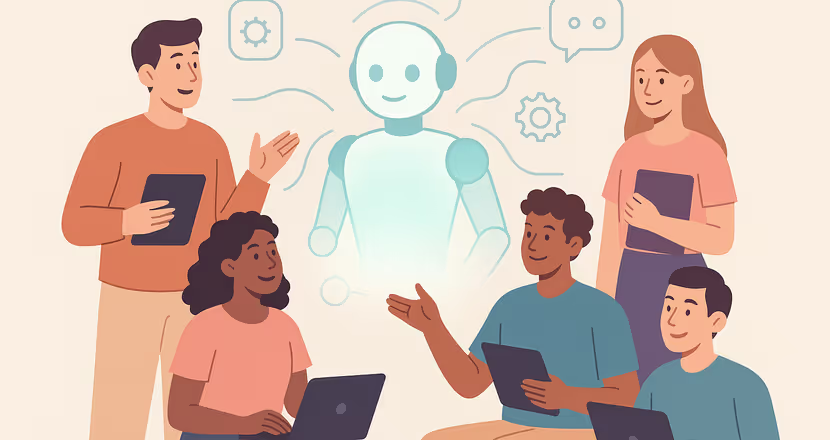
An agentic AI sales workflow completes multi-step tasks on the rep's behalf through an AI agent. The distinction that matters for sales is simple and consists of the following steps:
- The assistive AI suggests, then waits for a human to act.
- Next, the agentic AI acts, then reports back.
- Generative AI drafts an email when you ask.
- An agentic workflow drafts the email, queues it for review, and updates the deal record without being told.
There are three conditions that matter for these sales blueprints. Each workflow needs a trigger (an event like a call ending), access to the conversation record (the transcript and the fields extracted from it), and a connected system to act in (a CRM, an email queue, a scheduling tool). Remove any one and you are back to a tool that suggests and waits.
1. Automated Post-Call CRM Enrichment
When a call ends, the AI agent reads the transcript, pulls out the deal-relevant details, and writes them to the CRM before the rep starts their next call. The rep does not have to spend time filling out a form.
The trigger is the call-end, with no rep action needed. The data is the full call transcript, parsed for signals such as budget, authority, need, timeline, competitor mentions, next steps, and deal stage changes. The action is the CRM write itself: the extracted details are pushed into structured CRM fields and a clean record reflects what was actually said.
The workflow applies the same extraction logic after every call, so each rep's conversations become fields consistently. That makes opportunity records easier to review, easier to forecast from, and less dependent on the rep's memory.. This is the core of post-call automation: the rep gets their time back, and the CRM finally reflects reality.
2. Automatic Follow-Up Email Drafting
The AI agent drafts the follow-up from what was actually said on the call, using the transcript as source material. Commitments, objections, and next steps become the body of the email.
The build starts with extraction. The workflow ingests the transcript, then pulls out commitments, objections, questions, and agreed next steps. The agent uses the buyer's own language: their exact words from the transcript feed the draft, so it mirrors how they actually spoke and avoids the sound of a form letter.
Teams could decide whether the agent queues drafts for review or sends them automatically. A practical pattern queues the draft for a human to approve before it goes out. That keeps the workflow quick for low-risk drafting, but gated for decisions that need sales judgment. The review queue also creates accountability because managers can see which follow-ups are ready, approved, or still waiting.
A draft waiting the moment the call ends helps the rep respond while the conversation is still fresh, the next step is clear, and the buyer's momentum has not cooled.
Asset Panda, a fast-growing SaaS company that helps businesses track and manage assets, ran straight into this bottleneck. Their reps were handling up to 10 demos per day across sales cycles ranging from same-day to 18 months. The time spent documenting calls and writing follow-ups was dragging down rep productivity.
After adopting Otter.ai, an AI notetaker and Conversation Intelligence Platform that captures conversations and turns them into summaries, action items, and a searchable record the team can act on, the team used Otter AI Chat to draft follow-up emails, proposals, and implementation summaries directly from transcripts. Over time, they refined templated prompts for specific use cases. The result: reps reclaimed time and started closing more deals faster, leaders gained real-time pipeline visibility, and CFO and CRO estimated the tool effectively handled the output of roughly one and a half people's worth of post-call documentation work.
3. Live Deal Coaching and Signal Capture
The agent listens during the live call and surfaces buying signals and prompts in real time, so the rep can adjust mid-conversation based on what the agent catches in the moment.
The build runs on live transcription, which turns the conversation into text the rep can see as it happens, and AI models analyze objections, competitor mentions, and buying signals as they occur. A coaching panel surfaces objection-handling tips and tracks methodology completion. If the call moves past budget or authority without coverage, the prompt gives the rep a chance to bring it back before the call ends.
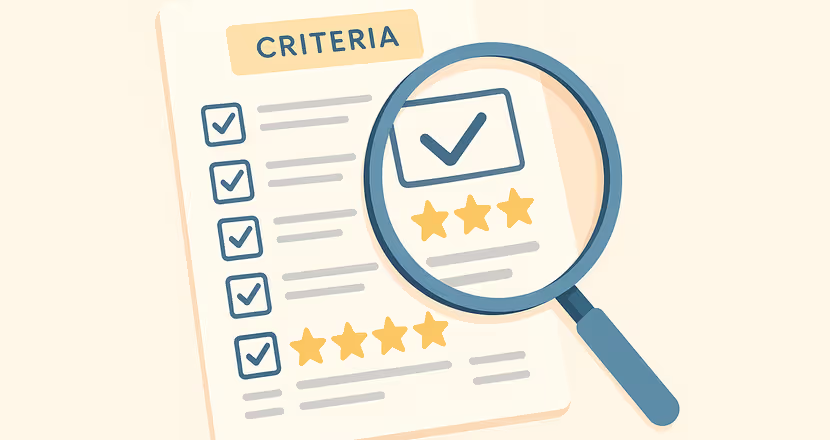
Mapping signals to BANT or MEDDIC gives the workflow structure. BANT focuses on Budget, Authority, Need, and Timeline. MEDDIC goes deeper into metrics, economic buyer, decision criteria, decision process, pain, and champions. A live panel can check off each qualification as the rep covers it.
For instance, Otter’s Live Coaching or Live Assist can be used to create custom signals and gain real-time sales insights and can be deployed to any framework of choice. This way, newer reps can get guidance during calls. They see prompts while the buyer is still on the call, which complements a strong sales meeting agenda and good pre-call prep.
4. Autonomous Inbound Qualification and Routing
The agent qualifies inbound interest and routes it directly to the right rep, so a warm lead gets a response in minutes.
One practical design is to move through a defined qualification path: confirm basic info, ask discovery questions, verify authority, assess budget and timing, score the lead, then route it. If those inputs are available, the workflow can combine sparse form data with firmographic, technographic, and behavioral signals to judge ICP fit before any human gets involved. Voice and chat agents can run qualification scripts, score responses in real time, and pass only warm leads through.
A routing design could define deterministic rules. Those rules can account for territory, ownership, account matching, service-level requirements, and calendar availability before placing a meeting on the right rep's calendar. Once a lead qualifies, the agent presents calendar availability and books the meeting in the same session.
Reduce the time between form fill, qualification, and scheduling so a warm lead does not sit untouched in a queue. This is one of the patterns covered in broader AI workflow automation for sales.
5. Pipeline Hygiene and Deal Updates
The agent keeps deal stages and notes current from meeting activity, so the pipeline reflects what is happening in buyer conversations.
The build connects meeting activity to CRM writes. After a call, the workflow reviews the transcript and recommends or applies updates to fields like stage, next steps, close date, risk, competitors, and qualification status. For higher-risk fields, the agent can queue changes for rep approval before writing them back. Automatic call logging in Salesforce is the underlying mechanism that makes this practical at scale.
The workflow can also surface stalled deals. A monitoring layer can be configured to flag reduced buyer activity, missing qualification data, repeated reschedules, unresolved objections, or absent next steps. When those signals appear, the workflow can surface at-risk opportunities for intervention before the forecast review.
Without clean data, forecasting and pipeline reviews inherit the same gaps the CRM has.
6. Cross-Meeting Deal Intelligence Retrieval
The agent answers questions across a deal's entire conversation history, so a rep can recall what a customer said three calls ago without scrubbing recordings or pinging colleagues. It joins transcript data with CRM context. Otter AI Chat lets teams ask questions about their meeting history in a conversational way. A rep can ask, "What did the customer say about the implementation timeline in October?" and get the answer with timestamp and speaker attribution. This is essentially a knowledge management strategy applied to the deal record.
This is most valuable before a renewal or a follow-up call. Prep is stronger when the system can read more than one transcript at a time. A good briefing needs the opportunity context, renewal date, account owner, prior commitments, and the specific language the prospect used.
A case of sales engineering team in MRI software shows the result. A 26-person sales engineering team with one-to-two-year sales cycles could query their full meeting history using Otter AI Chat and pull up specific client requirements, objections, and prior decisions in minutes. That produced $150,000 in annual savings, over 20 minutes reclaimed per meeting, and ROI within two and a half weeks.
7. AE-to-CS Handoff Briefs
The agent builds the handoff brief from the deal's recorded conversations, so the customer success team inherits real context from the sales cycle.
A practical handoff brief can include the deal history, customer goals with success criteria, stakeholder map, AE commitments, known risks, technical requirements, and the customer's timeline. The workflow is strongest when it captures that context as the sales cycle unfolds.
That is exactly what recorded conversations make possible. Each call automatically contributes to the running deal record, so the brief draws from what was actually said. Small details from discovery calls, such as the buyer's main pain point, decision-maker names, or budget constraints, are easy to miss unless they are captured as the deal progresses.
Fewer commitments get dropped at the seam between sales and onboarding, where context loss can turn a strong close into a shaky implementation.
How Otter Powers Agentic Sales Workflows
Every workflow above reads from the same asset: the recorded, transcribed call. Otter is an AI notetaker and Conversation Intelligence Platform that captures conversations and turns them into summaries, action items, and a searchable record your team can act on.
On the Enterprise plan, several of these blueprints run inside Otter directly. Otter provides live coaching during calls. It surfaces objection-handling prompts and tracks BANT or MEDDIC completion as the rep covers each one. It syncs to Salesforce and HubSpot and pushes structured insights into Opportunity and Deal fields, with custom field mapping. It drafts follow-up emails automatically from what was said on the call. And its Model Context Protocol (MCP) server connects Otter's meeting knowledge to external AI models like Claude, allowing it to create content based on the meeting history. The connection works bidirectionally, so meeting context can power workflows in tools beyond Otter, while external models can query the meeting record directly.
For cross-meeting retrieval, Otter AI Chat answers questions across the full conversation history with speaker and timestamp attribution. Ask what objections a prospect raised on the last two calls before a renewal, and Otter returns the answer without anyone scrubbing recordings.
Conclusion
Each of the seven workflows above closes that gap from a different angle, and each gets more useful when it shares the same conversation record. That record is what Otter captures, structures, and makes searchable for the rest of the stack.
A practical starting point is to pick one workflow and run it with one team. Try post-call CRM enrichment or follow-up drafting for a few weeks, then add the next workflow on top of the same conversation record. Get a demo or try it free on your next call.
Frequently Asked Questions About Agentic AI Sales Workflows
What Is Agentic AI?
Agentic AI refers to AI that can pursue a goal by choosing steps and taking action with limited supervision. In sales, that means an agent that reads the conversation record, updates the CRM, drafts the follow-up, and surfaces stalled deals, all on a defined trigger like a call ending.
What Is the Difference Between Agentic AI and Generative AI?
Generative AI creates content in response to a prompt. Agentic AI acts on a goal. In sales terms, generative AI drafts the email; an agentic workflow drafts it, queues it for review, and updates the deal record.
How Do You Use AI for Sales?
AI for sales can support prospecting, meeting prep, follow-up, pipeline updates, and coaching in the flow of work. Otter.ai, for instance, helps capture every conversation and automatically generate insights, follow-ups, and CRM-ready notes that sync seamlessly with Salesforce, HubSpot, and other leading platforms so you can focus on selling.
How Do You Build an Agentic AI Workflow?
Start with a task where you can clearly define what "done well" looks like. Then give the agent a trigger, access to the conversation record, and a connected system to act in. The clearer the task, exception handling, review step, and destination system, the easier it is to turn the workflow from a suggestion engine into an agentic process.
Related posts