Meeting Notes vs. Meeting Minutes: Key Differences & When to Use Each

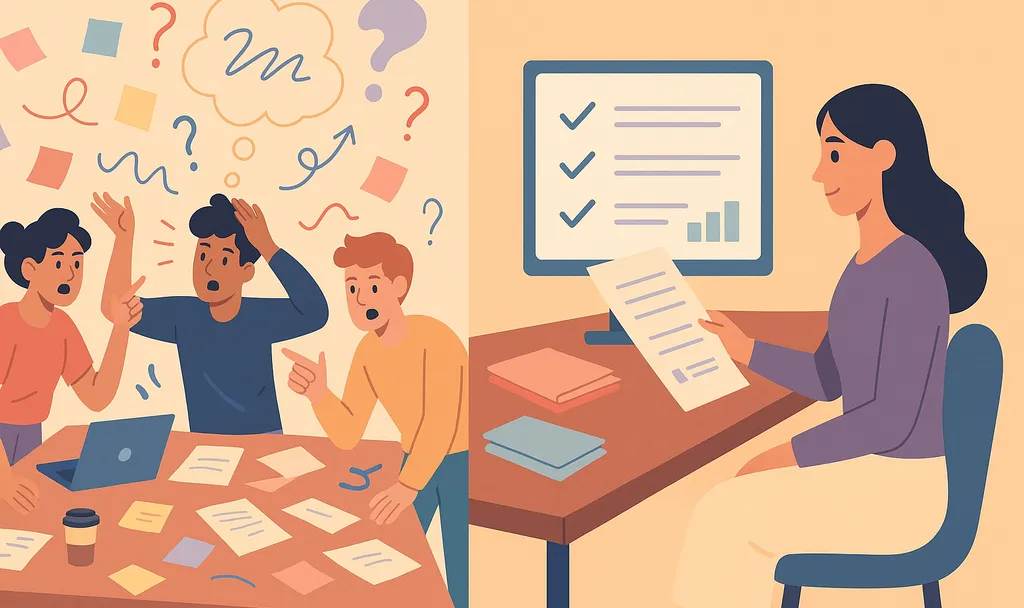


Someone asks for the meeting minutes from last week's planning meeting, and what actually gets sent is a page of bullet-pointed meeting notes. It happens constantly, and most of the time nothing turns on it. But when a board asks for the record of a vote, or an auditor asks what the finance committee approved, sending meeting notes in place of meeting minutes creates real problems for the organization.
The confusion is understandable. Both come out of meetings, both capture what happened, and both often live in the same drive. What separates them is who owns producing them and whether they carry any weight outside the room. A daily standup runs fine on a shared doc; a board meeting needs motions, votes, and a signed record.
The Short on Time Version
- Meeting notes are an informal, flexible record of key points, decisions, and action items, kept for personal or team use with no official standing.
- Meeting minutes are the formal, approved record of attendees, motions, votes, and decisions, and boards, nonprofits, and public bodies are often legally required to keep them.
- Minutes fit any meeting with governance, financial, or legal weight, while notes fit team syncs, one-on-ones, brainstorms, and project check-ins.
- An AI notetaker and Conversation Intelligence platform like Otter.ai can draft notes and summaries automatically, though formal minutes still need a person to format and approve them.

What Are Meeting Notes?
Meeting notes are what you jot down, in whatever format works, so you remember what happened and who owns the next steps. They capture key points and decisions.
Most notes record who attended, what was discussed, what got decided, and which action items belong to whom, plus the next meeting date. Formats vary, and a template is one place to start.
Notes aren't the approved company record. They don't get formally approved, and they focus on takeaways rather than verbatim discussion.
What Are Meeting Minutes?
Meeting minutes are the formal, official record of the decisions and actions taken during a meeting. In many states and for most nonprofits, they're part of the required corporate record, which means they can be requested in an audit or litigation. Requirements vary by state and entity type.
Minutes record the actions taken, not a verbatim account: date and location, attendees and quorum, motions with mover and seconder, vote outcomes, action items, and the secretary's signature. A designated secretary or clerk drafts them, not the meeting chair, though in small committees the chair sometimes acts as secretary. The secretary writes up the motions and votes, circulates the draft, and the body approves it at the next meeting, at which point the minutes become a permanent corporate record.
How Meeting Notes and Meeting Minutes Differ
Meeting notes and meeting minutes differ in formality, purpose, structure, authorship, detail, legal standing, approval, and retention.
For example, notes might record that the launch is slipping to June and that Dana will confirm with Sales by Friday. Minutes would instead record that, on a motion made by Dana and seconded by Luis, the board approved the revised budget.
Minutes are official corporate records and can be subpoenaed in legal proceedings. Notes usually sit outside the approved governing record, though depending on how they are created and stored, they may still be discoverable, so the legal weight cuts both ways. Minutes stay focused on outcomes because an overly detailed account of every comment can become discoverable material and create litigation risk.
When Do You Need Meeting Notes vs. Meeting Minutes?
Use minutes when law, bylaws, policy, or a meeting's governance process requires an approved record, including for budget approvals, policy adoptions, contract awards, or recorded votes.
Take formal minutes for board meetings (corporate or nonprofit) and committee meetings. Councils and other public meetings governed by open-meetings laws also call for formal minutes, as does any session where motions and votes occur. Notes are enough for team syncs and standups, one-on-ones, brainstorms, project kickoffs, and internal check-ins. If a meeting has no formal governance process, notes will do.
How Otter Helps You Draft Meeting Notes or Meeting Minutes
Recording a meeting accurately while taking part in it is hard. Otter is an AI notetaker and Conversation Intelligence platform that turns every meeting into a transcript and a structured summary with action items, and makes the decisions, takeaways, and insights searchable across meetings without changing how your team already meets.
It transcribes in real time with 95%+ accuracy, and can answer questions of any transcribed meeting via Otter AI chat. Otter can be configured to join the Zoom, Google Meet, or Microsoft Teams calls you choose, or record in person from the desktop or mobile app.
Otter's MCP (Model Context Protocol) server is bidirectional, which means data flows both ways. Claude and ChatGPT can securely pull context from your past meetings, and Otter can push summaries and action items back into the 30+ tools it integrates with, including Slack, Notion, and Jira. Otter AI Chat works across all of your conversations in Otter, including meetings shared with you, so asking what the board decided about the budget in March returns an answer instead of a hunt through old files.
Woven Health Collective, a healthcare marketing and medical communications agency, works with pharmaceutical, biotech, and medical device companies in highly regulated therapeutic areas. Its teams had relied on individual attendees' manual notes, which produced fragmented records and inconsistent interpretations that project managers had to reconcile after every meeting. With Otter capturing live transcripts and storing summaries in a centralized workspace, AI Chatlets employees retrieve past decisions, terms, and client preferences, and made action items traceable across the team.
Working from a single verified record has reduced the miscommunication that used to come from reconciling separate note sets. New team members can also search past client conversations directly, so they ramp faster instead of building context meeting by meeting.
For formal board minutes, Otter's output is a drafting aid. The transcript and summary give the secretary an accurate starting point, but a person still formats the motions and votes into the official structure, and the board approves the result at the next meeting.
Capture Your Next Meeting With Otter
Notes and minutes do different jobs, and the choice between them comes down to what the meeting needs to leave behind. Notes keep a team aligned on what was decided and who owns the next step, and they fit team syncs, one-on-ones, brainstorms, and project check-ins. Minutes give the organization an approved record of attendees, motions, and votes that holds up in an audit, a board review, or a legal proceeding, and they belong in board, committee, and public meetings where governance rules apply.
Capture the meeting well once and either record is quick to produce from the same source. Otter transcribes the conversation in real time, generates a structured summary with action items you can use directly as notes, and gives a secretary an accurate starting point to format into official minutes at the next meeting.
Try Otter free on your next meeting and get your first 300 minutes at no cost, or get a demo to see how teams use it to turn conversations into notes, minutes, and searchable records.
Frequently Asked Questions About Meeting Notes vs. Meeting Minutes
Are Meeting Minutes Legally Required?
For many boards, nonprofits, and regulated organizations, yes. Minutes are the official legal record of decisions and are often required by bylaws or law. For ordinary internal team meetings, informal notes usually fit the purpose. If a meeting carries governance or compliance weight, keep proper minutes and have them approved.
Who Takes Meeting Minutes?
Minutes are usually taken by a designated secretary, clerk, or administrator who isn't leading the meeting, so they can focus on capturing decisions accurately. Notes, by contrast, can be taken by anyone for their own or their team's use. Assigning the minute-taker in advance helps keep the official record consistent.
Can Meeting Notes Replace Meeting Minutes?
Only when minutes aren't formally required. Where they are required, notes lack the structure, completeness, and official standing to satisfy governance or legal requirements. For informal meetings, notes are sufficient and practical.
Do You Need Both Notes and Minutes for the Same Meeting?
In most cases, choose based on the meeting. A board or committee meeting calls for formal minutes, while a team sync or brainstorm calls for notes. Occasionally someone keeps personal notes alongside the official minutes, but for most meetings one or the other is enough.
What's a Practical Way to Capture Meeting Notes or Meeting Minutes?
Record and transcribe the meeting so your attention stays on the conversation, then shape the output into whichever record you need. An AI notetaker like Otter transcribes the conversation and generates a structured summary with action items you can use directly as notes or format into official minutes. Otter supports 30+ upload formats, including MP3, MP4, and WAV. For formal board minutes, a person still reviews and approves the final version.
What Is the Best Tool for Meeting Notes and Meeting Minutes?
Otter is built for both. It can be configured to join the Zoom, Google Meet, and Microsoft Teams calls you choose, or record in-person conversations from the desktop or mobile app, and it transcribes with 95%+ accuracy. Every meeting produces a summary with action items that works directly as notes, and gives a secretary an accurate starting point to format into official minutes for board approval. With 30+ integrations and a bidirectional MCP server, the record and its action items flow into the tools the team already uses, including Slack, Notion, Jira, Claude, and ChatGPT.
Related posts

.avif)