7 Ways to Preserve an Employee’s Work and Knowledge After They Leave


When experienced employees change roles or leave, the notice period is sized for HR paperwork, and years of judgment don't hand over in two weeks. Because 42% of an employee's job knowledge is unique to that individual, coworkers need a way to access that portion of the job.
Knowledge transfer is how organizations keep that expertise. It's the deliberate process of moving skills, context, and judgment from one person to another before the employee is no longer in the role.
The Short on Time Version
- Knowledge transfer moves expertise, judgment, and working relationships, from one person to another before a role change or retirement takes them out of reach.
- One of the hardest kinds of knowledge to transfer is tacit knowledge: the experience-based judgment people share out loud but rarely write down.
- The seven strategies span auditing critical knowledge, documenting processes, capturing tacit knowledge from conversations, shadowing, cross-training, building a searchable knowledge base, and offboarding interviews.
- Recording walkthroughs and handover meetings with Otter.ai turns spoken expertise into a searchable record instead of a fading memory.
Why Expertise Has to Move Before Roles Change
When someone with years of context walks out the door, the work they held together doesn't continue on its own. Expertise has to move into a form colleagues can actually use, whether that's content, learning materials, tools, and processes, or a direct handoff between people.
Some of it is explicit knowledge, which is anything already written down, such as procedures or manuals. Other parts are tacit: experience-based judgment, what Michael Polanyi meant in writing that "we can know more than we can tell." Teams also depend on relational knowledge, knowing who holds expertise and who to call when the plans break down.
Knowledge transfer is distinct from knowledge management, the ongoing system that stores and organizes what a company knows; transfer is the process that moves expertise between people. By 2025, 11,400 Americans turn 65 every day. 84% of senior leaders worry about knowledge loss from retiring employees, but only 8% of organizations consistently capture it. Transfer usually starts too late, because it begins at resignation, and misses a hard-to-capture type, because tacit knowledge shared out loud often doesn't get written down.
7 Strategies to Transfer Knowledge Before It Walks Out the Door
The strategies that hold up are the ones already running before anyone gives notice, because a two-week handover can't manufacture years of judgment on deadline.
1. Audit and Identify Your Critical Knowledge
Start by finding where continuity depends on one person's knowledge. For each role or process step, use a knowledge mapping process to map what's needed and who has it, then score each area on two axes: how hard the role is to replace and how likely the person is to leave.
Engineers call the extreme case a bus factor of 1, where one departure halts a function. When one person controls an approval or carries client context for a critical step, a single exit can interrupt continuity for the team.
2. Document Processes and SOPs While the Work Happens
Explicit knowledge is the easier half, provided documentation happens during the work rather than in someone's final week. For work that happens on screen, create step-by-step guides from the task itself, then store them where people already work, in the knowledge base. Assign owners and review intervals so documentation stays trustworthy. Documents rarely capture the reasoning behind the steps.
3. Capture Tacit Knowledge From the Conversations Where It Lives
You can capture important parts of an expert's judgment in a few recorded sessions if you get them talking while they work. The Space Shuttle knowledge capture project interviewed former program members to preserve critical decisions and lessons learned.
Record Expert Walkthroughs and Narrations
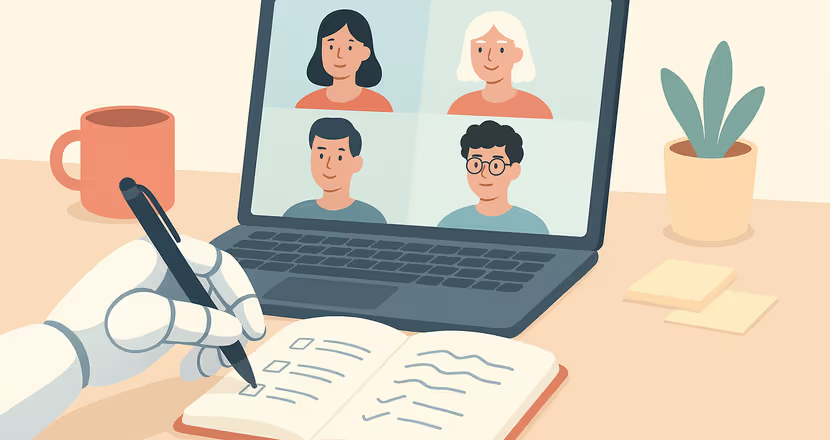
Ask experts to narrate their reasoning while doing the work, the think-aloud technique. Video documentation preserves demonstrations and the reasoning behind them, including context written notes miss.
Ask Questions That Surface Judgment
The Critical Decision Method walks an expert back through a non-routine incident with probes like "What cues did you notice that other people might miss?" Those answers rarely appear in any SOP.
Turn What Was Said Into a Searchable Record
A recorded session only helps if people can find what's in it. The Otter.ai platform is a Conversation Intelligence Platform that captures spoken expertise and turns it into searchable knowledge. Its AI notetaker turns walkthroughs, working sessions, and knowledge transfer interviews into meeting transcripts and summaries. It offers industry leading transcription accuracy, with the whole team being able to query the searchable record.
Otter can be configured to join the Zoom, Google Meet, and Microsoft Teams sessions you choose. For existing recordings, Otter supports 30+ upload formats, including MP3, MP4, and WAV. For live handovers, AI Chat answers questions and drafts action items mid-call.
4. Pair Experts and Successors Through Mentoring and Shadowing
Some knowledge only transfers through repetition beside the person who holds it. Succession planning research found 81% of organizations use mentoring and coaching, and the 30% using job shadowing were significantly more likely to be high performers.
Give the Pairing Structure and a Cadence
Formal pairs can meet every other week, with learning objectives defined up front. For complex roles, plan enough lead time for repeated practice rather than a single handoff.
Run a Tandem Period Before the Handover
Succession planning helps transfer tacit knowledge and shortens the learning curve for successors. It also reduces the need for resource-intensive formal training. Recording those sessions gives the successor something to revisit, and Otter turns each one into a transcript they can search months later.
5. Cross-Train to Build Team Coverage
Shadowing prepares one successor. Cross-training builds redundancy across the team, so no single departure stalls the work. Build a skills matrix that maps every employee against the competencies their role requires, then use it to spot where a capability sits with one person. Close those gaps by rotating responsibilities on live work, not just in training modules. Say only one engineer on a support team knows the billing system. Pair them with a second engineer on every escalation for a quarter, and both can run the queue alone by the end of it.
6. Build a Searchable Knowledge Base for Organizational Memory
Cross-training spreads knowledge across people; a knowledge base makes it findable by anyone. Without one, teams lack an ongoing system to capture and share what the company knows, then locate it when needed, the core function of knowledge management.
Confluence and Notion are common homes for corporate knowledge management. Add review ownership and source attribution so people can tell whether answers are current and where they came from.
Make Spoken Knowledge Part of the Base
Documents are the record of what was decided; conversation records capture who said it and when, with context. Otterturns what's said in meetings into structured, searchable knowledge. Ask Otter AI Chat what a departed engineer said about a system's failure modes, and it returns the answer with speaker and timestamp.
MRI Software runs on this pattern. Its 26-person sales engineering team demoed 165 products across long sales cycles, with multi-hour debriefs that leaned on memory and frantic notetaking. Otter gave the team an interconnected knowledge hub where anyone could query meeting history through Otter AI Chat. The result: $150,000 in annual savings, 20 minutes saved per meeting, ROI within 2.5 weeks, and onboarding that dropped from hours to minutes.
Connect the Base to the AI Tools Your Team Already Uses
Otter supports 30+ integrations, including Claude, ChatGPT, Salesforce, HubSpot, Slack, Notion, and Jira, with automated updates via MCP. Through Otter's MCP server, Claude and ChatGPT can query meeting history directly, and the MCP client pulls live data from Gmail, Google Drive, Notion, Jira, and Salesforce, so what was said in a handover can land on the Notion page where the successor will look for it.
7. Make Knowledge Transfer Part of Offboarding
Even with a knowledge base in place, departures need their own process. Knowledge capture can run year-round, so teams can front-load the work when someone resigns.
In week one, use a knowledge-loss risk matrix to score the departure, then assign an owner and timeline to every capture task before the last day. Departing employees also take their network: the "go to" people they call during crises. Structured exit and handover interviews can cover contacts and in-flight decisions, including the exceptions no document mentions. Recording those interviews with Otter means the context survives the departure.
Capture Your Next Handover With Otter
Every strategy above works better when it starts long before a resignation letter. Succession planning runs 12 to 36 months, and continuous capture through normal work, especially for the tacit knowledge that lives in conversation.
Otter's Conversation Intelligence layer turns every walkthrough and handover into a searchable record of decisions, action items, and context, connected to the tools your team already uses through MCP or native integration. Try Otter free to record your next handover, or schedule a demo to see how it works across a team.
Frequently Asked Questions About Knowledge Transfer
What Is Knowledge Transfer?
Knowledge transfer is the deliberate process of moving expertise and context, including skills, from one person or team to another so critical knowledge stays in the organization after someone leaves or changes roles, including retirement. It covers documented (explicit) knowledge and the harder-to-capture experience and judgment (tacit knowledge). It's the active side of knowledge management, and it determines whether expertise survives a departure.
What Is the Difference Between Tacit and Explicit Knowledge?
Explicit knowledge is anything already documented, such as processes, manuals, reports, and other written materials, and it's straightforward to hand off. Tacit knowledge is the experience and judgment living in someone's head, with context built through years of doing the work. Tacit knowledge needs conversation and observation because documents rarely capture experience, judgment, and context.
Why Is Knowledge Transfer Important?
When employees leave without transferring what they know, teams lose institutional memory and often redo work that's already been figured out, which slows onboarding. Structured knowledge transfer keeps operations running through turnover and retirements, and it shortens ramp time for new hires. It also protects the decisions and context behind how work actually gets done.
How Do You Transfer Tacit Knowledge?
Because tacit knowledge often requires direct work experience, one effective approach is to capture it where it's shared: recorded process walkthroughs and shadowing sessions, including working meetings, often using a narration technique where the expert talks through their reasoning. Turn what's said into something searchable so it remains available after the session ends. Otter includes AI notetaker functionality that records and transcribes these sessions, then turns them into a searchable record the successor can revisit.
What Is the Difference Between Knowledge Transfer and Knowledge Management?
Knowledge transfer is the active process of moving expertise between people, usually triggered by a departure, promotion, or onboarding. Knowledge management is the ongoing system that captures, organizes, and surfaces that knowledge across the organization. Transfer feeds the management system: one is the event, the other is the infrastructure that makes it last.
What Is the Best Tool for Capturing and Transferring Knowledge?
Otter captures work conversations that carry role knowledge. It can be configured to join the Zoom, Google Meet, and Microsoft Teams sessions you choose, transcribes walkthroughs and handovers, and turns them into a searchable record so tacit knowledge remains available after the person who held it moves on. Otter AI Chat lets anyone ask a question across past sessions and get an answer with speaker and timestamp. Through MCP, those insights flow into Notion, Jira, Claude, or ChatGPT and become organizational memory that outlasts any single employee.
Related posts