How to Create a Free AI Policy Template for Your Organization

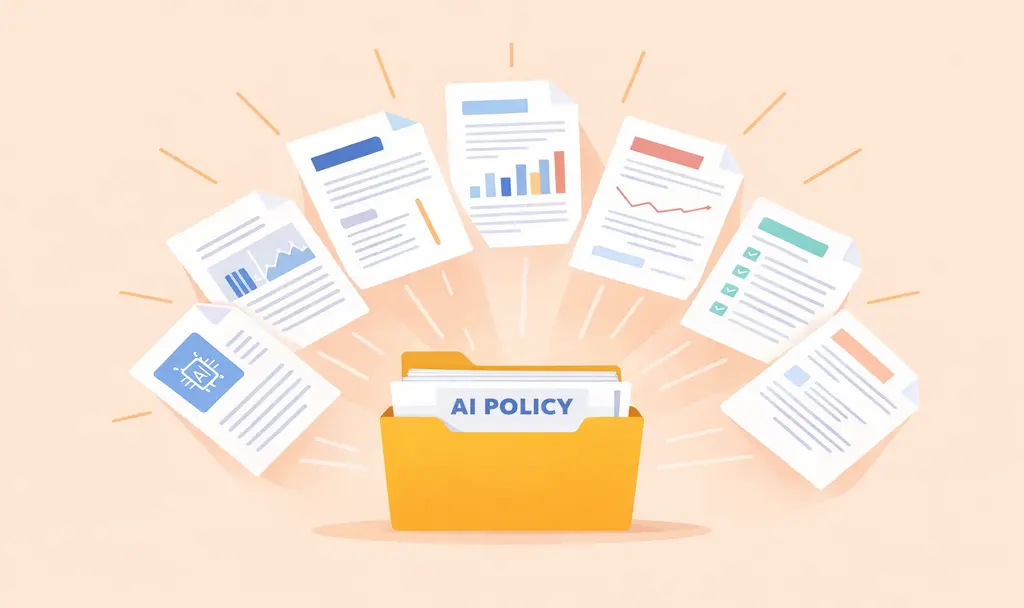


AI adoption is outpacing AI governance, and the gap keeps widening. 69% of organizations already suspect or have evidence that employees use prohibited public GenAI tools, yet only 24% have fully enforced AI governance policies. Outside scrutiny has caught up too, as AI disclosure among S&P 500 companies jumped to 72% in 2025. AI governance is now a board-level question, not just an IT one.
A free AI policy template helps set clear rules for safe AI use and gives IT a governed path for adoption, including the category most templates miss, which is AI notetakers that join meetings as participants. Below, you'll find what a strong policy includes, how to roll it out without pushing teams back into shadow AI, and how to apply it specifically to meeting tools.
The Short on Time Version
- What an AI policy template is and how it differs from a general acceptable use policy.
- Who it applies to and what it should include.
- How to roll it out without pushing employees back into shadow AI.
- How to govern AI notetakers, the category most templates miss.
What Is an AI Policy Template?
An AI policy template defines how employees can use AI tools, what data can go into them, and how the organization handles shadow AI. It differs from a general acceptable use policy in scope. AI tools can take in, process, and store organizational data in ways existing IT policies were never built to handle, so the rules need to be more specific.
Who an AI Policy Applies to Inside the Organization
The scope matters because an AI policy only works if it covers everyone who can bring an AI tool into the company. An effective policy applies to every employee, contractor, and vendor who uses AI at work, including personal accounts used for work, free-tier tools, and AI features sitting inside products you already license.
To make that coverage explicit, name three categories in the scope clause:
- Personal accounts used for work
- Free-tier and trial AI tools
- AI features inside tools they already license
Why the Timing Matters
Naming those categories only matters if you act on them now, because both AI use and regulation are accelerating. AI is already used regularly in at least one business function by 88% of respondents, and the EU AI Act applies with penalties of up to €35 million or 7% of global annual turnover. For US-only organizations, consent governance is the more immediate concern. The point of the policy is to give teams a governed way to use AI tools that capture, organize, and act on information from meetings, not just to reduce shadow AI.
How to Roll Out an AI Policy
A policy is only as good as its rollout. A phased approach protects adoption while building AI governance, with the goal of making safe use easier, not pushing teams back to manual notes. The phases include the following:
Start With Discovery
Before you draft any rule, you need a clear picture of what's already in use. Identify where critical organizational knowledge lives before layering governance on top of workflows. Spend the first 30 days running a discovery sprint: pull SSO logs, expense reports for AI subscriptions, and calendar metadata for notetaker bots. Publish the inventory before proposing any restriction so teams see the policy as a response to reality, not a top-down guess.
Pair Forbidden Tools With Approved Alternatives
Discovery will surface tools you want to block, and blocking without an alternative just pushes employees back into shadow AI. For every Tier 4 tool you block, designate a Tier 1 or Tier 2 alternative. For AI notetakers specifically, block personal-account tools at the calendar or network layer and name an enterprise-governed assistant as the Tier 1 default.
Maintain a "blocked → use this instead" table on the same intranet page as the tier list. Never publish a Tier 4 update without the alternative alongside it.
Train Employees on the Why
Once the approved options are clear, training is how you get people to actually use them. Effective data and AI governance is an active system of rules, practices, roles, decision rights, monitoring, and accountability, not a static document. Training has to land that distinction, so include at least two real anonymized incidents to show employees the actual consequences of violations, not just the rules on the page.
Build an Exception Process
Even with strong training, edge cases will come up. Strong policies pair clear rules with fast, transparent exception paths; without one, employees route around the policy entirely. Commit to a 5-business-day turnaround on exception requests and publish the form, the reviewer, and the decision criteria. Track the percentage resolved inside that window as a governance KPI.
With the rollout approach settled, the next question is what actually goes inside the policy itself.
The Free AI Policy Template for Organizations
The AI policy template includes sections that map to a specific governance need and include guidance you can apply directly:
Section 1: Define the Policy's Purpose and Scope
State the objective and specify applicability: all employees, contractors, temporary workers, and third-party vendors. Write a one-sentence purpose statement and a one-sentence scope statement. If you cannot do it in two sentences, the policy is too vague.
Section 2: Establish Shared Definitions
With scope set, make sure everyone uses the same vocabulary. Define key terms at minimum: Artificial Intelligence, Generative AI, AI Notetaker, Shadow AI, Agentic AI, Model Training, and Prompt Data. Keep each definition under 30 words and include one concrete example per term so non-technical reviewers can apply them.
Section 3: Approved, Restricted, and Forbidden Tool Tiers
Shared definitions feed into the tiering model. Establish four tiers: Tier 1 (low risk, pre-approved), Tier 2 (moderate, IT review), Tier 3 (high, CISO and legal review), and Tier 4 (prohibited). This aligns with NIST AI 600-1 and the EU AI Act's risk tiers.
Publish the current Tier 1 and Tier 4 lists where every employee can find them, such as your intranet homepage, and update at least quarterly.
Section 4: Map Data Classification to Tool Tiers
Tiers only manage risk when they are tied to the data flowing through each tool. Map your existing data classification framework to AI tool tiers, and place customer PII, financial records, and health data in Tier 3 or above. Build a one-page matrix with your data classes as rows and AI tool tiers as columns. Mark each cell as allowed, allowed with conditions, or prohibited.
Section 5: Require Documented Consent Before Recording
Data classification also sets the rules for recording, which is the gap most templates miss. AI notetakers typically join calls as participants rather than installed software, so they slip past traditional procurement and security review. The legal exposure is concrete: when any participant is in an all-party consent state, the most conservative approach applies, and AI-generated transcripts create timestamped records that expand discoverable material in litigation.
Default to all-party consent for external meetings, add a standard consent block to your invite template, and standardize on a meeting assistant that surfaces consent prompts and keeps an audit trail. For example, take Otter. ai. Their Enterprise workspace centralizes recordings under admin control rather than leaving them scattered across personal accounts.
Section 6: Evaluate Vendors on Training and Data Residency
Permission to record the meeting is only part of the picture. What happens to that data afterward depends on the vendor, so require a structured questionnaire covering model training, data residency, and security certifications.
Start by building a questionnaire with the following questions:
- Do you train on customer data?
- Where is data stored?
- What is your retention period?
- Which certifications do you hold?
- Can you sign a DPA or BAA?
Note: As a reference point, Otter answer "no" to question 1, offers a BAA on Enterprise, and provides SOC 2 Type II documentation on request.
Section 7: Gate Tool Access Behind Verified Training
Vendor controls only work if the people using the tools understand the rules. Gate Tier 2 and above tool access behind verified training completion, with separate tracks for general users and power users, and tie training completion to provisioning. Platforms with SCIM provisioning (included with Otter’s Enterprise plan) let you bind tool access to LMS status, so accounts stay inactive until the AI policy module is finished.
Section 8: Define Audit Triggers and Enforcement Mechanisms
Training sets expectations; auditing confirms they are being met. Track shadow AI detection events and policy violations, and include an emergency AI shutdown mechanism for tools that create unacceptable risk. Anchoring to NIST AI RMF and ISO 42001 gives auditors something concrete to evaluate against.
Define at least three audit triggers in writing, such as a new tool appearing in network logs, a vendor change to data-handling terms, and any external complaint about recording. Assign a named owner for each.
With the template in place, the next step is to apply it to the category that generates the most exposure: meeting tools.
How to Govern AI Meeting Tools
The most difficult category to govern is AI notetakers and AI meeting assistants. They are personal-account-friendly, they record sensitive conversations, and they often sit outside IT's procurement pipeline. The controls above (centralized identity, vendor reviews, consent defaults) only work if your meeting platform supports them.
More than just an AI notetaker, Otter is aconversation intelligence platform that captures meetings and turns them into searchable summaries, decisions, and action items. Ottersupports SSO via SAML with an identity provider of your choice, and departing employees can be automatically deprovisioned via SCIM/Directory Sync. Domain Capture takes that a step further, letting admins claim their organization's email domain and bring existing personal Otter accounts into the enterprise workspace.
Compliance and Data Handling for Procurement Review
Centralized accounts only matter to procurement if the platform itself can pass review. For example, Otter holds SOC 2 Type II attestation and offers HIPAA compliance with a BAA as an Enterprise add-on, and audit logging shows who accessed what data and when.
Get the Productivity Without the Liability
AI tools are already in your organization. The question is whether they sit inside a system IT can see, govern, and audit, or whether they keep showing up in personal accounts, free-tier dashboards, and meeting invites no one reviewed.
A strong AI policy answers that question on your terms. It maps tools to tiers, ties data classes to those tiers, makes consent the default for recording, and runs every vendor through the same five questions before procurement signs. Pair it with a phased rollout, an exception process people actually use, and a governed meeting assistant for the category that creates the most exposure, and the policy stops being a document on the intranet. It becomes the way work gets done.
The payoff includes IT getting visibility into where organizational knowledge lives, who can access it, and how long it sticks around. Teams, on the other hand, keep the productivity gains with meetings that turn into searchable summaries, decisions that are captured the first time, and action items that do not depend on whoever happened to take notes. That is what a working AI policy delivers.
Schedule a demo to see how Otter fits into a governed AI stack.
Frequently Asked Questions About AI Policy Templates
Is There a Standard AI Policy?
No single mandatory standard exists. NIST AI RMF 1.0 is voluntary, ISO 42001 is certifiable, and the EU AI Act is binding for organizations whose AI systems touch the EU market.
How Often Should an AI Policy Be Updated?
Review the approved tool list and tiering assignments on a regular schedule, and trigger an off-cycle review when new regulations take effect or a material AI incident occurs.
What's the Best AI Notetaker for a Governed Environment?
Look for SSO/SAML, SCIM deprovisioning, SOC 2 Type II, a no-training-on-customer-data policy, and admin audit logging. Otter's Enterprise plan covers all five and supports Domain Capture to absorb existing personal accounts.
Related posts