Institutional Knowledge: What It Is & How to Capture It

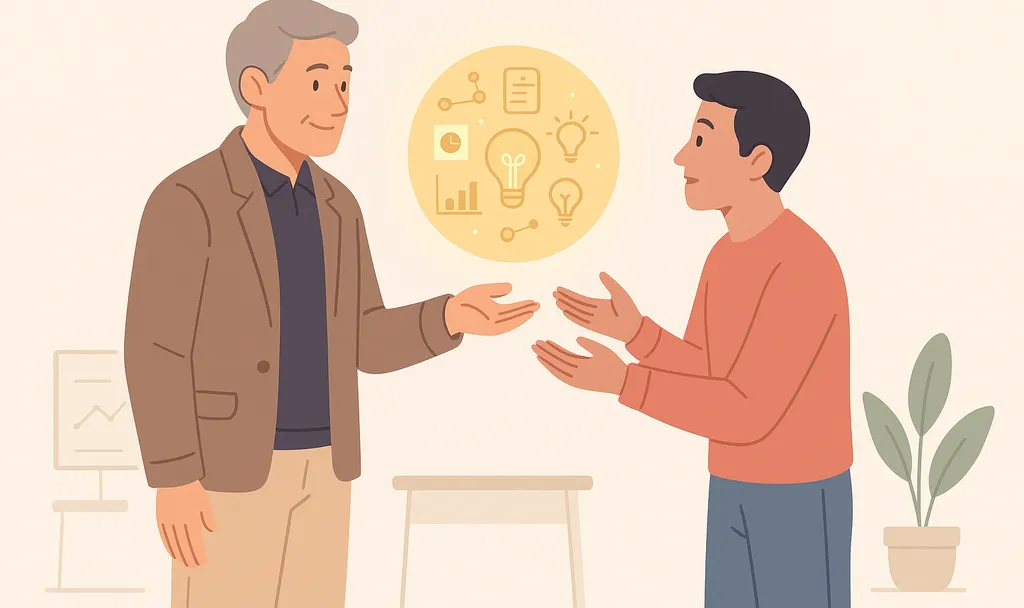


When a long-tenured employee retires, some knowledge leaves too. Institutional knowledge is the accumulated processes, relationships, decisions, and know-how that let an organization run. Much of it is exactly what employees carry in their heads.
When it isn't captured, the cost shows up in familiar places: new hires spend months ramping up on context that used to live in one person's head, and the same questions get asked in meeting after meeting. Some of it lives in SOPs and wikis, some in the judgment experienced employees carry between projects, and some only in the conversations where decisions actually get made, which is the layer written documentation tends to miss.
The Short on Time Version
- Institutional knowledge is the collective processes, relationships, historical context, and know-how an organization builds over time and includes documented (explicit) knowledge and undocumented (tacit and tribal) knowledge.
- Knowledge-transfer plans maintain continuity through turnover and retirement, workforce layoffs, knowledge hoarding, and conversations nobody writes down; the need is especially clear given that voluntary turnover costs U.S. businesses an estimated $1 trillion a year.
- Capturing it means documenting processes in SOPs, building a searchable knowledge base, using expert pairing, and making offboarding knowledge transfer standard.
- Conversational knowledge shared in meetings and handovers can be especially difficult to preserve, which is why some teams record and transcribe those conversations with an AI notetaker like Otter.ai.
What Is Institutional Knowledge and Why It Matters
Institutional knowledge is a shared organizational asset that survives only through continuous knowledge transfer from one person to another. The discipline of capturing and organizing it is called knowledge management, and the asset itself is often referred to interchangeably as institutional memory but they are not the same. Institutional knowledge is the know-how itself, and institutional memory is how well the organization holds onto it and can pull it back up later.
It generally falls into three forms:
- Explicit knowledge is documented and transferable, covering policies, procedures, reports, and training materials.
- Tacit knowledge is harder to formalize or communicate: it's the judgment and intuition an experienced employee builds up over years.
- Tribal knowledge is known within an in-group but remains unknown outside it, surviving only through mentoring, on-the-job training, and continuity of staff.
When any of these is accessible, institutional knowledge keeps operations running through turnover, shortens ramp-up for new hires, and stops teams from re-solving problems that were already solved. When it's unavailable, inefficient knowledge sharing can reduce productivity at a large U.S. business by $47 million a year, with employees waiting 5.3 hours a week for information. Looking further out, more than 30 million Americans turning 65 in the next four years may trigger a large-scale knowledge transfer, with an estimated output impact of $6.9 trillion to $9.6 trillion.
The through-line here is that the knowledge that costs the most to lose is usually the knowledge nobody thought to write down, so capturing it has to be a deliberate part of how the team works.
How Institutional Knowledge Becomes Unavailable
Institutional knowledge slips away in a few common ways:
- Turnover: In a survey of 5,000 executives, 46% said they only planned to stay in their current role for two to five years, taking context with them when they leave.
- Retirement: 65% of older workers have been in their job for more than 10 years, and research on older workers shows the knowledge HR teams say is hardest to rebuild is also the least written down.
- Layoffs, silos, and hoarding: Workforce cuts, team silos, and knowledge hoarding tied to office politics or job insecurity all cut into what the team can actually use.
- Conversations no one writes down: In project meetings, handover calls, and onboarding sessions, someone explains the reasoning behind a decision out loud and no one records it. Once the meeting ends, that thinking lives only in one person's head.
Those three forms show up in five recognizable types in day-to-day work, and each one calls for a different retention approach.
The Types of Institutional Knowledge
Explicit, tacit, and tribal describe what institutional knowledge is, the categories below describe where it actually lives inside a team's daily work. In practice, it shows up in five recognizable types, and each one maps back to one of those forms:
- Process knowledge: Undocumented workflow steps that keep operations running. For example, a technician may know a recurring equipment fault's repair sequence even though the procedure was never documented. (Usually tacit or tribal.)
- Technical know-how: Deep expertise about systems and code. For example, only one engineer may remember the business constraint behind a legacy system's unusual architecture. (Usually tacit.)
- Relationship and customer knowledge: Client history that lives in individual minds rather than the CRM. For example, a client lead may know that a customer wants technical updates before budget discussions, even if the CRM does not record it. (Usually tacit.)
- Historical and decision context: The reasoning behind current practices. For example, a team may still follow a review step introduced after an old project failure, while only former participants remember why. (Often tribal.)
- Cultural and tribal knowledge: The informal norms that shape how work actually gets done, rarely written into any handbook. (Tribal by definition.)
Identifying the type helps determine whether to document it, transfer it through people, or capture it from conversations.
How to Capture Institutional Knowledge
There's no single place to capture institutional knowledge, because it lives in different places. A practical approach layers a few methods together: some to write things down, some to move knowledge between people, and some to catch what only ever comes up out loud.
Each step of capturing institutional knowledge builds on the last, so they work best when treated as an ongoing practice rather than a one-time project.
Identify What Knowledge Is Most at Risk
Start by finding out what would actually hurt to lose. That means looking at who holds critical context, which processes only exist in someone's head, and where turnover or retirement is likely in the next 12 months. Prioritize knowledge tied to specific individuals, undocumented workflows, and long-tenured employees whose experience isn't reflected anywhere on paper. This audit tells you where to spend effort first, so you're not trying to document everything at once.
Document Explicit Knowledge in SOPs
Standard operating procedures (SOPs) translate personal expertise into a language the rest of the organization can use. SOPs may take the form of a decision tree, a written procedure, or a visual workflow. Screen-capture tools can speed this up by generating step-by-step walkthroughs with screenshots as someone clicks through a process. The goal is to turn "the way Priya does it" into something anyone can pick up and follow.
Build a Centralized, Searchable Knowledge Base
Documented knowledge only pays off if people can find it, so pair SOPs with an internal wiki or knowledge base that supports search, ownership, and ongoing maintenance. Assign clear owners for each area of content so pages don't go stale, and make the knowledge base the default place people look before asking a colleague. It centralizes what's already been written down; anything created only in conversation still has to be captured before it can live there.
Pair Experienced Employees With Newer Ones
Tacit knowledge resists documentation, so transfer it through proximity. One effective pairing model has less experienced employees work side by side with experts on a project for three to six months. Shadowing, mentorship, and co-owned projects all let judgment and intuition move between people in a way documents can't replicate. This is especially useful for the kind of knowledge that's hard to explain until someone runs into the situation themselves.
Build Knowledge Transfer Into Onboarding and Offboarding
Waiting until someone's final week leaves few options, so treat knowledge transfer as a year-round process. Build it into offboarding with structured handover calls, exit interviews focused on process knowledge, and time set aside for the departing employee to document what only they know. On the onboarding side, point new hires to the knowledge base first and give them a named person to shadow, so they're absorbing context from day one rather than months in.
Capture the Reasoning That Comes Up in Meetings
Even with strong documentation and mentoring, most teams lose the reasoning behind decisions because it gets shared out loud and never written down. Recording the meetings where those decisions happen, including handover calls, project retrospectives, and customer conversations, turns them from someone's memory into something the whole team can go back to.
An AI notetaker like Otter.ai can join the calls you choose, transcribe them, and turn each one into a searchable record with decisions and action items attributed to the person who said them.
Keep the Knowledge Base Maintained
Institutional knowledge changes as the organization does, so a knowledge base isn't a one-time build. Set a regular review cadence, assign owners for each area, and archive what's no longer accurate. A knowledge base that's out of date is worse than none at all, because it teaches people not to trust it.
How AI Helps Preserve Institutional Knowledge
Documentation and mentoring cover most explicit and tacit knowledge, but they miss what gets said out loud and never written down. AI notetakers close that gap by recording the conversation and turning it into a retrievable record, instead of leaving it in one person's memory.
Turn Every Meeting Into a Searchable Knowledge Record
The Otter platform is an AI notetaker and Conversational Knowledge Engine that captures the knowledge already present in meetings and turns each one into a clear summary with decisions and action items. Its Conversation Intelligence layer preserves meeting context in a searchable record of decisions, action items, and speaker-attributed reasoning. Otter can be configured to join the Zoom, Google Meet, and Microsoft Teams calls you choose and transcribe them with industry leading accuracy on clear audio, and it also processes 30+ upload formats like MP3, MP4, and WAV.
Let Anyone Query the Institutional Record
Ask Otter AI Chat why a process runs the way it does, and it returns the answer with the speaker and timestamp from the meeting where the decision was made. Live AI features such as Live Assist go further, answering questions and drafting action items mid-call, so the knowledge is taking shape before the meeting ends.
MRI Software's 26-person sales engineering team, which supported 165 products and relied on memory and manual notes for post-demo debriefs, used Otter AI Chat to build an interconnected knowledge hub. The pilot delivered ROI in 2.5 weeks, saved 20 minutes per meeting and $150,000 annually, and cut onboarding from hours to minutes.
Push Meeting Knowledge Into the Tools Your Team Already Uses
Meeting knowledge is only useful inside the systems the team already works in. Otter connects bidirectionally through model context protocol (MCP), so data flows both ways. Assistants like Claude and ChatGPT can query your conversation records, and Otter can push meeting outcomes back out into Notion, Jira, Gmail, and other tools. It also syncs to CRMs like Salesforce and HubSpot, plus Slack and 30+ other integrations, so a handover call can land in the relevant Notion page the moment it ends, findable by people who were never in the room.
Start Capturing Institutional Knowledge With Otter
Institutional knowledge is only an asset if it outlives the people who hold it. Explicit knowledge belongs in documentation, so processes, policies, and decisions can be found by anyone who needs them. Tacit knowledge moves between people through mentorship, pairing, and structured handovers, where experienced employees pass on the judgment that documents can't hold.
The conversational layer is the one most teams underinvest in. Decisions, reasoning, and customer context are shared out loud in meetings every day, and most of it is never written down. Otter AI Chat lets you ask questions across your meeting history and returns answers with speaker and timestamp attribution, while integrations push insights into tools such as Claude, ChatGPT, Salesforce, HubSpot, Slack, Notion, and many others, so the knowledge lands exactly where the next person will look for it.
Try Otter free or get a demo for your team's next handover call, retrospective, or onboarding session.
Frequently Asked Questions About Institutional Knowledge
What Is the Difference Between Institutional Knowledge and Institutional Memory?
Both terms describe the accumulated knowledge an organization holds and are often used interchangeably. When distinguished, institutional knowledge emphasizes the know-how itself and institutional memory emphasizes retaining and recalling it over time.
What Are Examples of Institutional Knowledge?
Institutional knowledge examples include the steps in an undocumented workflow, why a past decision was made the way it was, which client prefers which approach, and the informal relationships that get things done. Some of this is written down; much of it exists only in conversations and individual memory.
Who Owns Institutional Knowledge in an Organization?
No single function owns all of it. HR typically leads offboarding and knowledge-transfer programs, managers own team-level context and mentoring, and IT owns the systems where documented knowledge lives. In practice, ownership is distributed, which is part of why so much of it goes uncaptured.
How Long Does a Knowledge Transfer Usually Take?
There's no fixed timeline, but a common pairing model has a less experienced employee work alongside an expert for three to six months. Waiting until someone's final two weeks leaves little time to capture tacit knowledge, so treating knowledge transfer as an ongoing process rather than a departure task tends to work better.
What's the Best Tool to Preserve Institutional Knowledge From Meetings?
Otter.ai is built for the conversational knowledge that documents miss. It can be configured to join the Zoom, Google Meet, and Microsoft Teams meetings you choose, transcribe them with industry leading accuracy on clear audio, and build searchable conversation records that preserve meeting context along with decisions and action items. Otter AI Chat lets anyone ask a question and get an answer with the speaker and timestamp. Through Enterprise MCP capabilities, those insights connect to Notion and AI assistants such as Claude or ChatGPT, so institutional knowledge stays accessible across the team.
Related posts