How to Conduct Customer Interviews



Most product decisions get made without ever talking to a customer, and it shows in the results. An estimated 75% to 85% of new products launched into the market don't succeed financially, largely because they solve a problem no one is actually paying to fix.
Customer interviews are the most direct way to find the problems people want addressed. A one-on-one conversation surfaces the unmet needs your analytics can't show and reveals what motivates customer priorities.
Neutral questions keep answers grounded in the participant's experience, and attentive listening builds rapport. Recording the conversation lets you stay engaged in it, and revisiting recordings during analysis produces useful insight.
The Short on Time Version
- Set a specific research goal: A useful customer interview starts with a specific research goal, since goals as broad as "learning about users" produce interviews that don't inform any decision.
- Ask about past behavior: Ask participants open-ended questions about specific past behavior ("tell me about the last time you...") because participants predict their own future behavior unreliably.
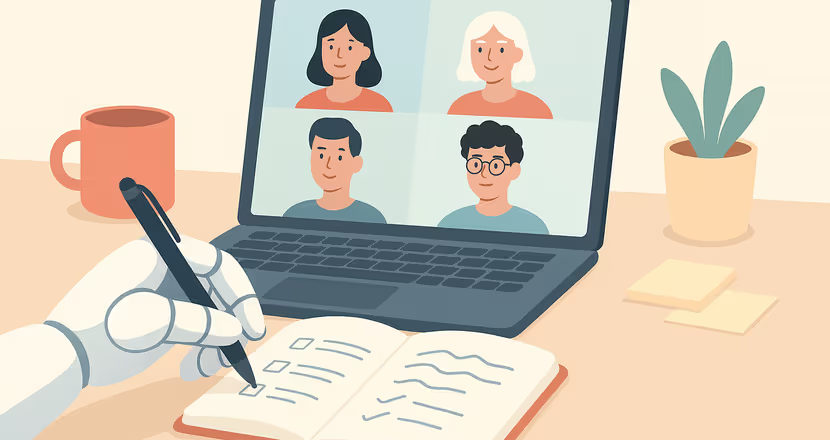
- Record with permission: With the participant's permission, record the conversation using a conversation intelligence platform like Otter.ai so you can listen and probe without needing to take notes.
- Analyze for saturation: Insight forms in analysis, where you code responses into themes across the whole set of interviews and stop recruiting once new themes stop appearing.
Why Customer Interviews Beat Surveys
Interviews get you the "why" behind a decision. Surveys collect ratings and rankings, but a user interview is a one-on-one attitudinal research method in which the interviewer asks questions and listens, with follow-up questions that elicit more detail. Surveys lock their questions before anyone responds, while interviews follow up on the spot to uncover why someone made a decision.
Interviews also surface what customers can't articulate unprompted. The classic milkshake research revealed that customers were "hiring" a fast-food chain's milkshakes to make their morning commutes less boring, a job no survey question would have uncovered.
The Step-by-Step Customer Interview Process
Work the six steps below in order the first time; once you've run a few studies, you'll layer them together.
Step 1: Set a Clear Research Goal
Goals that are too broad, such as "learning about users," fail to inform any decision. Make the goal specific enough to answer: "Why don't people buy my product?" covers too many possibilities for one study, while "Does my pricing page accurately answer my users' questions?" can be answered and acted on.
Let the goal shape who you recruit and what you ask. Write research questions first, then align each interview question to your research questions. The goal also sets the sample: a churn question needs churned customers; a discovery question may need people who have never heard of you.
Whoever runs the interview needs to hear the answer and have the authority to act on it. For early discovery, founders and product managers (PMs) are best positioned to sit in the seat. The pattern recognition builds intuition you can't outsource. As studies scale, dedicated researchers or customer success (CS) leaders take over, with PMs and designers observing. Avoid handing interviews to anyone whose comp depends on the outcome; the incentive quietly tilts the questions.
Step 2: Recruit the Right Participants
The goal names your segment; recruiting means finding real people inside it without biasing the sample.
Screen without revealing the study's purpose. A screener survey confirms fit before you book anyone. Use the funnel technique: start with the broadest, least revealing questions before asking specific ones, because participants who guess the study's purpose can game their way in. And don't recruit only happy customers: sales interviews pointed to pricing as the top weakness, while churn interviews located the frustration in product issues.
Plan for saturation instead of a fixed number. The famous "5 users" figure applies to a usability-testing model. For interviews, most codes surface within the first 6 interviews and theme saturation typically arrives by 12. So start with five to six, analyze as you go, and recruit more only while new themes keep emerging.
Reach out with a short, honest message. Keep the outreach email brief, name the ask clearly, and don't oversell. Use this reusable template.
Subject: Quick 30-minute chat about [problem area]?
Hi [Name], I'm [role] at [company]. We're researching how people handle [problem] today, not selling anything.
Would you be open to a 30-minute chat in the next two weeks? I'll send a $[amount] gift card as a thank-you.
Happy to work around your calendar: [scheduling link].
This keeps the message clear and makes the next step easy.
Set incentives that match the audience, according to the participant's time and seniority. Use these rough benchmarks.
- Consumer users: $25 to $50 for a 30-minute call.
- Prosumers and small and midsize business (SMB) operators: $75 to $150.
- Enterprise buyers or specialized roles: $200 to more than $400 for roles like clinicians and lawyers.
Existing customers often decline cash, so offer swag, product credit, or a donation instead.
Step 3: Write Questions That Get Honest Answers
Once the right people are booked, wording decides whether you get stories or polite fiction. Small shifts in how a question is framed can turn a rehearsed answer into a real one.
Ask about specific past behavior. Self-reported claims are unreliable, as are user speculations about future behavior. Ask about specific past behavior instead: "The last time you faced this problem, what did you do?"
Apply the Mom Test principles. Coined by Rob Fitzpatrick in his book The Mom Test, it's a short set of rules for getting truth instead of flattery from any interview, even one with your mom. Keep four principles in your head:
- Talk about their life, not your idea: The moment you pitch, they start being polite.
- Ask about specifics in the past, not opinions about the future: "Would you use this?" produces fiction; "What did you do the last time this came up?" produces facts.
- Talk less, listen more: If you're explaining, you're not learning.
- Dig for real commitments: Time, money, or reputation on the line means the problem is real; "that's interesting" means nothing.
Together, these principles keep the conversation focused on evidence rather than approval.
Use jobs-to-be-done framing. The jobs-to-be-done framework treats a purchase as progress the customer is trying to make in their life. Open with "When was the first time you thought about buying [PRODUCT]?" to anchor the conversation to a real triggering event.
Finally, build a loose discussion guide. Order questions from soft to deep, and treat it as a "discussion guide" you can deviate from when the conversation takes a useful turn. Avoid opening with closed yes/no questions. Use this reusable structure:
- Opening and permission: "Thanks for the time. Okay if I record so I can focus on listening?"
- Role and context: "Tell me a bit about your role and what a typical week looks like."
- Problem recognition: "When did you first realize [problem] was something you needed to solve?"
- Recent experience: "Walk me through the last time [problem] came up. What happened?"
- First attempt: "What did you try first, and where did it break down?"
- Other stakeholders: "Who else was involved, and what did they care about?"
- Limits and trade-offs: "What would have made that experience worse, or unworkable?"
- Closing question: "Is there anything I should have asked but didn't?"
This sequence moves from context to a specific experience while leaving room for useful follow-ups.
Step 4: Conduct the Interview
Listen closely and use follow-up questions while documentation stays out of the way.
Build rapport and listen actively. Call the session a chat rather than an interview and keep acknowledgments neutral. A useful target gives the customer 90% of the speaking time and the interviewer 10%. Before you hit record, ask for the participant's permission out loud. Most privacy regimes, including the General Data Protection Regulation (GDPR) and California Consumer Privacy Act (CCPA), treat that spoken confirmation as your legal basis for storing the transcript.
Probe without leading. Keep a bank of neutral probes: "Tell me more about that," "Can you give me an example?" and "Why is that important to you?" The echo technique repeats the participant's last words with a slight questioning tone, so your vocabulary can't bias them. And silence works: when in doubt, count to 10 before speaking.
Handle difficult moments gracefully. A few participant patterns break most interviews. Have a move ready for each:
- The rambler who drifts off-topic: Wait for a breath, then bridge with "That's helpful context. Bringing it back to [topic]…"
- The yes-person who agrees with everything: Replace leading questions with contrast questions ("What would have made that experience worse?") to force a real position.
- The one-word answerer: Deploy silence and open probes before assuming they have nothing to say.
- The pitch-hijacker who wants product feedback: Redirect to their behavior with "Before we get to what you'd want, I'd love to understand how you handle it today."
These responses keep the conversation productive without leading the participant.
Right after the interview, spend the ten minutes after the call locking in what you just heard:
- Follow-up: Send a short thank-you and confirm any follow-up you promised.
- Debrief: Write a three- to five-bullet debrief covering the biggest surprise, strongest quote, clearest pattern, and any question to add next time.
- Transcript organization: Tag the transcript so it's findable during synthesis.
This quick follow-up preserves the details you'll need for analysis.
Step 5: Analyze Interviews for Themes
Analyze responses across interviews to produce the insight.
Code responses into themes. Thematic analysis tags observations and quotes with codes. A theme emerges when related findings appear multiple times across participants or data sources. One answer can carry several codes, and a short debrief after each session means final synthesis builds on work already done.
Then find patterns across interviews. Tabulate how often each code appears, but remember that the most valuable insights are sometimes mentioned only once. Trends that were invisible in any single conversation become obvious when you can query the whole set at once.
Finally, pull quotes that carry the insight. Verbatim quotes substantiate findings and put the participant's voice in front of stakeholders. Favor short quotes drawn from across participants, and search the transcript to jump straight to the timestamped moment.
Step 6: Turn Insights Into Action
Themes only pay off when someone changes something because of them. Distill findings to 3 to 10 key insights before writing an action plan, then pair them with quantitative data so nobody stalls the finding over sample size.
Share findings in small, timely pieces with direct quotes. Use customer-language messaging. An interview-driven homepage rewrite lifted trial signups 28%.
Make it a continuous discovery habit. One-off studies age fast. Modern product teams treat interviews as a weekly cadence. Interview at least one customer per week, so insight compounds instead of arriving in quarterly bursts. Bake it into the calendar the same way you bake in standups.
How to Capture and Search Interviews
Notetaking while running the interview is the most common culprit of disrupted interviews because it pulls your attention away from the participant and erodes rapport. Recording removes that trade-off when you confirm recording permission out loud with the participant at the start.
Otter.ai is a conversation intelligence platform that turns every conversation into a searchable record, includingthemes, quotes, and decisions across every interview your team runs. It supports an interview workflow in the following ways:
- Call recording: Joins the calls you choose on Zoom, Google Meet, and Microsoft Teams, and captures in-person conversations through the desktop or mobile app, so nobody has to remember to hit record.
- Transcription and highlights: Transcribes with 95%+ accuracy on clear audio, and lets you highlight key moments live.
- File processing: Processes previously recorded audio and video in 30+ formats, so past interviews become part of the searchable set.
- Summaries and search: Turns every interview into an automated summary and a searchable part of the organization's memory.
- Action Items: Surfaces every follow-up in the Action Items dashboard, so nothing promised on a call gets lost between the interview and the next step.
- Tool connections: Connects to 30+ tools including Claude, ChatGPT, Slack, Notion, Jira, Salesforce, and HubSpot, with automated updates to external applications available on every plan via Model Context Protocol (MCP).
Together, these capabilities turn scattered call recordings into a single searchable record your team can actually use.
The value of Otter shows up after the calls stack up. Otter's MCP server lets Claude or ChatGPT query your transcripts directly, so you can ask which frustrations repeated across your last eight interviews and get an answer drawn from the transcripts themselves. Or, just use Otter AI Chat to run the same kind of query from inside Otter, surfacing pain points across every interview at once without any re-listening.
Once you've spotted a pattern, the follow-up work happens in the tools your team already uses. Otter works bidirectionally, meaning it can pull from your transcripts into other apps (drafting a Slack recap or a Salesforce note from the last interview) and push updates from those apps back into Otter, so the record stays in sync no matter where the follow-up happens.
Try Otter on Your Next Customer Interview
Interviews only compound in value if the record does. A conversation you can't search, quote, or revisit stops paying off the moment the call ends. Otter captures every interview on Zoom, Google Meet, and Microsoft Teams (plus in-person conversations through the desktop or mobile app), transcribes it with 95%+ accuracy, and turns it into a searchable part of your team's memory.
Otter AI Chat lets you query themes, quotes, and objections across every interview you've ever run. Instead of re-listening to recordings, you ask a question and get the answer with speaker and timestamp attribution.
Try Otter for free today, or get a demo to see how it fits your team's interview workflow.
Frequently Asked Questions About Customer Interviews
What Is a Customer Interview?
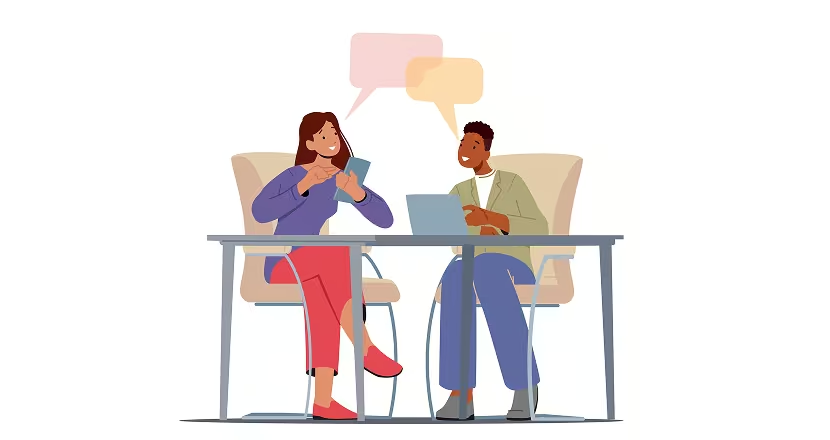
A customer interview is a one-on-one conversation with a current or past customer, or a prospect, that explores their needs and the motivations behind how they make decisions. Unlike a survey, it produces qualitative depth and room for follow-up questions you didn't plan. Always record with the participant's permission. It lets you stay present and gives you an accurate record to analyze later.
How Many Customer Interviews to Conduct?
Many teams start with five to six per segment and keep recruiting until new themes stop appearing, the point of saturation. Fewer, well-run interviews with the right people beat a large number of unfocused ones.
Questions to Ask in a Customer Interview
Ask open-ended, non-leading questions that get people telling stories about real experiences: when they first realized they needed a tool like yours, and how they handle the problem today. Avoid hypothetical questions ("would you use..."), since they produce unreliable answers.
How Do You Analyze Customer Interviews?
Group responses into recurring themes, note how often each comes up, and pull representative quotes. Then synthesize across all your interviews as a set. Cross-interview synthesis produces the insight. A conversation intelligence platform like Otter gives you searchable transcripts and can surface themes and quotes across every interview, which saves hours of re-listening.
What's the Best Tool to Capture and Analyze Customer Interviews?
Otter is a conversation intelligence platform built for customer interviews. It can be configured to automatically join Zoom, Google Meet, and Microsoft Teams calls, captures in-person conversations through the desktop or mobile app, transcribes with 95%+ accuracy on clear audio, and lets you highlight key moments live. Afterward, Otter AI Chat surfaces recurring themes across every interview, and MCP lets Claude or ChatGPT query those transcripts for synthesis.
Related posts