Loading...
Detroit City Council Formal Session, part 1
President Sheffield
You going to step out in?
Unknown Speaker
One word.
President Sheffield
All right. Good morning, everyone. We will now call to order our formal session for today, Tuesday, June the 18th. And Madam Clerk, please call the roll.
Speaker 1
Councilmember Scott Benson. Councilmember Freder Hall The third councilmember Leticia Johnson present councilmember Gabriela Santiago Romero. Present. Councilmember Mary waters. Councilmember Angela Whitfield Callaway present. Councilmember call me on a second. Council President Pro Tem James. Hey, Council President Mary Sheffield present. Madam President, you have a quorum.
President Sheffield
All right there being a quorum booth. President we are now in session. And for our prayer this morning our invocation we're going to have Sergeant Knox lead us in invocation one of our own. Thank you so much. representing large and
Speaker 2
it's definitely a pleasure. Definitely be a pleasure before his honorable body and just this like they always tell me to be FSL ready? So whenever you call it upon so can we all bow for word of prayer please? Gracious Heavenly Father, we thank you on this day. Thank you for your love, your grace, and your mercy. Oh God, we lift our hands to you to give you all the praises that you so rightfully deserve. Oh god. Thank you for being the gods that you are today yesterday and forevermore. Oh god. Well, we just asked you just to be up in this place. Touch everyone abundant the sound of my voice. Oh, God. You know what's going on in their lives right now. God Lord, I just asked you this to move shake, cultivate. Do whatever it is, oh God, just to make it reflect the character of you. Oh God. I asked that right now in the name of Jesus. Lord, I just asked you just to be at this table Oh God, and to move however you so will. The business of the city of Detroit. As we give you all the praises all the honor and glory in Jesus name, amen.
President Sheffield
Amen. Beautiful prayer. Thank you so much, Sergeant Knox. All right, the journal this session of Tuesday, June the fourth will be approved and before we move forward with our referrals. We do have a special presentation on behalf of the green Taskforce. And so we will now yield the floor over to Councilmember Benson. And for those who are joining us online, we will cut off public comment after the presentation this morning. Councilmember Benson All right.
Speaker 3
Thank you and thank you. This is an annual tradition for us at the green Taskforce. And so it's an honor privilege of coming for city council and give you our annual update. And we have representation from all seven of our subcommittees today and we're going to try to keep it relatively brief that we can feel questions from colleagues about what's going on and we have some really timely announcements as well about what's going on sustainability and the resiliency space. And so, without further ado, I believe Danielle, would you please the good doctor, come and kick it off for us?
Speaker 4
Make sure you I'm sorry. Keep my hand on it. Good morning, Danielle Wilkins. I am the founder and the CEO of the Green Door initiative in the city of Detroit where the environmental justice organization we our mission is to ensure that everyone is environmentally literate, capable of promoting and living out a sustainable lifestyle. I'm also co chair to the Climate Committee within the grey Task Force and I am so delighted and honored to be able to serve in that capacity and to represent my community in that capacity. I will add another new thing just been appointed to the White House Environmental Justice Advisory Council by the President.
Unknown Speaker
Thank you.
Speaker 4
So  advising and providing information that we hope will continue the investments in environmental justice for communities like ours in the city of Detroit. So I just want to thank you for this opportunity. And I want to just remind us what environmental justice is. Environmental Justice really is about the equal protection under the law when it comes to environmental protection and communities of color. The poor are often on the bottom of the of the ladder when it comes to that kind of protection. So our work throughout this country is to make certain that those communities get relief for the kind of burdens that they carry around energy. The threat of losing energy and power when extreme weather events and climate change and other things occur, such as what we're experiencing this week is no coincidence that the extreme weather patterns are what they are right now the extreme heating patterns, and you will hear data later talking about what that means for health for life expectancy. And it's and just the quality of life and the inability to thrive. I also want to talk about the fact that environmental justice really is an aspiration that helps to encourage people who are carrying the greatest burden, get fair treatment and the access to speak their truth and to provide direction in terms of what relief looks like when it comes to these kinds of issues like valuing the voices of people most impacted. It's truly important because we're talking about asthma, Detroit leads and asthma conditions. due to air quality, air quality has everything to do with much to do with that is with with climate change and whatever and we're going to talk a little bit about that later on. So meaningful involvement is key. And in each of our districts there are spots within our districts that are carrying even greater burdens and being able to elicit that kind of involvement. That kind of contribution will go a long way in making our city healthier, thriving. I am looking forward to the kinds of injuries initiatives that come from that workforce development in the green economy and environmental sector. We call it the green collar work and training folks in our community to be responsive to disasters and other things that are causing those kinds of problems and make a good living doing that and supporting that. I'm going to stop here because we have some content experts who are going to bring in the real data and whatever that helps to just better help us better understand how to move forward. Thank you for this opportunity. Todd.
+1
advising and providing information that we hope will continue the investments in environmental justice for communities like ours in the city of Detroit. So I just want to thank you for this opportunity. And I want to just remind us what environmental justice is. Environmental Justice really is about the equal protection under the law when it comes to environmental protection and communities of color. The poor are often on the bottom of the of the ladder when it comes to that kind of protection. So our work throughout this country is to make certain that those communities get relief for the kind of burdens that they carry around energy. The threat of losing energy and power when extreme weather events and climate change and other things occur, such as what we're experiencing this week is no coincidence that the extreme weather patterns are what they are right now the extreme heating patterns, and you will hear data later talking about what that means for health for life expectancy. And it's and just the quality of life and the inability to thrive. I also want to talk about the fact that environmental justice really is an aspiration that helps to encourage people who are carrying the greatest burden, get fair treatment and the access to speak their truth and to provide direction in terms of what relief looks like when it comes to these kinds of issues like valuing the voices of people most impacted. It's truly important because we're talking about asthma, Detroit leads and asthma conditions. due to air quality, air quality has everything to do with much to do with that is with with climate change and whatever and we're going to talk a little bit about that later on. So meaningful involvement is key. And in each of our districts there are spots within our districts that are carrying even greater burdens and being able to elicit that kind of involvement. That kind of contribution will go a long way in making our city healthier, thriving. I am looking forward to the kinds of injuries initiatives that come from that workforce development in the green economy and environmental sector. We call it the green collar work and training folks in our community to be responsive to disasters and other things that are causing those kinds of problems and make a good living doing that and supporting that. I'm going to stop here because we have some content experts who are going to bring in the real data and whatever that helps to just better help us better understand how to move forward. Thank you for this opportunity. Todd. Speaker 5
And  good morning. My name is Todd Scott. I am the Executive Director for the Detroit greenways coalition and I also co chair the transportation and mobility committee along with Myra teta, who was in the audience today and my role is now with the Wayne County Department of Health, human and veteran services. Our committee covers a wide range of topics from basic sidewalk issues beschreven bridges, ADA compliance, electric vehicles shared mobility and greenways. And these align with the Detroit sustainability Action Agenda goals to make it easier and safer for Detroiters to get around without a personal vehicle to enhance infrastructure and operations to improve resilience and climate impacts. And to reduce municipal and citywide greenhouse gas emissions. Safety has been one of the major focuses of our committee on Detroit continued continues to see over 100 traffic fatalities each year, including one of the highest pedestrian fatality rates among US cities. Our chart shows how we're still recovering from a major increase during COVID-19, which is a nationwide issue that National Highway Traffic Safety Administration largely blames excessive speeding, but Detroit is moving in a positive direction. Thanks to this honorable body passing a Vision Zero resolution that says the only acceptable number of deaths and serious fatalities on our roads zero. This can best be achieved through a safe systems approach, which is underlying the city's streets for people plan. And through the safe system approach. We're saying that people make mistakes but when they make mistakes we indeed have a road design that doesn't lead to people having fatalities and serious injury accidents. to codify this work, we're working with councilmember Johnson and her staff on a complete streets plus ordinance. This ordinance should help ensure that city continues to build streets that are designed for safe and efficient travel for all road years users of all abilities including motorists pedestrians, people with disabilities, transit users, bicyclists as well as our youth and seniors. The plus means the streets will also reduce stormwater runoff by reducing by introducing green stormwater infrastructure. This ordinance also pushes the county in the state to do the same when they're working on roads within the city of Detroit, something they don't always do. And as for climate change, the transportation sector is the largest source of greenhouse gas emissions. And there's two primary actions we can take first is to increase resiliency in the face of increased stormwater and rain events and increased temperatures. We can do this through green stormwater infrastructure, planting trees and even simply removing unnecessary pavement. This is something that's been done at places like Roosevelt park where there's no longer a six lane Boulevard going through the middle of the park. It's also been done on on Rosa Parks at the Boulevard where we used to have six lanes going northbound more than the lodge Expressway and that's been reduced to an a reasonable amount of lanes and the additional lanes have been converted to green space. I should add that we also need to encourage people to use greener modes of transportation by continuing to invest in them. I'm really excited to hear the conversations that are occurring in Lansing right now about increasing transit investments throughout the state of Michigan. I can say that my bus rolled through the Hargrove transit center this morning was beautiful, stunning. But we also need to invest more nonmotor as infrastructure too. We shouldn't be coercing people to use these greener modes. We should make them so attractive that they have that's our first choice is to use them. And lastly, we need to build our cities in more compact ways. So by having 15 minute neighborhoods where people can get everyone where they need to go and 15 minutes is ideal for people walking, biking and using transit. That means continued investments and local streetscape projects. So we're bringing retail into the city of Detroit so people don't have to travel distances outside the city to get their basic services. And that is ideal for not only making, walking, biking more effective, but also lifting up Detroit based businesses. And now I'll hand it over to Irma.
+1
good morning. My name is Todd Scott. I am the Executive Director for the Detroit greenways coalition and I also co chair the transportation and mobility committee along with Myra teta, who was in the audience today and my role is now with the Wayne County Department of Health, human and veteran services. Our committee covers a wide range of topics from basic sidewalk issues beschreven bridges, ADA compliance, electric vehicles shared mobility and greenways. And these align with the Detroit sustainability Action Agenda goals to make it easier and safer for Detroiters to get around without a personal vehicle to enhance infrastructure and operations to improve resilience and climate impacts. And to reduce municipal and citywide greenhouse gas emissions. Safety has been one of the major focuses of our committee on Detroit continued continues to see over 100 traffic fatalities each year, including one of the highest pedestrian fatality rates among US cities. Our chart shows how we're still recovering from a major increase during COVID-19, which is a nationwide issue that National Highway Traffic Safety Administration largely blames excessive speeding, but Detroit is moving in a positive direction. Thanks to this honorable body passing a Vision Zero resolution that says the only acceptable number of deaths and serious fatalities on our roads zero. This can best be achieved through a safe systems approach, which is underlying the city's streets for people plan. And through the safe system approach. We're saying that people make mistakes but when they make mistakes we indeed have a road design that doesn't lead to people having fatalities and serious injury accidents. to codify this work, we're working with councilmember Johnson and her staff on a complete streets plus ordinance. This ordinance should help ensure that city continues to build streets that are designed for safe and efficient travel for all road years users of all abilities including motorists pedestrians, people with disabilities, transit users, bicyclists as well as our youth and seniors. The plus means the streets will also reduce stormwater runoff by reducing by introducing green stormwater infrastructure. This ordinance also pushes the county in the state to do the same when they're working on roads within the city of Detroit, something they don't always do. And as for climate change, the transportation sector is the largest source of greenhouse gas emissions. And there's two primary actions we can take first is to increase resiliency in the face of increased stormwater and rain events and increased temperatures. We can do this through green stormwater infrastructure, planting trees and even simply removing unnecessary pavement. This is something that's been done at places like Roosevelt park where there's no longer a six lane Boulevard going through the middle of the park. It's also been done on on Rosa Parks at the Boulevard where we used to have six lanes going northbound more than the lodge Expressway and that's been reduced to an a reasonable amount of lanes and the additional lanes have been converted to green space. I should add that we also need to encourage people to use greener modes of transportation by continuing to invest in them. I'm really excited to hear the conversations that are occurring in Lansing right now about increasing transit investments throughout the state of Michigan. I can say that my bus rolled through the Hargrove transit center this morning was beautiful, stunning. But we also need to invest more nonmotor as infrastructure too. We shouldn't be coercing people to use these greener modes. We should make them so attractive that they have that's our first choice is to use them. And lastly, we need to build our cities in more compact ways. So by having 15 minute neighborhoods where people can get everyone where they need to go and 15 minutes is ideal for people walking, biking and using transit. That means continued investments and local streetscape projects. So we're bringing retail into the city of Detroit so people don't have to travel distances outside the city to get their basic services. And that is ideal for not only making, walking, biking more effective, but also lifting up Detroit based businesses. And now I'll hand it over to Irma. Speaker 4
Thank  you, Todd and good morning honorable body. My name is Irma leaphart I am a freshwater advocate with the Sierra Club Michigan chapter. I'm a native Detroiter and I live in district one. Climate change is causing massive rainstorms. And that results in disastrous flooding and combined sewer overflows. toxic pollution from factories and sewage pollution caused the EPA to designate a Detroit and Rouge River as areas of concern. Fortunately, under the Biden administration, are
+1
you, Todd and good morning honorable body. My name is Irma leaphart I am a freshwater advocate with the Sierra Club Michigan chapter. I'm a native Detroiter and I live in district one. Climate change is causing massive rainstorms. And that results in disastrous flooding and combined sewer overflows. toxic pollution from factories and sewage pollution caused the EPA to designate a Detroit and Rouge River as areas of concern. Fortunately, under the Biden administration, are Speaker 6
large investments for drinking water, wastewater and stormwater infrastructure and also increased funding for the Great Lakes Restoration Initiative, which helps to remediate and clean up our rivers. Federal funds also help address water affordability by reducing costs that were previously passed on to ratepayers. A recent local win for us in Detroit was the funding for the development of the Detroit River Watershed Management Plan, a key document for accessing funds and for protecting the source of our drinking water the Detroit River. Other priorities for the water committee include, As Todd mentioned, passage of a complete streets plus ordinance. This will help keep stormwater runoff from flowing from roads which is the largest source of runoff into our sewer system. Out of an overwhelmed and aging sewer system. Second would be to expand composting. Compost can be used for green stormwater infrastructure projects, backfill at demolition sites and on vacant land to improve soil health and infiltrate stormwater to reduce flooding. We also want to see the creation of a city wide green infrastructure plan that but the plan would highlight the work that DWSD GSD Parks and Rec and forestry and DPW is streets for people. They're already doing a phenomenal amount of work. So we need to highlight that put it in one place so that we can recognize that and also to value the benefits and the and this collaborative work. There are also our stakeholders throughout the city that are also working on people like Sierra Club and for instance the ruse Eastside community network etc. There's a plethora of organizations that are also doing green infrastructure we need to highlight that work in one place. These all these initiatives also will create green jobs. Construction and maintenance of projects suppliers growers, people who can do water and water and energy efficiency, minor plumbing, repairs, composting, recycling and disconnecting downspouts which is a city ordinance, but we know approximately at least a third of our residents of our homes are not they're just their downspouts are not disconnected. And this is key to managing stormwater or keeping it out of the system. So GSI green stormwater infrastructure manages polluted stormwater runoff and helps with water quality. We know this but it also improves air quality. It provides habitat for pollinators which is essential to our urban farmers. And it creates nearby nature experiences. This benefits 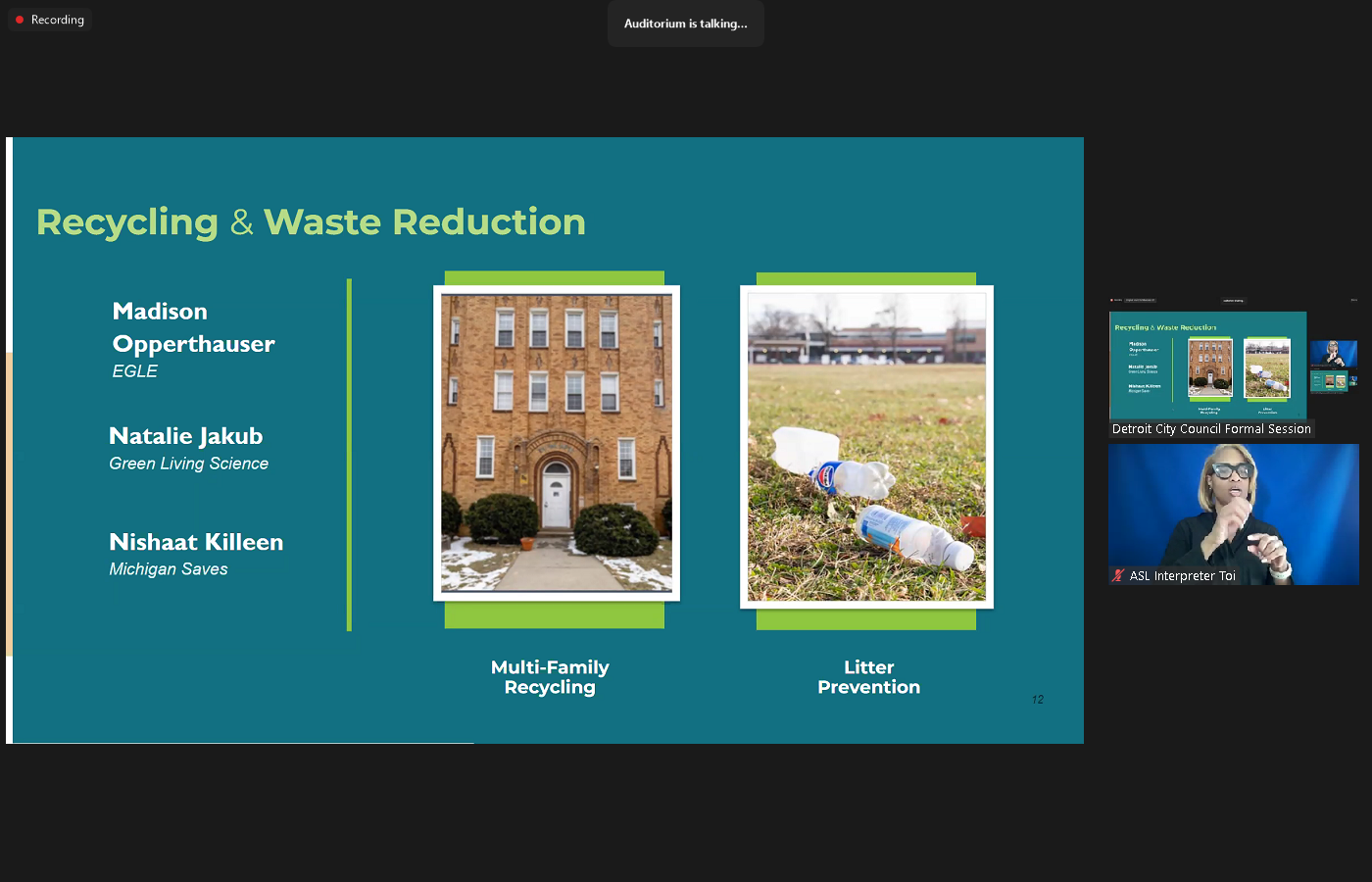
 our mental health and we are having a mental health crisis in the country and in our city. It can increase property value, enhance commercial corridors and beautify our community. So thank you so much for your support. And next up is Natalie. Good morning everyone. My name is Natalie Jacob and I'm the co chair of the recycling and waste reduction committee. of the grant green taskforce executive director of green living science and a resident of district two. My co chairs and a shot clean as a resident of District Six and my other co chair Maddie Oprah 1000 is a resident of district five since 2015. curbside recycling has been available to Detroit residents and single family homes. As an opt in program. We currently have a participation rate of 41% in 2021 Detroit residents and 900 tons of trash to the landfill daily, which contributes to a whole host of negative health impacts. By some estimates 90% of Michigan's waste stream is recyclable or compostable. We'd like to see the city continue to move away from landfill disposal and start prioritizing recycling. So many so materials can be put to their highest and best use while also creating jobs and stimulating the economy. Our committee has focused on these solutions, continuing to expand recycling services to multifamily and commercial buildings throughout the city. The development of a universal recycling ordinance to make sure we have a recycling cart in front of the homes of all Detroiters and increase the capture of materials from commercial facilities. continuation of the litter prevention media campaign to communicate with residents the importance of keeping our city and waterways clean. And finally, DPW should adopt a recycling and waste diversion plan to chart the path forward and achieve the goals we've
  set for ourselves through the Detroit climate strategy. We ask that you thoughtfully consider these projects when they're brought before you And in closing our goals are to make it just as easy for every resident to recycle and compost as it is to throw away trash. And on behalf of the organics recycling committee chaired by Michelle Jackson. More than a third of food waste goes to landfills which creates huge amounts of methane, a greenhouse gas 25 times more potent than carbon dioxide that impacts Detroiters and communities that are policy priorities include increasing recycling of food waste, and diverting 30% from landfill by 2029. Increasing access to healthy food through surplus food rescue and increase the use of compost as demolition backfill or vacant land amendment to improve soil health and stormwater infiltration. Their goal is to continue building Detroit's compost infrastructure and ecosystem and appreciate any support to help move this work forward. Thank you and I'll pass it to Kendall Good morning. My name is Kendall Coonan. And I'm the co chair of the energy waste reduction committee. I'm also the incoming Executive Director of the Detroit 2030 district and a resident of district seven DWR committee drives awareness of energy efficiency issues and opportunities in Detroit. I want to first begin by saying a huge thank you to all for your unanimous support and adopting an energy and water benchmarking ordinance last November. Detroit is now joined leading US cities by adopting this policy for buildings and as check the box for achieving a key action in the Detroit climate strategy. But we still have more work to do. The first phase reporting deadline in this for this ordinance is this coming October 1 And it requires buildings that are 100,000 square feet or greater to report their energy and water usage data from 2023 to the city. We are focused on continuing to build awareness and the Detroit 2030 District is able to support with compliance. The second phase of the ordinance will require buildings 25,000 square feet or greater to comply by June 1 of next year, reporting the prior years energy and water usage data. We aim to have high compliance rates in the first year so please work with us to help us spread the word to the commercial and multifamily building owners and managers in your districts. Buildings in Detroit have the highest potential for energy reduction and benchmarking is the first step to identifying that potential. And I'm going to turn it over to my other co chair Ben. Good morning. My name is Ben dickey. I'm currently serving as the Director of Community partnerships with Walker Miller energy services and she's a Detroit based black and woman owned business. As you all are aware, utility costs are a major part of a household budget and many households especially those with limited income will spend 30% or more of that income on energy costs. Michigan has recently been allocated $211 million in federal inflation Reduction Act funds which will begin to be deployed later this year and is aimed at improving energy efficiency and single and multifamily housing across the state. Because this funding is targeted at low and middle income households Detroit will see 10s of millions of dollars in investment over the next three to four years. This is not only an opportunity for families to make energy saving improvements to their homes but also a time for local businesses to grow and prosper taking advantage of the associated training and workforce development resources to serve their communities. In order to deploy these resources effectively, however, Detroit needs to be prepared to supply a pipeline of households that are prepared to receive these improvements. So it continued focus on strategically aligning various home repair resource programs such that the home repair the Detroit home repair taskforce is working on with the energy efficiency programs will ensure that the traders are well aligned to benefit from the resources to make their homes healthy, reliable and more affordable. Thank you.
+2
our mental health and we are having a mental health crisis in the country and in our city. It can increase property value, enhance commercial corridors and beautify our community. So thank you so much for your support. And next up is Natalie. Good morning everyone. My name is Natalie Jacob and I'm the co chair of the recycling and waste reduction committee. of the grant green taskforce executive director of green living science and a resident of district two. My co chairs and a shot clean as a resident of District Six and my other co chair Maddie Oprah 1000 is a resident of district five since 2015. curbside recycling has been available to Detroit residents and single family homes. As an opt in program. We currently have a participation rate of 41% in 2021 Detroit residents and 900 tons of trash to the landfill daily, which contributes to a whole host of negative health impacts. By some estimates 90% of Michigan's waste stream is recyclable or compostable. We'd like to see the city continue to move away from landfill disposal and start prioritizing recycling. So many so materials can be put to their highest and best use while also creating jobs and stimulating the economy. Our committee has focused on these solutions, continuing to expand recycling services to multifamily and commercial buildings throughout the city. The development of a universal recycling ordinance to make sure we have a recycling cart in front of the homes of all Detroiters and increase the capture of materials from commercial facilities. continuation of the litter prevention media campaign to communicate with residents the importance of keeping our city and waterways clean. And finally, DPW should adopt a recycling and waste diversion plan to chart the path forward and achieve the goals we've +1
set for ourselves through the Detroit climate strategy. We ask that you thoughtfully consider these projects when they're brought before you And in closing our goals are to make it just as easy for every resident to recycle and compost as it is to throw away trash. And on behalf of the organics recycling committee chaired by Michelle Jackson. More than a third of food waste goes to landfills which creates huge amounts of methane, a greenhouse gas 25 times more potent than carbon dioxide that impacts Detroiters and communities that are policy priorities include increasing recycling of food waste, and diverting 30% from landfill by 2029. Increasing access to healthy food through surplus food rescue and increase the use of compost as demolition backfill or vacant land amendment to improve soil health and stormwater infiltration. Their goal is to continue building Detroit's compost infrastructure and ecosystem and appreciate any support to help move this work forward. Thank you and I'll pass it to Kendall Good morning. My name is Kendall Coonan. And I'm the co chair of the energy waste reduction committee. I'm also the incoming Executive Director of the Detroit 2030 district and a resident of district seven DWR committee drives awareness of energy efficiency issues and opportunities in Detroit. I want to first begin by saying a huge thank you to all for your unanimous support and adopting an energy and water benchmarking ordinance last November. Detroit is now joined leading US cities by adopting this policy for buildings and as check the box for achieving a key action in the Detroit climate strategy. But we still have more work to do. The first phase reporting deadline in this for this ordinance is this coming October 1 And it requires buildings that are 100,000 square feet or greater to report their energy and water usage data from 2023 to the city. We are focused on continuing to build awareness and the Detroit 2030 District is able to support with compliance. The second phase of the ordinance will require buildings 25,000 square feet or greater to comply by June 1 of next year, reporting the prior years energy and water usage data. We aim to have high compliance rates in the first year so please work with us to help us spread the word to the commercial and multifamily building owners and managers in your districts. Buildings in Detroit have the highest potential for energy reduction and benchmarking is the first step to identifying that potential. And I'm going to turn it over to my other co chair Ben. Good morning. My name is Ben dickey. I'm currently serving as the Director of Community partnerships with Walker Miller energy services and she's a Detroit based black and woman owned business. As you all are aware, utility costs are a major part of a household budget and many households especially those with limited income will spend 30% or more of that income on energy costs. Michigan has recently been allocated $211 million in federal inflation Reduction Act funds which will begin to be deployed later this year and is aimed at improving energy efficiency and single and multifamily housing across the state. Because this funding is targeted at low and middle income households Detroit will see 10s of millions of dollars in investment over the next three to four years. This is not only an opportunity for families to make energy saving improvements to their homes but also a time for local businesses to grow and prosper taking advantage of the associated training and workforce development resources to serve their communities. In order to deploy these resources effectively, however, Detroit needs to be prepared to supply a pipeline of households that are prepared to receive these improvements. So it continued focus on strategically aligning various home repair resource programs such that the home repair the Detroit home repair taskforce is working on with the energy efficiency programs will ensure that the traders are well aligned to benefit from the resources to make their homes healthy, reliable and more affordable. Thank you. Speaker 7
And 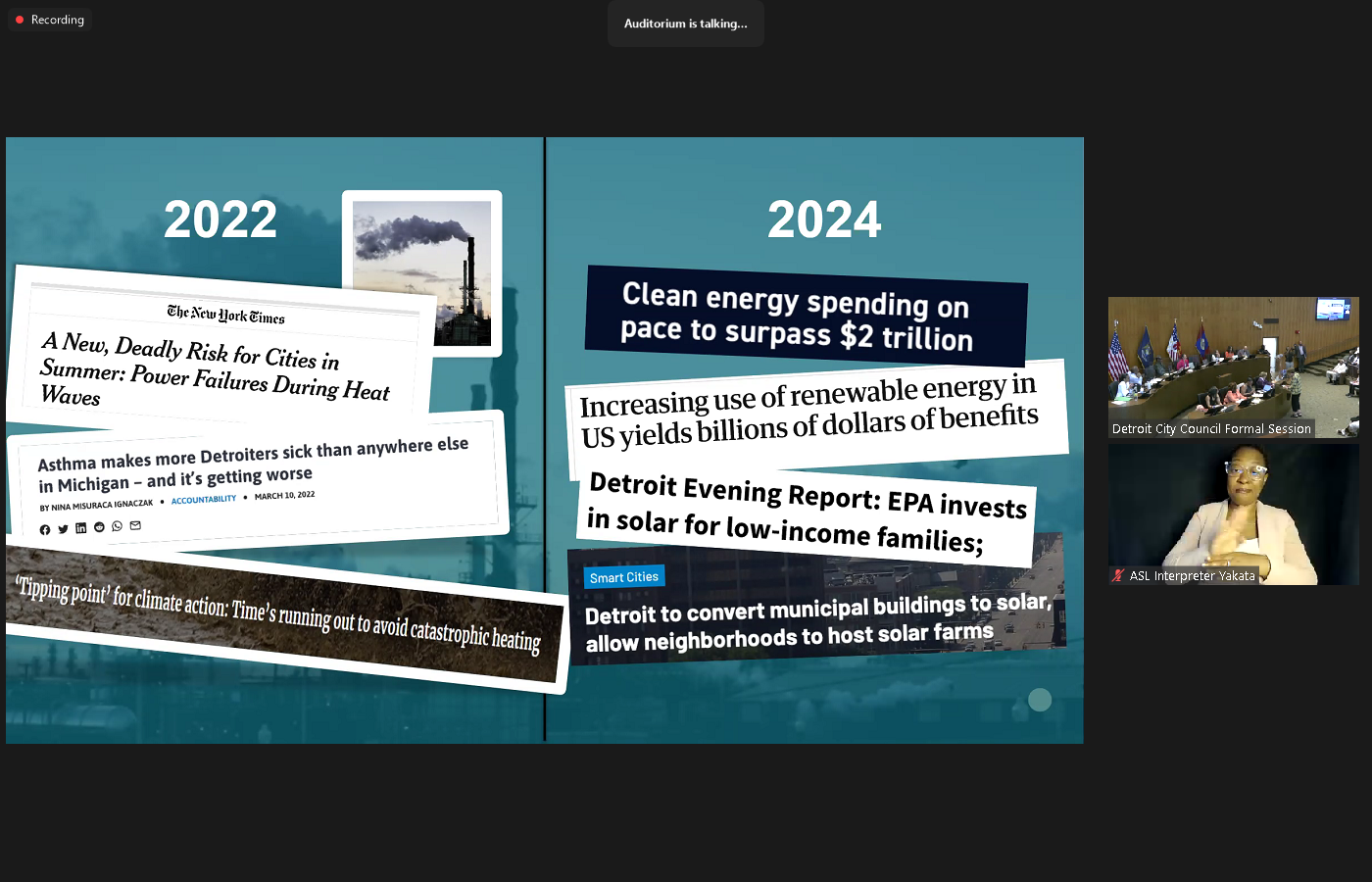
 he's introducing Diane Van Buren co chair of the Renewable Energy Committee. I am a Detroit resident district five and also co owner of D two solar a woman owned solar business in Detroit. My co chairs include Diane cerclage, who is a resident of District Six, and Delbert Brown, a resident of district one. Our job as the Renewable Energy Committee, and we've been around for several years now things just Councilman Benson is to move the needle of renewable energy in Detroit. And if you look at those headlines last time we were here was in 2022. It was pretty grim when I came up here last time I was talking about where are we and we were number 63. And the the total list of cities with how much solar there was per capita. We were we were just entering the time when the Biden administration was able to start releasing the funds. And look at where we are now. We now have Lansing supporting us. We now have the federal government supporting us. So we need to support us as well. Right. So what we have is that opportunity to move the needle exponentially. And it's not just adding solar. What we really are looking for is that economic development opportunity for Detroit errs in two ways. One is jobs. The other is reducing your energy costs, and that counts for the city to one we can see that just a few years ago, the average cost per kilowatt hour in Detroit with DTE was 12 cents. You check your bill between three o'clock and seven o'clock in the summertime. That shoots up to 22 cents a kilowatt hour. So that's almost doubled in just a few years. And what does that mean everybody who goes home and starts flipping on the air conditioners and flipping on the stove and doing things you're getting hit at the highest rate in this city in the state almost the nation. What time is that from three to seven. So when the sun is shining, in the summertime, we could be producing our own solar. So that's why we're really really working hard and trying to make sure that things change. Councilman young Thank you. I'm glad I can say thank you in person. Thank you for assigning staff from the City Planning Commission to help with moving the needle on solar and investigating. So that's where we're continuing to move that if we have these opportunities of solar in Detroit, we're going to move out of the basement of the nation at number 63. We're gonna shoot up to being a solar star, and that we can show the nation that the Midwest Detroit has the will the political will the state funding, the federal funding and also city support for solar Thank you. And now I get to introduce Kristin Shaw, co chair of the Climate Committee
+2
he's introducing Diane Van Buren co chair of the Renewable Energy Committee. I am a Detroit resident district five and also co owner of D two solar a woman owned solar business in Detroit. My co chairs include Diane cerclage, who is a resident of District Six, and Delbert Brown, a resident of district one. Our job as the Renewable Energy Committee, and we've been around for several years now things just Councilman Benson is to move the needle of renewable energy in Detroit. And if you look at those headlines last time we were here was in 2022. It was pretty grim when I came up here last time I was talking about where are we and we were number 63. And the the total list of cities with how much solar there was per capita. We were we were just entering the time when the Biden administration was able to start releasing the funds. And look at where we are now. We now have Lansing supporting us. We now have the federal government supporting us. So we need to support us as well. Right. So what we have is that opportunity to move the needle exponentially. And it's not just adding solar. What we really are looking for is that economic development opportunity for Detroit errs in two ways. One is jobs. The other is reducing your energy costs, and that counts for the city to one we can see that just a few years ago, the average cost per kilowatt hour in Detroit with DTE was 12 cents. You check your bill between three o'clock and seven o'clock in the summertime. That shoots up to 22 cents a kilowatt hour. So that's almost doubled in just a few years. And what does that mean everybody who goes home and starts flipping on the air conditioners and flipping on the stove and doing things you're getting hit at the highest rate in this city in the state almost the nation. What time is that from three to seven. So when the sun is shining, in the summertime, we could be producing our own solar. So that's why we're really really working hard and trying to make sure that things change. Councilman young Thank you. I'm glad I can say thank you in person. Thank you for assigning staff from the City Planning Commission to help with moving the needle on solar and investigating. So that's where we're continuing to move that if we have these opportunities of solar in Detroit, we're going to move out of the basement of the nation at number 63. We're gonna shoot up to being a solar star, and that we can show the nation that the Midwest Detroit has the will the political will the state funding, the federal funding and also city support for solar Thank you. And now I get to introduce Kristin Shaw, co chair of the Climate Committee Speaker 8
Good morning. My name is Kristen Shaw, co chair of the Detroit green Task Force Climate Committee. And lead for transportation decarbonisation the city of Detroit offs, mobility innovation. As you may have noticed, it's very hot today. It is only June and it's expected to reach 91 degrees. There is an excessive heat warning that will be in effect until this Friday. While the two degrees centigrade we have been warned about from scientists is feel small. It's on days like today that we feel it even more, but not everyone feels the heat the same way. I want to commend the city and the city council for their outreach to Detroiters getting them to cooling centers and staying safe while these extreme weather events take place. But we must take bigger action to prevent it not just to respond to it. Today's biggest headline is timely. Organizations have petitioned FEMA to recognize extreme heat and wildfires as federal emergencies or disasters. This would allow additional aid to come in when days like today and this week are taking place and help the people who need it most. Heat already kills more people in the United States annually than hurricanes,  floods and tornadoes combined. Today is also a recognized ozone day. Some cog began recognizing these dates decades ago, and are recognized when ozone levels and pm 2.5 are extremely high. This is measured by an air quality index. You can see it on the screen today we are in the orange and this is this means the AQa has exceeded 100 It's unhealthy, it disproportionately affects sensitive groups and it worsens as it gets worse. into 2023 There were 17 ozone days 17 pm 2.5 action days and three days that called for both Michigan set a new record and March when temperatures rose to 74 degrees. So what does this mean for Detroit? I've included these two slides to show the extreme disparity and burden on these impacts for Detroiters. So based on this EPA tool, we can see how much harder these greenhouse gases hit our city and residents. So this is a map of a PM 2.5 And if we look at what this looks like compared to the rest of the state, you can basically see the exact outline of our city. Why does this matter? In addition to the comfort and joy that comes from being outside and enjoying fresh air, our fresh air is under threat from these greenhouse gases. They cause extreme public health challenges and are disproportionately impacted by their Twitter's the good news, the greenhouse gases are avoidable. Through aggressive climate action. pm 2.5 exposure leads to heart disease, asthma and low birth rate. The traders have died from heart disease at at least 1.5 times more than other Americans. 16.2% of Detroit adults and 14 points and 14.6% of Detroit children have asthma compared to 11% of Michigan adults and 8% of Michigan children. And in 2023 nearly 2000 Detroiters died from extreme heat. There is a direct relationship between how we address the clean energy transition energy efficiency, the transition away from fossil fuels specifically, and how it impacts our air and water and our community. Health. The City of Detroit must address climate change to protect the communities in an equitable and just way. We can achieve this by restoring our natural resources, improving sustainability planning and ensuring that all investments prioritize climate solutions. We also hope to strengthen the city's relationship with region and international partners recognizing that the climate impacts extend beyond our borders. Each of the committees you've heard from today focuses on indicators to reverse the impacts felt by Detroiters. The Climate Committee will set overarching goals to make policy implementation not only easy but meaningful. We aim to recommend changes that Detroiters can see and feel within their lifetimes. We invite you to join us in making this happen. And with that, I'd like to move to introduce my colleague, Irma leaphart, who spoke earlier to discuss how together we can effectively respond to climate change and protect our communities.
+1
floods and tornadoes combined. Today is also a recognized ozone day. Some cog began recognizing these dates decades ago, and are recognized when ozone levels and pm 2.5 are extremely high. This is measured by an air quality index. You can see it on the screen today we are in the orange and this is this means the AQa has exceeded 100 It's unhealthy, it disproportionately affects sensitive groups and it worsens as it gets worse. into 2023 There were 17 ozone days 17 pm 2.5 action days and three days that called for both Michigan set a new record and March when temperatures rose to 74 degrees. So what does this mean for Detroit? I've included these two slides to show the extreme disparity and burden on these impacts for Detroiters. So based on this EPA tool, we can see how much harder these greenhouse gases hit our city and residents. So this is a map of a PM 2.5 And if we look at what this looks like compared to the rest of the state, you can basically see the exact outline of our city. Why does this matter? In addition to the comfort and joy that comes from being outside and enjoying fresh air, our fresh air is under threat from these greenhouse gases. They cause extreme public health challenges and are disproportionately impacted by their Twitter's the good news, the greenhouse gases are avoidable. Through aggressive climate action. pm 2.5 exposure leads to heart disease, asthma and low birth rate. The traders have died from heart disease at at least 1.5 times more than other Americans. 16.2% of Detroit adults and 14 points and 14.6% of Detroit children have asthma compared to 11% of Michigan adults and 8% of Michigan children. And in 2023 nearly 2000 Detroiters died from extreme heat. There is a direct relationship between how we address the clean energy transition energy efficiency, the transition away from fossil fuels specifically, and how it impacts our air and water and our community. Health. The City of Detroit must address climate change to protect the communities in an equitable and just way. We can achieve this by restoring our natural resources, improving sustainability planning and ensuring that all investments prioritize climate solutions. We also hope to strengthen the city's relationship with region and international partners recognizing that the climate impacts extend beyond our borders. Each of the committees you've heard from today focuses on indicators to reverse the impacts felt by Detroiters. The Climate Committee will set overarching goals to make policy implementation not only easy but meaningful. We aim to recommend changes that Detroiters can see and feel within their lifetimes. We invite you to join us in making this happen. And with that, I'd like to move to introduce my colleague, Irma leaphart, who spoke earlier to discuss how together we can effectively respond to climate change and protect our communities. Speaker 4
Thank  you, Kristen. So we're here today asking for your continued support for programs and policies that push Detroit closer to being an equitable, healthy, sustainable and resilient city of the future. With the abundance of federal funding through the climate bill, the bipartisan infrastructure law Great Lakes Restoration Initiative, plus programs to address environmental justice initiatives like the justice 40 that were really tailor made to get that money and through local, regional and international partnerships and collaboration. We can now not only imagine, but make real a healthy and sustainable city that's for all of us to thrive and prosper. So we're asking and hoping that you will consider us as the green taskforce chairs and committees to use us as a resource. We're passionate, we're knowledgeable and we will do what it takes and work with anybody and hopefully all of you to make the changes that are needed. We ask that you send a representative from your office to perhaps someone you designate as a sustainability point person to our meetings. We ask that all Council decisions that are done through a lens of sustainability, perhaps through a sustainability checklist, and to advocate for incorporating sustainability guidelines and all municipal operations and funding decisions to assure that we are truly truly valuing the triple bottom line of people planet as well as revenue. In collaboration with administration, we ask for full expenditure of ARPA funds. Support, we ask that you support and fund perhaps the expansion of the Office of Sustainability. We were some of us were in Seattle a few years ago. They have an office with 30 people and yes, they have a funding source. But let's try to do better. And lastly, we ask for your help to advocate for regional and state policy that supports our Detroit climate strategy, our sustainability action agenda, and the state's My Healthy Climate Plan and any other and all other climate change initiatives with record high temps that Christian talked about that we're seeing this week. extreme storms like what we saw Sunday night, we really don't have a choice. The climate change beast is upon us. It is essential that we act in earnest with all hands on deck. We know we are singing to a choir of climate champions. So thank you sincerely for allowing us this time to speak to you. We thank you for your efforts your support and the time. Thank you.
+1
you, Kristen. So we're here today asking for your continued support for programs and policies that push Detroit closer to being an equitable, healthy, sustainable and resilient city of the future. With the abundance of federal funding through the climate bill, the bipartisan infrastructure law Great Lakes Restoration Initiative, plus programs to address environmental justice initiatives like the justice 40 that were really tailor made to get that money and through local, regional and international partnerships and collaboration. We can now not only imagine, but make real a healthy and sustainable city that's for all of us to thrive and prosper. So we're asking and hoping that you will consider us as the green taskforce chairs and committees to use us as a resource. We're passionate, we're knowledgeable and we will do what it takes and work with anybody and hopefully all of you to make the changes that are needed. We ask that you send a representative from your office to perhaps someone you designate as a sustainability point person to our meetings. We ask that all Council decisions that are done through a lens of sustainability, perhaps through a sustainability checklist, and to advocate for incorporating sustainability guidelines and all municipal operations and funding decisions to assure that we are truly truly valuing the triple bottom line of people planet as well as revenue. In collaboration with administration, we ask for full expenditure of ARPA funds. Support, we ask that you support and fund perhaps the expansion of the Office of Sustainability. We were some of us were in Seattle a few years ago. They have an office with 30 people and yes, they have a funding source. But let's try to do better. And lastly, we ask for your help to advocate for regional and state policy that supports our Detroit climate strategy, our sustainability action agenda, and the state's My Healthy Climate Plan and any other and all other climate change initiatives with record high temps that Christian talked about that we're seeing this week. extreme storms like what we saw Sunday night, we really don't have a choice. The climate change beast is upon us. It is essential that we act in earnest with all hands on deck. We know we are singing to a choir of climate champions. So thank you sincerely for allowing us this time to speak to you. We thank you for your efforts your support and the time. Thank you. Unknown Speaker
Thank you.
Speaker 3
Thank you, colleagues. And at this time there any questions for the green Taskforce? I'm sure our acquire climate champions have a few questions.
President Sheffield
Yes, Councilmember Santiago Ramiro. Thank you, madam president through you to the green Task Force. Thank you all. So much for the work that you do. I have one question when it comes to the benchmark ordinance. Can you let us know? Is there a form you mentioned support in going in identifying buildings in our districts? When and how do we let them know that they should be reporting because happy to identify and send over the information to those properties.
Speaker 9
I can certainly follow up with an email as well but the City of Detroit's Office of Sustainability Team has developed a benchmarking webpage that has a how to guide an 11 Minute Webinar. recorded webinar making it as simple as possible for people to find information. They also have office hours, so if a building owner or manager needs additional support, they can reserve time with their team.
President Sheffield
Thank you. Thank you, Madam President. Thank you. Mr. Benson. Thank you, Councilmember Johnson.
Speaker 10
Thank you, Madam President. And good morning to all of you. Thank you so much for the presentation. I feel like you were stepping on my toes for sure each one of you. Because everything that you all talked about, we're dealing with in District Four. I'm sure my colleagues are dealing with a lot of it. In their district as well. And so I appreciate all of the research and the work that has gone into your advocacy work, your suggestions, and I look forward to making sure that one of my team members is at your meetings, because I see that I can reach out to you and get support. Just ensuring that what we're advocating for in the district that impacts the entire city is brought with advocacy with research behind it. So thank you to Todd Scott, for your support in your decade, at least, of work focused on the Complete Streets plus the green streets ordinance. We're looking to roll that out very soon, and hope to have my colleagues support because green streets and complete streets are important for a number of reasons. It was also mentioned the GSI work that the city is doing. We're not seeing enough of it in District Four. And we have some some reasons that that has been presented to us but we're looking to push through those challenges. That we have on the east side with clay soil just to make sure that we are addressing green stormwater infrastructure and making sure that we keep as much water as we possibly can out of the sewer system. Many of you know about the the sea walls the the challenges that we're having with so many things water related in District Four that impacts the the entire city. And so I would love to be able to continue to connect with you all for your support just to make sure that we're moving forward in the right direction. I know Michelle Jackson is not here, but of course she represents District Four and has been doing a phenomenal, some phenomenal work around composting and so I'm looking forward to continuing those conversations with our staff and making sure that we understand and then we're also educating our residents throughout the district just to understand and value the importance of composting. I know there have been some discussions with the administration and with member bench and relative to composting and looking forward to seeing that move forward to see how we can utilize and how beneficial composting is and it may be able to address some of the clay soil challenges that we're having in the District Four and on the east side. And so I thank you all so very, very much and look forward to having a closer relationship with all of you as we move forward recognizing the impact of all of the work that you're doing on our city. So thank you again, thank you member Benson for the continued support and making sure that the task force has everything that they need, in order for them them to continue doing the work and I'm just looking forward to a number of initiatives that are Malik Hart spoke about as it relates to our continued support of the work that you're doing. Thank you. Thank you, Madam President.
President Sheffield
Thank you, member Johnson. Councilmember Doha. Thank you, Madam
Speaker 11
President. Good morning to you all. Good to see you again. Remember first meeting you when member Benson hosted in district seven. The green taskforce as well gave out awards and I can tell you when I had the opportunity to meet many of you and view some of the extraordinary things that you've done in the city of Detroit. I was kind of taken away I always joke with member Benson I said that was the day I really learned about composting. As many of you know, the work that you do and the education you provide to our communities are extremely important even to elected officials. I think oftentimes, we take for granted and sometimes we think we know so much as it relates to our environment or as we have these discussions about clean air or clean water. You guys are on the ground every single day. This is something that you guys push for every single day. And so I just wanted to extend my heartfelt thanks for the education you gave me about composting, but also our communities as we talk about a safer and a cleaner Detroit. That educational component is so important for us to keep our communities clean, but particularly for our generations to come. So thank you so much for all you do. Thank you Madam President.
President Sheffield
Thank you remember Dr. Hall. And I don't hear it see any additional hands just want to also personally thank you all for your service because it's truly a service the dedication that you provide and the research and knowledge to the city of Detroit around the environmental issues. So thank you so much. If residents want to get involved in the taskforce are they open to the public to attend it if you can just maybe state the date and time that you all host your meeting so that regular citizens who want to live their expertise and your advocacy to this issue can be a part of it as well.
Speaker 3
Thank you, madam president that they meet and so the green taskforce meets the third Thursday of the month and we meet virtually and in person virtually at we we go back and forth every other month virtually and in person we meet in person at the MSU Center at 3pm. Three to 4:30pm is when we meet and so if people are interested in joining participating, please contact my office 31322411983132 to 41198 and we will put you in touch with current Wimberly who chairs in directs the green Task Force and under his leadership, we have grown and expanded and just this is always something I want to talk about and dispel a myth. And so when we started this work in my office, it was the urban myth. That sustainability resiliency is all about suburban soccer moms. That's not true. And as we see today, and as we see the impacts of global warming and the greenhouse gas crisis, that this disproportionately impacts poor and vulnerable black and brown communities throughout the world, and right here in the city of Detroit, and Charity begins at home. So our focus is right here in the city of Detroit. So our work looks to dispell to mitigate any negative impacts around sustainability and help reduce people's energy burden. And so when we talk about solar, we talk about how we can reduce the costs, how we can reduce your energy burden when we talk about making sure that your house is a strong and tight envelope, how you can save money on your energy. Those are the ways that the green taskforce helps everyday residents as well and so it is looking forward to continue to work with my colleagues and create a situation where the city of Detroit is the greenest city in the country. And with that colleagues I motion to accept as per the Detroit city charter this report as the verbal report to receive and file for the annual requirement for our task force. Motion
President Sheffield
has made to receive the report in Hearing no objections that action will be taken. Again, thank you, Councilman Robinson for your your leadership in this area and your work with the green Task Force and thank you all for taking the time to come down and present to us this morning. We truly appreciate you guys and keep up the good work and we're looking forward to working with each and every one of you. Let's give them another round of applause
President Sheffield
All right. Thank you so much again, Robinson and we will continue now with our agenda this morning. There being no reconsiderations or unfinished business. We will proceed to the budget Finance and Audit standing committee for the budget Finance and Audit standing committee
Speaker 12
will be posting the office of contracting and procurement. Alright, those two reports
President Sheffield
will be referred to the budget Finance and Audit Committee or the internal operations Standing Committee. The
Unknown Speaker
reports from various departments.
President Sheffield
The three reports will be referred to the internal operations standing committee for the Neighborhood and Community Services Committee
Speaker 12
doing posts from various city departments. The
President Sheffield
three reports will be referred to the Neighborhood and Community Services standing committee for the Planning and Development Committee. flow reports from various departments before reports will be referred to the Planning and Development Committee, or the public health and safety standing committee.
Speaker 12
There during for reports various city departments.
President Sheffield
All right, the 34 reports will be referred to the public health and safety standing committee. We will now move to the voting action matters under other matters. There are no items Madam President, under communications from the mayor and other governmental officials in agencies.
Unknown Speaker
There are no islands Madam President.
President Sheffield
All right. We will call for general public comment everyone will have a minute and a half for public comment. And we will start with Miss Sheila followed by Mr. Edge.
Speaker 13
Good morning, Your honorable Council and
President Sheffield
we're gonna cut off public comment as well to sorry, go right ahead.
Speaker 13
Okay, I can speak now. Okay, good morning. My name is Sheila Dafa. I am the owner of three directing. I've been in Detroit, Michigan my whole entire life. I'm here today to ask you to vote no. on item number 19.2 Contract Number 600632 Item number 19.4 Contract Number 6006313 contract item number 19. Five. Contract Number 60063144 Autonomous trucking company. The reason why I'm here today is because I was in the program. I've been bidding and this person was placed in the program in the trial period program. I've been doing demo the whole time. And I could no longer participate because I only tore down three buildings. And even all the prior work that I did. It didn't matter. They said that my prior qualifications didn't matter because I only pulled three permits within five years. I couldn't participate. So I was placed in a trial period program. This contractor does bidding. He's done more than five buildings in five years. He's done work throughout the whole entire state of Michigan and he's been placed in the trial period program is to my understanding that the director wants him to get a Detroit demolition experience. And I don't understand what that means. I never seen that in the pre qualifications prior. I don't know what that means. All I know is that I was awarded eight garages within the last two years. I was given six months to do them. I did them in three weeks. There's been no more bids put out. I'm constantly paying all these fees, insurances and everything. And I haven't been able to work. So please,
President Sheffield
thank you so much. I haven't noticed here too. Possibly when we get to that item, possibly maybe bring it back in a week to allow us to work with procurement to see what can be done. And to get a better understanding of your situation. So we do have a note and when we get to those items, we'll make sure we raise those concerns. Okay. Thank you for coming down. Okay, thank you. Okay. And can we make sure the timer is working? I didn't see it moving. Okay. Thank you. Thank you, Miss Sheila. Thank you. All right, we'll move along. To Mr. Ige. Arthur age, followed by Mr. Cunningham.
Speaker 14
Good morning, honorable body Locke. Thanks for allowing me to speak today. I'm here representing Miss dabba Mana 3d Breckin a couple of years ago, I spoke to you all about the demolition program and I'm not going to go into that you can look at your archives and see that but 3d wrecking has a Class A license that qualifies them to tear down the Renaissance if that comes up for demolition. They gave her garages for trial period. She did those in three weeks and that's done. The history of breach Miss dabba mod she has done numerous demolition contracts through the city back all the way to the archer ministration. She has probably tore down over 800 houses for the city of Detroit. So I'm here today to ask you to make this demolition program as I said before bear for her and any other contractors that want to come in here and do work in the city of Detroit. Thank you.
President Sheffield
Thank you so much, Mr. hboc. You,
Unknown Speaker
thank you.
President Sheffield
Thank you, Mr. Cunningham.
Speaker 15
Good morning council people. Good morning everyone the sound of my voice 313444914 And on Facebook, retro active fairness. I'm asking everyone to set up a voice to get on the coaches. Right and talk to the people don't be Cydia uppity. Just get in there and just just talk to the folks you're gonna get the good the bad and the ugly. It's very hot out there. I don't have air conditioning in my vehicle. So there's this gentleman Mr. Barrett, I see him when I'm driving around I'm giving out that the the bus tickets and things and people always ask me for help with the clothes or with I have it in the trunk or like water and things like I'm a very poor man myself, but I like to pay it for and Mr. Beer. How long you live in the city of Detroit?
Unknown Speaker
64 years 64 Your
Speaker 15
whole life? Well, like how long have you been homeless? I've six about six years, six years. You see me when I'm getting off the bus tickets in the water and stuff like that? I do. Yeah. Have you ever used cam before? Yes. Yes. Even a little bit. Abuse camera boy. Yes. So the last couple of people I get virtually up to the microphone. They were the last people I brought were assisted by some of the council people. And I'm hoping that something's going to happen for Mr. Barrett. Anything else you want to say?
Speaker 16
I'd say the best buy was out to Bucha millio. It kicked off the bus no reason because the Transit Police are the reason typically just because you're homeless. There he is the media bus driver Jeunesse Thank you. It's not right with
President Sheffield
Mr. Bear, it's time now he's speaking okay, and you can go now go riding
Speaker 16
the bus every day. The bus system was so messed up. I get read the bus driver. Buzzer and sit down and shut up. My real friends please does room isn't stop that. You looked at everything. Will you look into that for me?
President Sheffield
Yes. Yes. Mr. Beer. Yes, sir.
Speaker 16
I will keep the bugs all but some of the bad bubbles tomorrow.
President Sheffield
Okay, thank you. All right. Thank you so much. And while you're here, you mentioned you said six years you've been homeless for six years. We just hope Francis just opened a facility that was is geared towards individuals that have our chronic chronically homeless and so we will connect you directly with Mr. Tim McCade. And to see if we can try to, you know, help you with housing while you're here as well. So if you could just my team will get with you, sir. And thank you so much for coming down. And will continue to work with you. Yes, sir. All righty, Mr. Hill Larry, he'll follow by Betty Lyons.
Speaker 17
Hello, my name is Larry Hill. I am the owner. Of SeaMAX scooter, the only scooter company that's headquartered in the city of Detroit and it's only one of two minority scooter companies. There have been five scooter companies that were given permits to operate in the city. So I'm asking your support and reversing and overturning my pavement design denial. I was denied a permit to operate after operating for the last four and a half years. The city council passed an ordinance to pass the ordinance for the scooters. And when they passed the ordinance Detroit scooter told me that I would have to take all of my scooters off the street on April the 14th Two days before the NFL draft and 2020 I poured out you know my life savings starting this company and after that permit was denied. It just financially devastated me, my family and my employees. And I am asking your support to overturn this permit denial. They gave me two reasons why they denied the permit. They said because my company was not big enough. Well, in four years, I've had over 10,000 riders. And what I've found is the smaller the company is the more manageable it is.
President Sheffield
Maybe I should have 10 or 14 I'm sorry, that timer isn't working. So it did cut off and I didn't want to cut you off. I want to try to keep it consistent with the one minute and 30 seconds. Okay, that is your time. I mean, remember Callaway and I worked on that ordinance so I'm not sure when Callaway if you want to work together. Okay, yes, I mean, remember CAL will work with you to see what we can do to this issue. Okay, sorry.
Speaker 18
You can see Peter right here and give him all your information. Can I have through the Chair may ask them a question, sir.
President Sheffield
Mr. He'll remember Callaway is trying to talk to you. I hear you
Speaker 18
said they who was that? You said they did? Detroit scooter mobility. Okay. Do you know who you spoke to Tim's
Unknown Speaker
Schlosser insurer.
Unknown Speaker
Thank you.
President Sheffield
Thank you. Thank you remember Callaway All right, Miss Betty Lyons followed by Barbara Logan.
Speaker 19
Of course I'm here regarding the return of overpaid property tax over $600 million $600 million that belong to the Detroit residents. I'm waiting for that advocacy from all of you that has so much good words to say I'm waiting for that tightness to show that we are supposed to have that money is ours. Well, last week, you spoke highly of people that lived in Detroit that love Detroit, and they have passed on they did not get a chance to touch or feel money that belongs to them. How do you feel how do you speak highly and you did not do your part and making sure they got justice and the money that belonged to them? Yes. And that includes the law department. Why do you go to school to learn justice and you don't show the people how to get what belongs to them. That is purely wrong. And I don't know how any of you sleep at night to know that money that belongs to the people is not given to them. And also I hope that some of you saw the great cellist Sheku para Mason, let couple of weeks ago the genius chalice that played for Meghan, and Harry's wedding a tree.
President Sheffield
Thank you so much Miss Lyons and Miss Logan, followed by Miss Mayberry.
Speaker 20
Hello, my name is Barbary Logan. And I'm here again about the over assessment in property taxes. I've uncovered some information from my own investigation about what happened years ago when I lost my home to over assessment property taxes and resulting in foreclosure. I lived there for 20 years raising my children sending them to college while they were in college. I lost my home because I objected to how much property taxes I was being assessed and which resulted in my rent being my oh my mortgage been increased by more than $1,000 in less than a year. City council did pass a resolution resolutions are not restoration. We need to be restored for the houses that the homes that we as homeowners in Detroit lost years ago and now is coming out. Only since I've been coming to these meetings and coming and engaging. did I find out the grievous crime that was committed to what but on us as property owners 20 years less than 20 years ago. I think that the city council should start an investigation about what happened and stop pushing this under the rug as if nothing happened. We lost our homes. We lost our generational wealth. We need to be restored not resolutions resolutions are not restoration. So they need to you need to start an investigation with the goal of restoring us our homes that were taken in 2008 The same year my mortgage company went out of business and the mayor was convicted of a criminal enterprise Thank you Miss that was a crime.
President Sheffield
Okay, thank you. Thank you so much Miss Logan extra time. I'm not sure if we want to be as a document. You sure.
Speaker 21
Just Just for clarification, though. I don't know Miss Logan and thank you for coming down here. apologize on behalf of the City of Detroit for any any issue that we caused as the city in terms of your challenge that you had with your home and your home being lost. But I wanted to find out that you have you received any documentation that we that we have requested from the various law department and legislative policy division and explains the situation on how we got to where we are because when you ask the question that have we investigated that we can bring folks before us but we have information on what happened that's not in denial whatsoever. The challenge is legally by the state, not by us alone, legally by the state. We have really reached the max of what we can do from a body of our own. And I don't know if you receive those documents that we've gotten prepared to provide and I know that people expect us to be able to just wave a magic wand but the laws prevent us from doing certain things that we've gotten as far as we can from this body alone. Have you received or seen any of those documents that walk through our internal investigation as to what took place.
Speaker 20
I filed a FOIA request about how much I was overstressed and when and what years. I have some information on my own. The Law Department says they don't have any information. So here's what
Speaker 21
we'll do. We've got documents that we want to provide you make sure that we I mean, the body has received documents on what happened and how we got to this point. Okay, you don't have to for you that information. I'm asking someone for my staff to ensure that we get you there those documents, okay, and we'll go from there. Okay, give you a better understanding of why we are acting and moving the way that we are there. A lot of people don't want to hear that. But the truth is there are laws that prevent us from just paying folks out and providing them a home. We have worked around literally every edge that we could now there's someone who's able to free up some more knowledge or wiggle room in a law that that's in place. That will definitely take that information and the criticism will receive that as well, but that it only gets us so far in terms of the law that we are still bound by with city council as a
Speaker 22
local body of government, but I'll make sure someone from my team gets that information to you so my please make sure you touch base. I appreciate whatever you can do. But as the city is as a city council, I don't I don't have money for a lawyer or lawyers right now. We're gonna get you the information. I'm pretty sure well, we'll go from there. Thanks for talking. There also is a program that will be launching in early July for individuals that were affected homeowners during a certain period of time in Detroit that may have lost their home to over assess me we'll make sure that you plug you with that program as well. And then also there's a coalition that is doing their independent fundraising to provide compensation and so you should be plugged in with that group as well too, because if you lost your home, you will be someone that they will want to be able to assist with the philanthropic efforts that they have to raise funding for individuals that may have been impacted. So we will connect you with that group as well too. I appreciate that. But I looked into all that I lost my home outside of that. 2009 So we'll let's just talk offline and that's okay. We'll give you the information that goes over the legal challenges that we face, being able to provide the right compensation and we will continue to work with you Miss Logan okay, I'm not speaking as an individual because I found out that it's more more people than me. A lot of seniors have lost their homes during and during that time. Okay, that was it was just illegal, for sure. Thank you. Thank you so much, Miss. Logan. Mr. Foster followed by Miss Mayberry. Good morning through the Chair. First, I appreciate everything you guys do. I just want to highlight a few things. First, what to be aware of and actively attentive to important societal facts and issues, especially issues of social and racial justice. By June 29 of last year, it was a six three ruling and in the form of action in higher education. You know, it was two dissents that I like in particular dissent. Jackson and dissent sought admire the first or quote the majority seems to think that race blindness solves the problem of race based disadvantage. Secondly, by any race consciousness college admissions to court closes the door of opportunity that the Court precedent says help open to young students of every race. It creates a leadership pipeline that is less diverse than an increasingly diverse society. Reserve in positions of influence and prestige in America. were predominantly white pool of college graduates you know, so I'm asking that the same NAACP, that find the Thurgood Marshall, the advocate for education for all and in our institutions, raise up their voice and provide some funding to get this equality for our children today. And for our residents here. I'm asking that our community society as a whole wake up is a reason why rhetoric is being spoken to be anti woke. We as a community have to wake up and be aware of our societal issues. Thank you.
President Sheffield
Thank you, Mr. Foster. Miss Mayberry. followed by Mr. Burton.
Speaker 23
Good morning. Good morning. I'd like to thank Mary Sheffield and her staff for raising the Juneteenth flag last Wednesday. But a wonderful affair. Thank you so so so so much. I just don't know what to say. I'm overjoyed about that. And my second Well, I got three things. The second thing is I have been calling the city the numbers that you have given to me to have them to come out and pick up the trash in the Martin Luther King Memorial Park. We're going to be there ending our Juneteenth Celebration there on this Sunday because we have someone to come out and put a porta Potti there and all that sort of stuff to clean up. We have had people to come out and I've been out there every, every day just every other day in the water, my flowers and all that sort of stuff. But can we get that done for Sunday? And my third thing is, is it some way that we can also get like a silence or ordinates to quiet down the neighborhood from speed racing at night like instead of calling the police I wanted to call the police or you know, but non emergency number that I can stop the Speed Racers up and down the street. Two or three o'clock in the morning or whenever cargo started about 12 o'clock and go to about three o'clock although I don't work, but it might you know, it's a hazard as well as him speeding up and down the street. That type of morning in my neighborhood.
President Sheffield
Maybe thank you again so much. We appreciate you. It was good seeing you at the event and we will make sure that we get with GSD regarding your event and cleaning of the park. Okay.
Unknown Speaker
Thank you. Thank you. So
President Sheffield
you offline on that and also the issue of the speeding and noise in that area. Okay, okay. Thank you Miss Mayberry. All right, Mr. Burton.
Speaker 24
City council members I'm glad to see everyone voted for is up at my panel to to speak a little louder so we can hear you say I'm glad to see everyone I'm voting for. I'm standing before FDC yo, my name is altered Burton. I'm a 71 year old resident of the city all my life. I can't really hear you. Just a 71 year old resident of the city. I'm glad to be here in your presence. I'm here in common to the solar panels in my neighborhood. I am the director of this international community to develop my outreach and inform a transportation service to all the facilities correctional facilities. And I'm here to make comment to the solar panels in our neighborhood. There's a lot of issues going on about people not showing up for the voting and demonstrating of the solar panels in our neighborhoods. And I want to formally introduce myself as the transportation service that will bring them down here to make themselves present. This is my first meeting had to hear and it's not going to be my last and I hope to bring other residents in my community, a district to Mrs. Galloway's district down here to make comments about the solar panels that we do want. I heard yesterday lady talking about solar panel is causing cancers and what have you, which is the ridiculous thing I've ever heard. So I'm gonna get together and open at present invitation to all the people in our community in our area district to seven mile and stay fair with Jana to come down to call me at one 800 Miss Van, this is number three, but one 800 mi SS VA n 6477826. And I will pick them up and bring them down here personally, to speak on this matter. Thank you for your time.
President Sheffield
Thank you so much for coming down. And I know we've been getting a lot of kind of public comment on solar, the solar project. And so next week, we will maybe have someone come on from the administration to give a quick update on where they are with community engagement and just the overall process because nothing has come before us yet. But we have been receiving a lot of public comments so we will reach out to the administration and have someone come on virtually next week to do a brief update on where the city is with community engagement so far. So thank you for coming down, sir. Madam Chair. Yes,
Speaker 18
yeah. And for this gentleman, just for the record, I think this is my third time saying I do support solar panels, not in communities as a farm or a mark not where people live. I do support solar panels being on structures, but I do not support solar panels being established as a farm and park where people still live, mostly black people. And when I see some solar farms and parks in Birmingham and Bloomfield and West Bloomfield Hill, it may be you can move my needle or right now sir, I do support solar panels on structures and not taking up acres and acres of land to install solar panels in a predominantly black neighborhood. Thank you Madam Chair.
President Sheffield
Thank you member Callaway. Alright, that will conclude in person and we will turn it over to those who have joined us virtually
Unknown Speaker
the morning Council President Can I be heard? Yeah,
President Sheffield
I think we're having an issue again. With the sound.
Unknown Speaker
The morning Council President.
Unknown Speaker
So morning, council president.
President Sheffield
He's going to take a minute for him to proceed. So colleagues, we could proceed to our agenda if everyone is okay as we wait for public comment. Dr. Powers I'm okay to move forward. Okay. So those who are joining us virtually, if you can, please be patient. We have some technical issues at this moment. We have our Media Services Department coming up now to fix the audio here in the auditorium. We are unable to hear any of our virtual callers so please stay on the line. We're going to proceed now with our agenda. And then we will come back to those who are virtual. Thank you so much for your patience.
President Sheffield
All right under standing committee reports for the budget Finance and Audit standing committee from the Legislative legislative policy division.
Speaker 1
Councilmember dr. Hall are resolution line item 16.1.
President Sheffield
Councilmember Hall
Speaker 11
Thank you madam president line item 16 16.1 is a resolution of authorization waiving the attorney client privilege on a lot department's opinion regarding the resolution to exercise City Council's power under the property tax reform ordinance. Move for approval for line item 16.1.
President Sheffield
All right. Any objections to waiving the privilege for 16.1? Hearing no objections that resolution will be approved. Or the internal operations standing committee from the mayor's office.
Speaker 1
Council member Johnson a resolution noting that this line item was postponed from last week formal session.
President Sheffield
Councilmember Johnson
Speaker 10
Thank you, Madam President Move for approval on line item 17.1. This is to appoint Eva Garza de Walsh to the board of police commissioners for a term beginning immediately and ending October 17 2028.
President Sheffield
Any objections? Objection, objection objection. The clerk would know if we can remember Callaway
Unknown Speaker
number kaldewei is a no
President Sheffield
remember Santiago Romero? Objection?
Unknown Speaker
Member Johnson objection.
President Sheffield
Parkwood No,
Unknown Speaker
Madam President.
President Sheffield
Hearing no further objections, the resolution is approved or shameful.
President Sheffield
From the Austin office of contracting and procurement
Speaker 1
awesome. Our budget is no resolution line item 17.2. Contract Number 6006291 100%. City funding to provide federal lobbyists services contractor boundary stone partners LLC, total contract amount 210,000. That's for law. Councilmember Johnson, a resolution.
President Sheffield
Council member Johnson
Unknown Speaker
Thank you madam president Move for approval.
President Sheffield
motion has been made to approve. Are there any objections? Hearing no objections, the one resolution will be approved. And we will now go back to public comment for online. Can you hear me all right.
Unknown Speaker
Good morning.
Speaker 25
Can you hear me? Yes, that's okay. All right. Our first caller is Steven hollering
President Sheffield
and I'd be heard Yes. Loud and clear.
Speaker 26
Okay, thank you. Yeah, the technology is not that great here. Um, so I just want to mention this week in it just all that a that even this week in Detroit and you know now I also have to say just how incredibly disappointed I am that with Saruman prolly team to that turning point conference and a white nationalist rally run by white nationalists net for rats, or I don't even know what his last name is. And started spreading misinformation about voter fraud this council, our clerks and just really playing in it with dolls Maga. White Nationalist eggs, which is just very you know, it just looks very bad on the city and you know, these right wing there's they're gonna they're gonna spread that around and you know, it's it's gonna be really scary and mislead and second of all, you know, I just really want to say, you know, regarding we have a serious gun violence issue in this country, you know, not only what happened in Rochester, but what happened in late for a bill in June. I believe, twice in Detroit, you know, we need to have stricter gun laws. You know, what they signed after under seal was great. I mean, it definitely.
President Sheffield
Right, thank you, Mr. Hari. Our next caller, Miss Yvonne.
Unknown Speaker
Our next caller is William M. Davis. Good morning.
Unknown Speaker
Can I be heard?
President Sheffield
Yes, sir. Okay,
Speaker 27
I'd like to start off by saying I completely agree with at the edge. I think the city council and the administration needs to do a whole lot more to help and assist black and brown businesses in the city. They have a dismal record. They need to be trying to make sure more of them stay in business and not be putting them out of business. Also, as relates to the the green taskforce presentation, I thought that was good. I would prefer to also hear a greater effort on doing something with a lot of homes in the city of Detroit, especially low income house, and seniors and people on fixed income have a lot of leaks in the house. That would be a great service to the city and to the bills. If there was the city was to help do something about that. That could cut down on flows into the combined sewer overflows. And instead so the the sewer system, and also I think it would be very helpful if rain barrels was provided that could aid and assist some of the reduce some of the flowers going into the system, and also make it easier for people to water their grass especially on hot days like this. When it's easy for your grass to burn off. I think a greater effort needs to be made which was actually started a long time ago to disconnect more the downspouts I think, you know, there's a number of little things they could do to help the city overall. Thank you.
President Sheffield
All right. Thank you, Mr. Davis.
Unknown Speaker
Our next caller is election integrity. Ru.
President Sheffield
All right, good morning.
Speaker 28
Eric glary. And they mess up your gig is up. Now we did did an investigation. I did my investigation. Proposal P was defeated in August 2021. As the same unit, Doha had those fake fraudulent votes he was in the primary election, but in a general election, those fake fraudulent votes and total way more than 61 by cast out of 12,000 votes. So when your dad was Sheffield third told me about the plan and 2019 I had no idea. Absolutely no idea what was going on, but now I do. I got more than a clue and idea. I got proof. Now James Taylor just heard you say your internal investigation. Yeah, I did all investigation, ya know. Jerry's work. He was lying on April 25 2025. She's when she says he sent out a report. Mary Sheffield's got busy Dave's tape. You also approved garland municipal bonds. Now, I'm in possession of a letter from Freedom of Information denial request, denied. There's no public notices but none of the contracts with authorities date back to 2012 at the clerk's office. And the reason being nor in the Detroit legal news, the reason being they were never issued may bring a DUNS number never did it. You never did it. And you total wild
President Sheffield
Thank you. Next caller please.
Speaker 25
next caller is Detroit a D O S
President Sheffield
Good morning.
President Sheffield
Morning Detroit ados. Good morning.
Speaker 25
Madam president she has been given permission to speak she just has to unmute.
President Sheffield
Okay, good morning, Detroit. ados. Okay, let's come back to this caller please. Eva.
Unknown Speaker
All right. Our next caller is Karen's iPad.
President Sheffield
Hello. Good morning.
Speaker 29
Good morning. Yeah, first off as it relates to solar farms. It's not the solar farm per se even though it can get to a buyer and call them massive fire. But But I'm talking about is it's gonna go to some wire somewhere. When it goes to those wires. It's gonna have an electromagnetic field. That's where the danger comes from. Maybe not the solar panels proper, but I'm talking about the field that comes from the wires that are gonna just want to see. So you want to DGAF but for me, I would say no, I mean, I'm not against solar but I'm against solar going to wires. You know, put them on House fine, but we're gonna take you out of danger. Put everybody in danger for power, brick. Now, let's talk about International Building Code chapter 27. This is going to be item 2702 dot 1.3 installation, emergency power systems and standby power systems are required. Now this was fire code NFPA 70 NFPA 110 and NFPA 111. Same thing for elevators. You gotta have a standby power system for elevators. No sense in these people in these high rise buildings being stranded in a building where they can't get downstairs that's a violation of the health code, fire code, city code and somebody needs to go to jail about it because who's checking who gives? Eph I do. And I'm not living in one somebody else should you know we only care about other than the green bounce going in our pocket.
President Sheffield
All right. Thank you, Karen.
Unknown Speaker
next caller is Richard Noto.
President Sheffield
Right, good morning.
Unknown Speaker
Can I be heard?
President Sheffield
Yes, we can hear you. Good morning.
Speaker 28
Good morning Council members. Um, first of all, I'd like to support Larry hill with a school of business I mean, I was able to meet with Lowry to somebody else who knew that I was having problems with the mobility department and clearly they are not supporting the businesses in the city of Detroit. We want to do something with the cork town shuttle. They've been shutting us down. Everybody else supports us but then I don't know you know what the situation is or what's going on but Larry should be reinstated and get his scooters. He's does a great job. He cleans his scooters up better than everybody else because he's personally involved and wanted so love you guys to support and get him the ability to have a permit so he can continue to expand his business like all other businesses in Detroit. That's Detroit way it's not necessarily given to the biggest people. We need to give it to the pity city of Detroit people so they so the city can grow and develop Thank you, everybody.
President Sheffield
All right, thank you.
Unknown Speaker
Next caller is phone number ending in 199
President Sheffield
or 199. Good morning.
Unknown Speaker
Hello. Can I be heard?
President Sheffield
Yes, you can.
Speaker 30
Oh, great. I like to address this to compliment dirt hill and also the mayor of the city of Detroit. I'm a city of Detroit retiree. Who was affected by the bankruptcy in 2014. After I retired in 2005, I paid my house off and other bills. But in 2015 the bankruptcy caused me to borrow money against my house. And then like some dental procedures, not having enough money for medicine and sometimes not having enough to eat presently I cannot afford it. And but my house and garage are in much needed repair. I lost my only son in June 2021 Which sometimes put me in a depression. Most of us retirees does not qualify for hope because of income bracket. I watched on TV the celebration of the lions downtown and the other day, the central station. Mayor Duggan says the city of Detroit is coming back after the bankruptcy. But what about the city of Detroit retirees who sacrificed their pension 10 years ago? Can someone please send a retiree? About 50% of us have died since 2014. Some written information about our return on the pension after the bankruptcy. I also want to
President Sheffield
All right, thank you. Councilmember Durga. Thank
Speaker 11
you, Madam President. Good morning to you caller if you can please contact our office at 313-224-2151. Again, that number is 313-224-2151. We'd love to get you some of the information that you are asking about and also invite you to participate in the retiree Task Force. We have gotten some vital feedback from retirees here in the city of Detroit and we are starting to have meetings with the Office of the Chief Financial Officer as well as the retiree citizens Task Force co chairs so we would love to hear your input as well, but please contact our office at that number. Thank you. Thank you, Madam President.
President Sheffield
All right, thank you member Doha.
Speaker 25
Next Sorry, madam president. Our next caller is Detroiters for Tax Justice.
President Sheffield
All right. Good morning.
Unknown Speaker
Good morning Council. Are you all
Unknown Speaker
good and happy
Unknown Speaker
June 15 to you? Yeah, um,
Unknown Speaker
I am
Speaker 31
here today to talk. Oh, my goodness. Okay.
Speaker 31
Okay, I wanted to talk to you about clawbacks where the Hudson project Detroit is the Tax Justice is imploring council to clawback the incentives. Gilbert touched on projects which we've seen over the past few years and here's why. Since getting incentives and abatements were Gilbert's original Hudson project to use, downsize the project and gotten even more incentives when GM moves out of the Renson and into the Hudson project, the city will lose all the property and income taxes paid by GM and its 800 employees. And those employees income taxes will then go to Gilbert under the transformation rounds. We'll have the 2000 jobs promised on this project 850 will be filled by GM so we will be incentivizing 11 150 jobs instead of the 2000. With the addition of losing the income taxes of 850 employees. The math of these actions puts the city in the loser column. Based on these developments, the city council can correct what has clearly become a win lose situation by calling black on on the current incentives that have been given to the Hudson project. We need our tax money
President Sheffield
Alright, thank you so much.
Unknown Speaker
Our next caller is Betty Ivana.
President Sheffield
Good morning, Miss Varner.
Speaker 32
Good morning, Madam President and to the honorable council members and to all within the sound of my voice. I come today, Betty a burner as a resident of the city of Detroit born and raised. I love my city. I come in peace and humbly ya know, that's how I come. I try to stay in peace. This week, I received another blast by the Detroit home accessibility program. asking do you know about the Detroit home accessibility program? I admire and thank the Council for allocate monies for the SR accessibility home repair Fund, which is a different program. It has been two years. I'm not pointing fingers. I don't know what the problem is. But I'm asking honorable council member waters and honorable council member Doha. Find out what the problem is. Yeah, got me bacon. People are contacting me because I've been telling people and I'm not saying today because we need this assistance. What is the problem? I don't understand the money's there. It was $2 million. Last time I heard you here it was $6 million. dollars in the program. Start the process. Yeah, please. We are in need. Thank you. I appreciate the work that you do for us.
President Sheffield
All right, thank you so much Miss Varner.
Unknown Speaker
next caller is Jay Gregory. Love.
President Sheffield
Greg Gregory. Love. Good morning.
Speaker 17
Good morning, honorable Council. I am calling this morning on behalf of the community advisory council district five and we have some concerns on our waterfront. I'll give you two addresses in specifics at 343. Just west of Oakland Park. It's a vacant lot. We're concerned about new development on that line. We would like to have a community engagement session dealing with both demolition as well as development. We'd like to know what's going to be built there what's planned for that particular lab, in addition at 430 and at 430 for two vacant buildings that have been vacant for over 25 years. Demolition permits has been issued. Our concern is not the new development. I concern is where the development is going to be. If it stays within the footprint of the two four storey buildings, all of the individuals along the Gulf Coast I'm very happy goes higher than that or goes down towards the waterfront. There is a major issue with the sea walls and the composition of the soil. Lastly, we would like the city to come out and do an engagement that tells us what's going on specifically along the water's edge. You passed a water barrier ordinance about two years ago dealing with the sea walls and that is giving a lot of us grief because it's about $2,500 Every two years for the test. So thank you for your concerns before you get to the reset.
President Sheffield
Thank you Mr. Gregory lab in our office will reach out to you directly after session to schedule some engagement meetings and now we had the opportunity to meet with you and a few members of the CAC recently we're these properties were mentioned. And so we will get back with you and plan some additional engagement around those concerned properties. Thank you so much for calling me and Mr. Gregory. Love. Our next speaker please.
Speaker 25
Our next caller is Chuck more state fair solar.
President Sheffield
Okay. All right. Can you hear me? Yes, we can hear you. Yeah,
Speaker 33
so I just want to say say I'm in favor to state their solar. I live in the state their community, and a lot of the residents here are in favor of it. One of the issues is come up with that we don't have any for our so for our property values. We don't have any comparable sales and I think the sales that will go to the solar project will allow us to have increasing property values. It's better use than their use of land dumping that's been going on here for years. But also the home improvements that are you know, through the states, the contractors through the Community Investment Fund. I think that's also a great opportunity for our community. And I also run the website stay up here together that org whoever wants to communicate and join or join us and look at what we have there. And in response to the other callers there is no radiation or fire or electromagnetic issues that are that are associated with solar. The one question I have is when is when date is an update on solar that you mentioned earlier?
President Sheffield
I'm sorry, what was the question?
Speaker 33
When is the up you said there's a upcoming upcoming upcoming state on the city council about solar?
President Sheffield
Yes, I mentioned that because we've received several public comments over the last few weeks that I'm going to have someone next week Tuesday during our formal session come before Council and just give an overall update on where the city is with the progress of solar panels and solar firms. This is being handled by the Department of neighborhoods. So it's coming from the administration who's really leading the effort, but we will have someone come before Council probably virtually and just provide a brief overview as to where they are to date and when do they foresee this coming before Council for approval? Madam Chair, okay, thank
Unknown Speaker
you very much.
President Sheffield
You're welcome. And you can listen to him for that conversation. Yeah.
Speaker 18
And ever Callaway. With that invitation. Can you also have someone from the law department to explain to us in terms of zoning because I think the land has to be zoned. I don't think it was properly zoned prior to my arrival on this council when it was installed at O'Shea was like a pilot program and has gone beyond the time that it was approved. So if we could please have someone from the law department to explain the hoops that we have to jump through to get the property zoned. Thank you Madam Chair.
President Sheffield
Thank you and Mr. Washington, Washington. I know that you are listening. If we can also make sure we have the appropriate people from law, Mr. Anderson ICU as well who are available for that discussion. Yes, Councilmember Yun?
Speaker 34
Thank you Madam President. I also just like to know where the Office of Sustainability is, and how they're participating in this project. I'd also like to know, because the plans that they had for the solar farms that didn't exist was my understanding that they had to pipe in energy from other parts of the state. I just want to know what that caught what costs would that be to the citizens of Detroit, you don't per person as well as per family. These are things that I really like to know. And I also want to know, is this something that you just want to discuss your manner president, you want to have just informal or did you also want to have a committee of the whole really kind of dig into this topic as well. So
President Sheffield
we'll see how Tuesday goes, nothing has come before us yet. And so I'm not planning a committee of the whole at the time, but just to get a brief update on when they foresee it coming to council. Once it comes to council, we can definitely look into a committee about Alright, so you can ask those questions next week when they come. Thank you. Councilmember Yang. All right, our next caller, please.
Unknown Speaker
Our next caller is Frank Hammer.
President Sheffield
Mr. Hammer Good morning.
Speaker 35
Good morning, Council. Good morning President and Sheffield. I want to thank the green task force for the excellent and detailed report. And I say that as a recipient of the green taskforce resident Leader Award. I also want to agree and it's rare that I do this with Mr. Hurrying, calling out the white nationalist Magga calls that were in our city last weekend. They are also climate deniers. All the more reason to get the green taskforce report to all Detroit neighborhood associations. One of the most dangerous contributors to greenhouse gases is the US military the Biden administration just passed a near trillion dollar budget for just one year for war. In February City Council voted to demand that war funds be shifted to peace and human needs. The resolution included Council holding public hearings. The resolution Arthur pointed out that Mayor Duggan as far back as 2017 promise to hold hearings about shifting military expenditures to peace and human needs. But those hearings never happened. I hope that you go forward with all deliberate speed to hold hearings on this very important subject that will have an impact on the climate crisis. Thank you so much.
President Sheffield
All right. Thank you, Mr. Hammer.
Unknown Speaker
Our next caller is Miko a Williams.
Unknown Speaker
Yes. Hi. Can I be heard?
President Sheffield
Yes, you can. Yes,
Speaker 34
I could do this about and reject white supremacy hate fascism. Racism, sexism, exotic phobia, ism, homophobia ism, where you could not come over to the city of Detroit over black people and try to get through all of this hatred. In our city. We are a loving city. We are a guy I know a lot of people don't like us be in a democratic city. But we are a city of black people. We are a city of excellence. And shame on Kwame Kilpatrick, the rapper's of Detroit and others were trying to go out here and they were talking about anything. But also I do agree that water is an essential human right. We have to protect our water we have to have affordability I would like to participate in those conversations surrounding water affordability every home should have affordable water at a price. We all could play. Thank you so much for taking my comment. Have a great day.
President Sheffield
All right. Thank you Miko
Unknown Speaker
next we will have phone number ending in 534.
President Sheffield
Good morning caller 534.
Unknown Speaker
Good morning. May I be her?
President Sheffield
Yes, you can.
Speaker 30
Okay, well, I definitely think first of all with this hot weather halt all the demolitions that are going on right now. I witnessed a despicable demolition on Friday. The judge wouldn't let us Why aren't you letting the little guy save their property? Why are you bulldozing this historic buildings with our from money it's just appalling. And they didn't do the wet wet, right? I inhaled, inhaled a bunch of demo dust from across the street. Where were the warnings to the neighborhoods that this to the neighbors that this was even going to happen. And that land bank demo people got in trouble for doing reckless demos and stuff spewing in the air and they had to help demolishing stuff during the hot months. So if you really care about us to do that, you really care about us making an effort to save the buildings instead of destroyed them and spew stuff around. Also, I do appreciate what was presented by the Green Door initiative. But what I did not hear and what I've been bringing up to this council repeatedly. And I saw it next to this demo job is net city hired mowers and some other mowers hire over mow over garbage constantly, constantly, leaving broken glass, cut up tin bottles, cut up Styrofoam, all this stuff is fugitive garbage is getting under the soil creating an absolute nightmare. I have brought this up repeatedly.
President Sheffield
Right Thank you Miss Warwick.
Speaker 25
Our next caller is conspiracy to destroy black homes.
President Sheffield
Good morning, morning
Speaker 18
Council as you know, a conspiracy to destroy black homes and I want to let this login known member Kate is being disingenuous as usual. The mayor can do something about owing us this money and pay in this he went up to Lansing and had two council members go up to Lansing to lobby further them to change the constitution and changing laws and the state laws to allow the land value tax which is illegal. So don't don't believe the height. Also you could call Coalition for Property Tax Justice at 31343886983134388698. And in it and for the contractors. Demolition Bid rigging has gone on by the mayor and his administration and here's a secret witness in
Speaker 33
Detroit. Records are busy pricing and shared what he knows about who's getting the work and how he says the big firms have been getting the contracts leaving the little guys to get hired as subcontractors with little profit. He says many were muscled out as contracts became more convoluted. 10 years ago, it was all about 20 to 30. Small, big. Everybody had their niche. It wasn't just six or five contractors. It's the profits of the big three demo companies that is at the heart of the FBI investigation. The defenders obtaining numerous documents indicating Bid rigging and price fixing. In February 2016. Michigan was in line for 300 million federal hardest hit fund dollars in Detroit houses were coming down to record numbers but the cost jumped from 11,500 for property in 2014 to $18,000 in 2016 creating millions of dollars in overbilling.
Speaker 21
Thank you, Madam President and Mr. Motta? No, you are good for calling folks out and saying we're disingenuous but the reality is I've told exactly the truth. The mayor and you said council members went up to the state of Michigan went to Lansing to get laws changed for the land value tax and that's exactly what they attempted to do. But that has not happened at this point. Because there are laws that are in place that do not allow the city to arbitrarily do so. So again, we are bound by laws of the state and the federal government. We cannot just arbitrarily make moves because we want to make them happen even if they're in the best what we believe interests of our residents of the city of Detroit. So thank you, Madam President. I'll leave it at that.
President Sheffield
Thank you President Pro Tem Tate.
Speaker 25
Our next caller is phone number ending in 3370337.
President Sheffield
Good morning.
Unknown Speaker
May I be heard?
President Sheffield
Yeah. Thank you. Yes. Good morning. Okay.
Unknown Speaker
This is
Speaker 36
Pat Bosch, resident of District Three. I've really appreciated the work that the green Task Force has done. But ironically, in spite of all that effort, city administration is proving Chronos cement operations at 3405 Gaylord and this rounding streets are dealing with all kinds of environmental problems and air quality problems. I cannot understand how this use could be shoved down people's throats without knowing about it. Secondly, when it comes to city contracts and Council's approval, this comment is not directed at any of the contracts that are on today's agenda. But when you approve a contract, let's just say for park improvements and you look at the entity that is being funded huge amounts of money. Look at how that company is treating the neighborhood where it is located in many of these contracts, entities are blighted and do not contribute to the overall environmental quality of the corridors where they are located. And thirdly, when we look at the work
President Sheffield
alright, thank you.
Unknown Speaker
Our next caller is Cindy Dora
President Sheffield
Sandy Dara Good morning.
Speaker 37
Okay, yeah. So thank you, Fred. And Frank war. Hammer. Oh, sure. Frank, thank you, and all Detroiters speaking today and listening. I will give my minute and a half public comment and send you the the rest on email for finishing my presentation. Verse Detroiters, every time it rains, all the garbage is taken down toward the street brain because that's the way the land sloped to take the water down toward the drain. Those are that's where we need to disconnect the sewer, the stormwater and then I could use it for our own irrigation which is save money on our water bill. We could have old farms we've got plenty of land and pretty soon we'll be funds again. If we keep demolishing sounds structures I was at the demolition was Joanne she call me I took her over there. They could have saved three quarters of the building and just torn off the back. Put some I mean this up on sonnet tubes, summit sauna jokes and I've been I've been across maybe six elbow support the very back of that roof that you want to say which the the original roof is like my roof I saw it it stepped so it's kind of great slope to it.
President Sheffield
Alright, thank you, Miss Daraa
Unknown Speaker
the next caller is Charles miles
President Sheffield
Good morning
President Sheffield
Charles miles Good morning
Unknown Speaker
Hello,
President Sheffield
yes, good morning. We can hear you. Oh, good
Speaker 26
morning. I I was calling in with concerns about property taxes. I've been down there quite a few times. And I've talked to a lot of different for the members of the council and I'm sure they know the name in the two addresses. And what I wanted to address is Dwayne county treasurer has talked to me and understood that there was errors made by the city of Detroit and they let me know that they weren't going to let you know what the city of Detroit treasurer that Mr. Patel that you know, is inaccurate and I was correct. For you all to be known about this issue for so long. I don't understand why you choose to send your lawyers to court the fight for you guys when you clearly know that you're wrong. And I'm just asking the city council members to please look at those addresses. Charles miles
President Sheffield
thank you so much. Mr. Miles.
Speaker 25
Our next caller is Renard mentioned ski.
President Sheffield
Good morning. Good morning, Madam
Unknown Speaker
President. Can I be hurt?
President Sheffield
Yes, you can.
Speaker 38
Good morning Council and Madam President. When he was Renard was Trotsky I'm a District Six resident and organizer with Detroit people's platform. I just want to take this body for passing a resolution to the state legislature to increase local bus operating funds. I'm still not sure where the state is at its process with its budget. But I think it's really concerning that they've decided to cut local bus operating from last year when there was a regional victory in terms of getting people to pressure state elected officials to increase that fund. With public transit, you need every bit of dollars that come in because it's a service and not for profit entity getting state local and federal dollars. The city in the federal government has done its job and we're calling on the state to consider this and and to invest in public transportation too. I also want to commend the earlier presentation on sustainability in the city. I think we need to look deeper into sustainability in terms of being a current climate impacted city. Right now. We are experiencing climate change. The climate is changing right now. It's not going to it's happening right now as we speak. And we need to understand what that means to families. In terms of utility rates of economic and equitable impacts as well. So let's dive deeper into this climate conversation and have DDOT be a part of that as well. Thank you.
Unknown Speaker
Thank you
Unknown Speaker
our next caller is Marguerite Maddox. Scarlett
President Sheffield
My name is Matt
Unknown Speaker
and
Unknown Speaker
I'm nine My concern
Speaker 39
was listening to every caller in person
Unknown Speaker
well know what Yeah. Yeah.
Unknown Speaker
Let it
Unknown Speaker
be may or may not want
Unknown Speaker
healing
Unknown Speaker
Bambi Bambi
Unknown Speaker
hearing for
Speaker 39
the to listen to your can lead to cancer I would like to bring the Happy Saturday get get these
Speaker 39
that we get
Unknown Speaker
there
Unknown Speaker
we
Unknown Speaker
go
Unknown Speaker
what made you?
Unknown Speaker
Show up
Speaker 39
the Antichrist
Unknown Speaker
you can be
Unknown Speaker
heavy
Unknown Speaker
not this word oh no you can right
Speaker 39
now thank you oh, one more among the above
Unknown Speaker
alright peace
Unknown Speaker
will have go
Unknown Speaker
thank you very much.
President Sheffield
All right. Thank you so much Miss Madox for your public comment. We appreciate you as always.
Speaker 25
Our final caller we're going back to Detroit ad O S.
President Sheffield
Ad honest. Good morning.
Unknown Speaker
Good morning through the chair. May I be hurt?
President Sheffield
Yes, you can.
Speaker 40
You've heard a lot of things from the community today that should be disturbing to all of us. The report that was given by the task force was a very good report but what it showed was that Detroit is number one in terms of asthma. What is the health department doing to address this issue? My other issue is this solar farm up, you're pushing for solar farms, but have you done the research on the toxic waste that it produces has the health department wait and you keep talking about the law department and changing ordinances. We don't want to change ordinances to make our conditions worse. I don't care who wants it? If it's not conducive for an environment for our children and our residents then we should reject it. We can put solar panels on homes that would help the people but solar farms are going to poison the people. As we know solar farms cause a lot of toxic waste. We have 200 sites with contaminated soil that you aren't addressing. So now you're going to bring solar farms into it. Will the solar farms help the residence or will these solar farms help buildings downtown? As you charge us with the benchmarking, which is another illegal thing you want to do?
President Sheffield
All right, thank you so much for calling in and that will now conclude all of our general public comment for this morning and we will proceed now. To our agenda. And we are now under the law department.
Speaker 1
Councilmember Johnson for resolutions line item 17.3 through 17.6.
President Sheffield
Councilmember Johnson
Speaker 10
Thank you madam president Move for approval on line item 17.3 through 17.6. These are various lawsuit settlement requests.
President Sheffield
All right. Any objections to any of the resolutions? Hearing no objections. The four resolutions will be approved. Under resolutions council
Speaker 1
president pro tem James Tate are resolution line item 17.7.
President Sheffield
President Pro Tem Tate
Speaker 21
President Move approval in line item 17.7. Okay,
President Sheffield
line item 70.7. Is waiving the privilege from the law departments legal opinion regarding the status of animal keeping in Detroit by registered nonprofit organizations. Are there any objections to line item 17.7? Hearing no objections that one resolution will be approved. Under resolutions, Councilmember
Speaker 1
Whitfield Callaway are resolution line item 17.8. Councilmember
President Sheffield
Callaway discussion Madam Chair, discussion member Callaway.
Speaker 18
Thank you Madam Chair. Senate Bill Senate Bill 27 Simply is going to ensure consistency and mental health coverage throughout our state. The bill amends the insurance code to provide for parity of coverage of treatment for mental health and substance use disorder as is provided for medical and surgical benefits. Governor Whitmer signed the bill on May the 21st. And I'm really excited about it and Madam I move for approval. All
President Sheffield
right, Council Member Callaway has moved this for approval. Are there any objections? Hearing no objections the resolution will be approved. From the office of contracting and procurement from the Planning and Development Committee.
Speaker 1
Also President Pro Tem James take five resolutions line items 18.1 through 18.5 noting all line items on contracts the first contract is contract numbers 6006106 revenue contract to provide short term lease of city property for staging for brush park development contractors brush Park image T limited dividend Housing Association LLC total contract amount 15,000 That's for planning and development. Next contract is contract number 6006107. Revenue contract to provide short term lease of city property for staging for MLK on second development contractor MLK on second limited dividend Housing Association LLC total contract amount 9500. Planning and Development next contract is contract number 6006344 100% CDBG funding to provide you with wages for the world Detroit young talent GED YT program contractor Detroit Employment Solutions Corporation total contract amount 1,500,000. That's for housing and revitalization. Next contract is contract number 6004406. Dash a one 100%. ARPA funding Amendment One to provide an increase of funds an extension of time for neighborhood beautification grant program. Contractor Wang Metropolitan Community Action Agency, total contract amount 3,500,000. That's for housing and revitalization. Last contract is contract number 6004776. Dash a 290 7%. ARPA and 3% grant funding second amendment to provide an increase of calls for call center and direct services for Detroit housing services. The HC contractor was weighing Metropolitan Community Action Agency total contract amount $13,390,180. That's for housing and revitalization. Council President Pro Tem James take five resolutions.
President Sheffield
President Pro Tem Tate
Speaker 21
the president move approval of line items 18.1 through 18.5. Please
President Sheffield
write and just discussion. Thank you so much President potentate line item 18.5 This is an additional $2 million to extend the housing services hotline and Mr. Washington do we have someone on for this particular contract?
President Sheffield
Good morning, Mr. Washington. This island back to the end of the agenda. You got I'm sorry. Sorry.
Unknown Speaker
Are we able to bring this item back to the end of the agenda?
President Sheffield
Okay. All right, bro. Tim. President
Speaker 21
moved to postpone the vote for line item nine, excuse me. 18.5. To the end of the agenda. Please
President Sheffield
hear no objections, we will postpone 18.5 Or move that to the end of the agenda. Oh, Tim has already moved the remaining items for approval. Are there any additional discussion discussion? Madam Chair? Yes, member Callaway.
Speaker 18
Thank you Madam Chair for line item 80.1 and 80.2. Is there someone on for from office of contracting and procurement I just have a quick question about these LLCs.
President Sheffield
Mr. Washington
Speaker 41
I do not see OCP on but I do have arch HRD online. Donald Trump could be promoted to maybe this
President Sheffield
right we will promote John Tron
Unknown Speaker
the chairs is drawn from the housing revitalization department.
President Sheffield
Okay, member Callaway,
Speaker 18
thank you so much. Yeah, I just have a couple questions regarding 18.1 and 18.2. So if you're out of the same office, so are these is this particular organization, establishing temporary LLC to get the temporary or short term lease of city property.
Speaker 42
The LLC is our subsidiaries of MHT the developer, these are two affordable housing deals. And so these are short term leases, to stage construction materials for the two separate projects. But I think as you have experienced many times, various real estate development projects the ownership is held on or different entities but the developer behind both is MHT.
Speaker 18
The chair so you said who was the developer MHT. Okay, so through the chair there they're establishing temporary LLC to get different contracts from the city for different developments.
Speaker 42
Through the Chair, no, they are separate LLCs MHT housing is the developer. These are two separate development projects and so they have their own LLCs in terms of the ownership
Speaker 18
with the chair. So m h t at 32 500 Telegraph Road and Bingham farms established both of these LLCs is my question.
Unknown Speaker
Are the chair Correct? Okay, thank
Unknown Speaker
you, Madam Chair.
President Sheffield
All right. Thank you and line item 18.4. I know we are adding $2.5 million to continue the neighborhood beautification grant program and I see Miss Hardy is here is going to get clarity on when this is approved when the application process will open up again for our nonprofits in neighborhood black clubs. To be able to apply for this neighborhood grant funding. Glad to see that we are increasing it because I know it's a very popular program. So you could just briefly introduce yourself and make sure your microphone is on.
Speaker 4
There we go. Good afternoon. Yes. Through the chair with this increase in funds for the $3.5 million. It would allow us to not only open up another round of funding in the app leaving November, October November, but also to pay out those organizations that have already been awarded grants through last year and this year. So we have a number of organizations in all of the districts have been awarded but we've been waiting for the funding to be approved. Once the funding is approved, we can pay those organizations out and then move forward to a release another round of funding at later this fall. All
President Sheffield
right, thank you so much. Looking forward to working with you guys. And thank you so much for that update. If there are no additional questions, pro tem has already moved these for approval excluding line item 18.5. Are there any objections? Hearing no objections. The four resolutions will be approved. prototype was
Unknown Speaker
with Chris for a waiver on line item 18.4. Please,
President Sheffield
waiver has been requested for 18.4 and this is for the beautification grant program, Hearing no objections that action will be taken
Unknown Speaker
as a waiver lot of 18.3
President Sheffield
waiver has been requested for 18.3 and this is for our growing trade young talent program. Hearing no objections that motion passes. From the Office of the Chief Financial Officer Office of Development in grants council president
Speaker 1
pro tem James Tate or resolution line item 18.6.
President Sheffield
President potentate the President
Speaker 21
will move approval of line item 18.6. Please.
President Sheffield
motion has been made for approval. This is the Michigan in S key to direct funded program grant. Are there any objections? Hearing no. Objections the one resolution will be approved. From the planning and development department.
Speaker 1
Council President Pro Tem James take two resolutions, line items 18.7 and 18.8.
President Sheffield
President potentate,
Speaker 21
President move approval of line items 18.7 and 18.8 Please
President Sheffield
write and then I just have a discussion really quick bro Tim will lunch. Thank you so much. On 18.8 This is prime real estate. downtown Detroit next Detroit Athletic Club was curious if there was an appraisal done on this particular property. This is being sold for $30,000 in the heart of downtown it seems a bit low on the amount. So Mr. Washington if you can come on. I'm not sure if you have any additional information on what appraisals were done for the property.
Unknown Speaker
Yes, I'm sure I would defer to Mr. Truong.
President Sheffield
Always return
Speaker 42
yes, sir chair Madam President. Brokers Pina value through summit commercial, who's the City of Detroit's commercial brokers? Prices square footage it around $10 a square foot on that is because the street retains the city retains a permanent public utility easement therefore, on making it impossible to build upon it is going to be outdoor space for the Detroit Athletic Club. That vacation was also approved. In a separate resolution in February of this year. That that is to the pricing
President Sheffield
and how was the property market it?
Speaker 42
It was not marketed. Madam President, the Detroit Athletic Club had petitioned the Department of Public Works to vacate on the one line of John are I know that they had also met with councilmember Santiago Romero as well as I'm forgetting the organization in terms of negotiating the reconstruction of the sidewalks as such, but it was not a an active marketing. They had petition to vacate the street and walk through that process which was approved.
President Sheffield
And just to get clarity you said the lot will be used for open outdoor patio space is that that's correct. Okay, and then you said $10 per square footage. I'm not sure how big the lot is. Can you just tell me how much overall the what the appraisal came in? It?
Speaker 42
Yes, it was approximately a lot find that exact number but pretty close to 3400 square feet or so.
President Sheffield
And is the property currently being used by the Detroit Athletic Club?
Speaker 42
Um, it is not is in the middle of vacation right now. But it's the construction is is not there.
President Sheffield
Okay, so for me, I guess I don't want to hold it up. It just seems like it's a little bit low. The the amount in which the property is being sold for understanding that this is right in the heart of downtown Detroit to be at $34,000. Can you send over the appraisal that you're referring to that was done on behalf of the city?
Speaker 42
Yep, there would be a broker's opinion of value which is less of a product and appraisal but I'll reach out to summit commercial and get that.
President Sheffield
Okay, you can send that to me in if they're colleagues, a member potentate, we can bring this to the end of the agenda and I can try to look at it while we're here at the table. That would be great.
Speaker 21
Absolutely. Postpone the vote for line item 18.8. To the end of the agenda, Madam President. Okay,
President Sheffield
thank you. If there are no objections, we will postpone 18.8 to the agenda. And thank you pro tem and he has already moved 18.7 for approval. Are there any objections? Hearing no objections, the one resolution will be approved. under unfinished business for the public health and safety standing committee.
Speaker 1
Councilmember young in on this note in a roll call line item 19.1.
President Sheffield
Councilmember Young. Thank
Speaker 34
you, Madam President. I want to thank Chairwoman Romero for our leadership for allowing me to go through her committee to be at this point. So thank you for your leadership. I would like to take from the table in ordinance to amend chapter 47 of the 2019 Detroit city code transportation for hire article. Eight streetcar system by one repealing Division One generally section 47 847 Dash eight dash two enforcement and section 47 Dash eight dash to use restrictions, exclusion and also repealing division to unlawful conduct. on or near the streetcar system. Section 47 Dash eight dash 11 obstructing street cars section 47 Dash eight dash 12 unauthorized access to streetcars system section 47 Dash eight dash 13 boarding street car without payment of legal fair section 47 Dash eight dash 14 misuse of streetcar kiosks or of ticket vending or ticket validating equipment section 47 Dash eight dash 15 use of streetcar system for non transit purposes section 47 Dash eight and 16 impeding or hindering employees of the streetcar system. Section 47 Dash eight dash 17 unlawful to obstruct rail tracks or property of the streetcar system section 47 Dash eight dash 18 skateboards in line skates, roller skates, bicycles or similar section 47 Dash eight dash 19 equipment use 14 section 47 Dash eight dash 20 activation of the emergency stop device except in an emergency section 47 Dash eight dash 21 street car doors, interference with proper Operations Section 47 Dash eight dash 22 In order to leave streetcar or streetcar system facilities section 47 Dash eight dash 23 failure to vacate elderly and disabled priority seating section 47 Dash eight dash 24 Smoking and spinning prohibited section 47 Dash eight dash 25 drinking and eating exception section 47 Dash eight dash 26 When a radios or other electronic devices on streetcar system prohibited exception claim of musical instruments prohibited excessive or unnecessary noise habited section 47 Dash eight dash 27 Animals prohibited except for service animals section 47 Dash eight dash 28 shopping carts prohibited section 47 Dash eight dash 29 oversize packages prohibited section 47 Dash eight dash 30 disposal of solid waste and deposit of bodily discharge prohibited thank God section 47 Dash eight dash 31 advertising section 47 Dash eight dash 32 Building Construction and improvement and section 47 Dash eight dash 33 no fireworks or unauthorized firearms and the repealing of the entirety of division three parking and driving near streetcar system compromised of section 47 Dash eight dash 51 blocking the streetcar system rail tracks section 47 Dash eight dash 52 Driving on streetcar rail tracks and section 47 Dash eight dash 53 impeding a transit vehicle towing to section two amending to dot amending Division One generally section 47 Dash eight dash one definitions three dot restating and renew renumbering Division One generally section 47 Dash eight dash to use restrictions, exclusions article division to unlawful conduct on or near the streetcar system section 47 Dash eight dash 14 equipment use section 47 Dash eight dash 15 activation of the emergency stop device except in emergency section 47 Dash eight dash 20 no fireworks are an authorized firearms section 47 Dash eight dash 26 Play a radios or other electronic devices on streetcar system Hamedan. Exception playing musical instruments hamady excessive or unnecessary noise prohibited section 47 Dash eight dash 18 advertising such as 47 Dash eight dash 31 advertising section 47 Dash eight dash 19 Building Construction and improvement and section 47 Dash eight dash 20 no fireworks are an authorized firearms for dot amending renumbering division to unlawful conduct on or near the streetcar system. Section 47 Dash eight dash 11 misuse of streetcar kiosks or of ticket vending or ticket validating equipment section 47 Dash eight dash 13 skateboards, inline skates, roller skates, bicycles or similar section 47 Dash eight dash 16 street car doors interference with proper Operations Section 47 Dash eight desta routine, playing a radios or other electronic devices streetcar system headbutted exception, playing musical instruments prohibited excessive or unnecessary noise prohibited and five dot Edie division to unlawful conduct on or near the streetcar system. Section 47 Dash eight dash 12 vandalism of streetcar system to bring city to bring the city code into compliance with state law laid on the table may say 2024
President Sheffield
Right. Thank you councilmember young, Hearing no objections that action will be taken. Councilmember young,
Speaker 34
I moved the ordinance to be placed on the order of third reading and considered read.
President Sheffield
Hearing no objections that action will be taken
Speaker 34
councilmember young, move the ordinance be passed as submitted. There being
President Sheffield
a roll call required with the clerk please call the roll.
Unknown Speaker
Councilmember Mary waters?
Unknown Speaker
Yes.
Unknown Speaker
Councilmember Angela Whitfield Callaway.
Unknown Speaker
Yes.
Speaker 1
Councilmember. Call me on the second. Yes. Council President Mary Sheffield. Yes. Councilmember Scott Benson. Yes. Councilmember Fred Hall. The third Yes. Councilmember Leticia Johnson. Yes. Councilmember Gabriela? Santiago Romero. Yes. Council President Pro Tem James T.
Unknown Speaker
Yes.
Speaker 1
Nine days. Madam President. That motion passes.
President Sheffield
All right. The ordinance is approved. Councilmember Young.
Speaker 34
Thank you, Madam President. I move the title to the ordinance be confirmed,
President Sheffield
Hearing no objections that action will be taken. From the office of contracting and procurement policy.
Speaker 1
Remember Santiago Romero 14 resolutions, line items 90.2 through 90 point 14 And madam president is if you will, like all these contracts are for construction and demolition. I will read the contract number and the amount okay.
Speaker 1
First contract is contract numbers 6006312 total contract amount $146,475. Next contract is contract number 6006319 total contract amount $2,144,682.22. Next time track is contract number 6006313. total contract amount $140,280. Next contract is mine item 19.5. Contract Number 6006314. total contract amount $138,390. Next contract is contract number 6006315. total contract amount $2,325,975.75. Next contract is contract number 6006316. total contract amount $2,344,274.10. Cent. Next contract 19.8. Is contract number 6006317. total contract amount $1,990,666.65. Cent. Next contract is contract number 6006318 total contract amount $2,059,353.71. Cent. Next contract is contract number 6006320. total contract amount $2,720,855.55 cent. Next contract is contract number 1911. Contract Number 6006322. total contract amount 1,365,000. Next contract is contract numbers 6005946. total contract amount $146,685. Next contract is contract number 6006197. Total, contract them out $4,388,725. Last contract 19 point 14 Contract Number 6006200. total contract amount $2,915,451.47. Cent. Councilmember Santiago Romero 14 resolutions
President Sheffield
All right. Thank you, Madam Clerk and Councilmember Santiago Ramiro. Thank you Madam President. Motion to discuss 19.2 through 19 point 10. Okay, discussion. Thank you, Madam President. There were a number of contracts that were requested to postpone. I have noted 19.2 19.4 and 19.5 as the contracts in question. I know you mentioned potentially holding these back, I would be happy to do so but these are the contracts that were brought up today. So if that's the case, I motion to bring back 19 point not 19.2 19.4 in 19.5. And one week discussion. All right. Discussion. Yes. Member
Speaker 34
young. Yes. No, I support the motion. I just want to know are we going to ask office of the pyramid? Exactly. To just address some of the things that Miss Deborah Mont was talking about in terms of how this happened. And so what exactly are there gonna be any strategies in order to deal with this in the future?
President Sheffield
So we have, we can have her come on mr. Washington.
Speaker 41
I'm sure we have Tony limit online, as well as Kelly travail and Eric Cooper.
President Sheffield
We will promote
Speaker 21
the President. Yes. Well, we'll wait these individuals to come forward. I would ask if we could also postpone for one week line item 19.8. Please I have a few questions about that. 119 20. A through you to Madam Chair.
President Sheffield
Through you, madam president to proceed, I'm happy to bring back 19.8 I will also bring back 19.3 So a note for the clerk we are bringing back and make a motion to confirm that we're bringing back 19.2 through 19.5, to postpone to postpone it for one week and 19.8. We are on discussion with that motion though so we can continue to discussion and I remember young still wanted to have some type of overview from procurement. So good afternoon, everyone. If you could just state your name and titles and remember you have the floor.
Speaker 34
Thank you Madam President. Yes, Miss Linda always good to see you. I just want to ask what is it? Is that your proper title? So I call you Mr. Clark. Are you like Rector deputy? You're like what the proper title here.
Unknown Speaker
Miss limited spy
Speaker 34
okay. I just want to make sure you know, I got last Friday before. So look, um, the question I want to ask you is we have this, this dapper monitor came up here Cindy she had done work in the past and felt that because the work that she had done that would allow her to be able to pitch more contrast more opportunities, taking that aside because I don't want to target a single individual but as a group dynamic. What are we doing about small contractors being able to provide more opportunities I know you had to be a process and I'm not trying to get do an end around the bid process in no way shape or form at all. But it's more than no doubt. Are there any sort of steps? Are there any sort of things that they could do to be able to qualify and be qualified in the future? In order for those contracts? Are there certain are certain steps they can take that will give them more points or give them more opportunities or those programs that already exist? Are there programs that you're improving to allow them to be able to gain more points to be able to deal with this? So there's a wider opportunity for them to be able to do more work in the future. And is it? Is that something that she couldn't have achieved through the bid protest process? Or is this just something that needs to change? Or this is something that you need to work on internally within the administrative process and their procurement process? Excuse me?
Speaker 43
Through the Chair, Tony Stewart limit, Deputy Chief Procurement Officer, so are a lot of questions and my team and I will try to address all of them. The first one was what are we doing to increase contractors? In the demolition program? We are doing a ton of outreach outreach that we are having with council members and without council members, just the opposite contractor procurement. We're having them on Saturdays. We have changed our our site to make it more user friendly. Or now we have videos on there actually showing people how to go in to learn how to do business with the city of Detroit. There are also standard office hours. We also have Orbotech help. They could come into the office and we can help them anybody that needs assistance on how learning how to actually submit a bid. We have partnered with apex. They can actually help contractors learn how to prepare government bid documents. So we have done a ton of outreach to increase our capacity for especially for demolition, which is why you'll see there we're not just the company that you're speaking of that was placed into the trial. Program. We had two new additional contractors that was also placed into the program. That was the first question. Another question you say it was is this a part of the bid process? And I know you didn't want to get into the bid process but any officer contract and procurement bidders are really required to be it on opportunities or contracts. And so based on that, in this particular situation, there was a request for quote, they were all qualified pre qualified to be in the program based on their skill. So here we're looking at just the crisis. And so when you look at the price, if you are certified, which we do encourage all Detroit companies that have the certification to get certified, in this case, the contractor that you're talking about 3d wrecking is certified and they received their equalization credits, which is required to or you know, to assist them with their bidding. But when you apply to equalization credits, if the price is 45% higher than the lowest bidder, and the off the contract procurement we have to be good by financial stewards over the residents funds, and we're going to continue to award to the lowest bidder. I would like to ask Kelly to come off mute so that she can just kind of walk you through to give you a better picture of what the pricing and equalization points look like. To help with this conversation. Kelly
Speaker 32
Good afternoon, through the chair, to council member Young. I'm Kelly Jumel with the Office of contracting and procurement to kind of give you an understanding of the process and of the bids that were received for our one which was set aside
Unknown Speaker
for
Speaker 32
for the trial program. We received a bid of $214,876 from 3d Reki when we applied her equalization credits because she had she was Detroit based Detroit resident Detroit headquarter and a Detroit micro business that changed her. Equalization to $189,090.88 Thomas Trucking is bid was $139,500 for group our two 3d Rec and provided us a bid of $225,920 with all applied equalization it brought her to $198,809 Thomas trucking price was $133,600 and on the third trial program group group are three 3d racking provided a bid of $221,930 equalization credits were applied to broader to $195,298 Thomas trucking submitted a bid of 131,800
Speaker 43
Thank you, Kelly for the chair. I would like to bring Eric Cooper on to kind of talk to you about the trial program and how we talk to the different vendors so that they can have a debriefing with us and so how we are trying to encourage them and help them to increase their opportunities. Eric
Speaker 44
Good afternoon do the chair Eric Cooper offs of contracting and procurement as it relates to the trial program or any of the demolition programs that we currently have, we do encourage the vendors to reach out to us you know if they if they see seem like they're not winning bids or getting opportunities so they can see what are the things that they need to improve on as we are evaluating so that we can give them that that positive feedback, you know that they need in order to make sure that they have the most competitive bid as they're going through this process. And we've done this with many of our demolition vendors as far as being able to give them the information that they need in order to make sure that they're being competitive and that they're not being left behind. So
Speaker 43
I hope that answers your questions as to what the officer contract with procurement is doing as a more holistic approach. That we are trying to help the small vendors have capacity. And in addition to that we don't have the demolition department on but the demolition department created a program such as this as a request from vendors who are not into like the emergency project. Performance projects. This was a way to show that they can have Detroit experience in order to then transition to the next level of the demolition phase which would be the emergencies and then the Request for Qualifications it states once you have perform the required services that you were lacking, then you can apply to move forward, which is what we have shared with all the demolition contractors.
Speaker 34
No, thank you very much. That was a very thorough answering my questions and I appreciate that. I just wanted to say there were just one more question I had about the issue involving bid protest. And let me just preface this first by saying I understand that after the 1989 Supreme Court decision, Richmond V croson that contract set asides for minorities have been prohibited. But I just wanted to ask it and maybe I don't know if you're the right person. To ask this. But I think that what was that mom was saying was still a very good point. And I was wondering, would that be the best process would the best process be through the bid protest process? To talk to that to highlight that the highlight there's a lot of Detroit contractors that are out there that do this work and that have been feel that they have not been able to receive a fair shake in terms of contracts received, even though from what you just expressed? You've done all you can to really be able to include or grow that participation level of minority base contractors in Detroit, these contractors. I just want to know what a bid with the bid protest process be the best place for them to be able to voice those concerns, or is there another place or platform which they should do that?
Speaker 43
Oh, throw the chair. The bid process. The bid protest process is strictly in regards to the actual a beat and so based on what you're saying if there are other contractors that are feeling that they haven't had an opportunity to get an actual be it then the best thing that they can do is reach out to the chief procurement officer or the deputy chief procurement officer. We have roundtables with many of the vendors. I will say that when each of them was pre approved, I have had a one on one with each of them. And I asked them questions about the previous process and how this process worked. And what could we do better? And so we're going to continue to do those type of things. And that is an actual place where they can address that. So they can do that.
Speaker 34
Thank you very much, Deputy Chief Human officer limit. Appreciate you. Thank you.
President Sheffield
Thank you. Ms. Let me just a quick question for me. So these three that were mentioned, were all based solely on just the lowest value the lowest price. That is correct. And just to get clear, because I know we've seen some contracts that have come in it necessarily wasn't the lowest bidder, but you are took other things into consideration. So can you explain how that decision is made? Because you're here in this situation? You have a Detroit based it's where headquarter you treat women you tour all of the things that we want. The contractor that's being awarded has 11 employees. Zero are Detroiters. She has the experience. She's been working in a city. So at what point do you make a decision to open up to other things to go into the bidding or RFP or RFQ process? Not just the lowest price? Because I've seen it beforehand. And when you say we take into experience we take into the type of equipment that they have and it can it depends. So if you could just briefly explain that to me that will make me a little bit more comfortable and understanding the decision. In this situation.
Speaker 43
I'll throw the fair. There are two types of solicitations that we're talking about. So the one that you're speaking on where you're saying that we're taking into their experience and their capacity, their equipment. That is one we're using the request for proposal and you'll see it's a RFP in that we're using a consensus evaluation, and we're taking into consideration the overall everything that was requested, again, experience, capacity, equipment and all of those things in this case, this was a request for quote, the contractors had already been pre qualified. And so we've done what we call a request for qualifications to get all of the demo contractors through the process to say, Okay, you got the experience. You got your equipment you have your employees, you have your wrecking license and all of the different things that are required. We check all those boxes based on what they submit, they are determined to be in a particular group. So it could be a residential, it can be commercial, it can be the trial program. And in this case, these bidders were placed into the trial program, because we have already evaluate their experience and all of those other things. The only thing that should separate them is we're looking for your lowest price. And also we know exactly what we're looking for. A lot of times in a request for proposal, we are looking for them to give us their expertise in this requestable quote, we already know their expertise. We know what we're looking for. We know we want you to go knock down this house, right? And so in that we're looking for you to provide us the best value for pricing. And when they provide their pricing, we're encouraging them to make sure that they have their equalization credits or their certification for Creo attached. In this case, unfortunately, when we went through all of that evaluation of the pricing, the company that you're talking about their protested prices were about 45% Higher, and so there's nothing that we could do regardless if we're trying to encourage more Detroit Detroiters or we're trying to encourage people to hire them. We have to select based on what was presented to us then that was the best value. Now we do encourage in all of our contracts is a blanket statement stating that we encourage you to hire Detroiters. There is a statement from our chief procurement officer. Encourage them to work with Detroit at work. And so we have done everything that we could do and everything that the body requests have the opposite contract and procurement to do more outreach to try to get more vendors. In this case, we've we've done all of that.
President Sheffield
And so the differences you've endured because she she actually applied in in bit is just maybe working with how we also get cost down because clearly that was a situation hurt in her situation. It's not that we needed more outreach. We have them that were qualified and able to participate. But costs seem to be a bit higher and it does cost more to do business. If you're headquartered here. I mean, I'm sure is just a lot more to have all of those additional, you know attachments to be trade base to be here quarter all of those things and so it raises the price, sure of our contractor, so that makes a lot of sense. What you just explained to me, I really appreciate that. And remember Callaway, you had your hand raised as well.
Speaker 18
Thank you so much, Madam Chair it and to your point I've learned since I've been on this council that we have some contractors who come in, they watch you know how other contractors have been bidding over the years and it sounds like 3d wrecking has had experience with submitting bids and being awarded those those contracts. How do we know? can't prove now, but I've I've learned I've seen contractors, lowball figures and then they come back for amendments. Because then they discovered a basement or then they discover something that was unforeseen circumstances so they have to come back so that's what I'm hoping is not happening here. I'm going to be watching Thomas trucking services out of browns town and I'm going to be watching it very very closely and I hope they are not going to try to come back and amend anything because I believe there's some low balling going on here and that's my opinion. I have no proof. But this young lady who appeared before us today has had experience with bidding. And sometimes the lowest bid is not always the best bid, the best quality bid just because you know you're charging something less. You're charging less than you can get the bid knowing on the back end you're going to come back and ask for an amendment because of some unforeseen circumstances so I'm hoping that's not going to have happened on with Thomas trucking, but we've talked to someone who has the experience and as the council president said, does business in the city headquartered in the city hired Detroiters, but now we've taken ourselves all the way out to Brownstown not headquartered here probably doesn't have any choice employees, but maybe they do know, but we know for fat. They don't. So I'm uncomfortable. I know for sure. There's absolutely no way I'm going to support Thomas trucking. I know I'm not and it is my prerogative. And I'm voting for folks who don't have a voice. I am their voice and this to me seems a little unfair. We cannot always base awarding contracts because they come in with a lower contract amount. That's one that's one requisite this great that they can come in. But it's always not the best contract because they come in with a lower amount. Because I guarantee you I've been on this council for three years. They come back and ask for an amendment amendment as a new contract is going to be an increase, then they need an extension. And we routinely do it and people watch it contractors watch what we do at this table and they know for sure, we have one contract who has 11 amendments and amendment is a new contract. And we just we voted up every time so I am sensing that somebody has low balled a figure so they can come back in a couple of months or a few months and ask for an amendment. And I'm going to be watching this very closely but I will be a no as well. Thank you Madam Chair.
President Sheffield
And thank you member Callaway. Yes, Miss limit.
Speaker 43
The chair I want to say to customer Callaway, we don't just select the lowest bidder all the time, we were selected the lowest responsible bidder, which meant that this bitter was also qualified to provide the job. So I just want to make for the record that as you stated that the lowest bidder is not always the best bidder, but the lowest most responsible bidder is what we look for in the off the contract and procurement and that is what we believe we have selected in this situation.
Speaker 18
Thank you Madam Chair, if I might, as I thank you. Thank you. Miss limit as I indicated earlier, I will be closely watching Thomas trucking personally watching it and I hope they do not plan on coming back asking for an amendment because they've discovered some unforeseen whatever, because I believe there's some low balling going here and not accusing anyone. That's my opinion. That's my opinion, because they probably have been watching W three directing and watching how they bid in this business. I get it, but we have a responsibility. This is this is proposal and bond money. So now we are awarding this three contracts to one company and Brownstown I would certainly want to know what their experiences have they ever done business with the city before we're off. Let me finish. I don't get you my questions. I want to know where else they've done this type of work. Where else had they been awarded bond money? So I'm very uncomfortable with these three contracts and Thomas trucking and I'll be a no Thank you Madam Chair. Thank you very much, ma'am. How are you?
President Sheffield
Thank you so much member Callaway and definitely have concerns as well too. And so we decided to bring this back. I'm not sure if anything would change by next week. But we will still postpone this to allow additional information to be provided to myself and my colleagues. So Member Santiago Ramiro. Thank you, madam president through you to OCP just one quick question. How do you decide between an RFP and an RFQ?
Speaker 43
Or the chair the request for quote was done because we have already qualified the people. So when you're making your determination for a quote, if you have done an RFQ Q, which is a request for qualification, you've already asked them about their experience, so you don't need to go back and ask them to provide, you know, like, Hey, give me your experience again. So what separates them then is the actual price. Typically when we're looking for a request for proposal, we are asking them to provide us certain things, their experience. We're looking for them to give us their expertise on how to actually do something. And in this case, we already have the demolition department that has experience on this is the home or this is the garage and new case that we're looking to have knocked down. This is the actual scope that needs to be done. We're not asking them to give us any insight on how to do it. We're just asking for them to give us the price so that they can do exactly what we're telling them to do to knock down the structure.
President Sheffield
Through the Chair. Thank you. I very much had similar concerns as the rest of my colleagues I see the amendments go through our committee when there's a basement discovered when there's backfill that's needed. So when you talk about responsible contractors and responsible bidders, it does seem as if we are seeing that 3d is not a responsible contractor or bitter but they have done work in the city of Detroit already. So I do have concerns about how it is that we decide who is responsible in one and when they're not when they have done business in the city of Detroit in the past and done it well, unless there are others other insights into that. But that's the concern, I think that we have here as a body is that it seems that there is a responsible contractor that did not receive these bond funded contracts. But yes, as member as council President mentioned, we did bring back 19.2 through 19.5 and 19 point eights. And we'll be reaching out with more questions. Thank you. Alright, so there's a motion to bring back 90.2 through 19.5, including 19.8 as well. Are there any objections to postpone these for one week? Here Hearing no objections that action will be taken. That's trying to look now we spent on presidents I did motion to approve the remaining items. So that would be 19.7 19 Excuse me. 19.6 19.7 19.9 and 90 point time for approval. Discussion and discussion discussion, Councilmember Johnson Thank you, Madam
Speaker 10
President, through you to members, Santiago Romero and to the administration. I actually have several questions regarding 19 point 10. There are several properties in District Four that I have questions about so I would like to make a motion to bring line item 19 point 10 Back in one week to postpone it for one week.
President Sheffield
All right, motion has been made. Any objections on postponing for one week? 19 point 10. Hearing none that action will be taken. All right. And what number did we stop it? I'm sorry. Motion to approve 19.6 19.7 in 19.9 18.9. Okay. Any objections? Objection Member Santiago. numeral two all three items. Any further objections?
Speaker 18
Objection, member Callaway on all the items.
President Sheffield
Okay, any other objections? Hearing none, those three resolutions will be approved. Member Santiago Romero. Thank you Madam President. I believe we will now turn it back to the clerk to read the record and it point 11 Or three madam president to Madam Clerk what number that we stop at
Speaker 1
90 Animal president to you through Member Santiago Romero. You will be in mind item 19 point 11 Now okay,
President Sheffield
thank you. Motion to approve. And we have 1119 point where we have
Speaker 1
1911 through 19 point 14 remaining member Santiago Remember you only move up through 19.2 through 10. So now you were 11 through 14. Thank
President Sheffield
you. That was my question. Thank you Madam Clerk. So with that, Madam President motion to approve 90 points 11 through 19 point 14. motion has been made for approval. Are there any objections and if you can show me as a no 119 point 14 Prison President Pro Tem Tate
Speaker 21
President Pro Tem Tae no on line items 19 point 13 and 19 point 14 Please. Yeah,
Unknown Speaker
waters,
Unknown Speaker
no 119 point 13 and 14
President Sheffield
Member Santiago Romero no 119 point 1219 point 13 and 19 point 14
Speaker 18
Remember Callaway uh no on 1213 and 14
President Sheffield
all right any further objections?
Unknown Speaker
Member Johnson a no on 19 point 14.
Speaker 1
Madam President Martin I'm 90 point 14 fails.
President Sheffield
Okay, that item fails in the remaining items. will be approved.
President Sheffield
When I moved on to our unfinished business,
Speaker 18
Madam Chair, yes. And request a waiver for line item 19 point 11.
President Sheffield
Okay, waiver has been requested for 19 point 11 Thank you,
Unknown Speaker
wherever.
President Sheffield
Any objections to that? And this is for the Northwest activity center design and build services. Hearing no objections a waiver will be attached. Also member young
Unknown Speaker
can request a waiver for our land 19.1.
President Sheffield
waiver has been requested for 19.1.
President Sheffield
And this is the ordinance that was just approved. Hearing no objections a waiver will be attached to 19.1.
President Sheffield
All right, under unfinished business.
Speaker 1
Councilmember Benson and ordinance noting a roll call line item 19. Point 20.
President Sheffield
Councilmember Benson
Speaker 3
to amend chapter 29 2019 Detroit city code miners by adding section 29 tech three tech 14 additional definitions and section 29 tech three tech 15 Curfew to provide for a superseding curfew for all minors beginning at 8pm on Monday, June 24 2020 for being the scheduled date of the Detroit annual fireworks display or any rescheduled date and continuing until 6am The following morning. applicable only in the area within the bounded by the Detroit River. Third Street laws freeway, the Fisher freeway extension of Fisher freeway, easterly to Gratiot Avenue ratchet Avenue Werner highway Shane Street, Atwater is free and the Aretha Franklin amphitheater laid on the table June 4 2024.
President Sheffield
Hearing no objections that action will be taken member Benson
Speaker 3
I move the orders we placed on the order a third reading and considered read.
President Sheffield
Hearing no objections that action will be taken. Councilmember Benson.
Speaker 3
I'm with the orders reflect the past as submitted discussion. Discussion. Councilmember Benson opening up for my colleagues there any questions or concerns?
President Sheffield
Any questions from my colleagues? All right. Seeing no questions there being a roll call required with the clerk please call the roll.
Unknown Speaker
Councilmember Angela Whitfield Callaway.
Unknown Speaker
Yes.
Speaker 1
Councilmember, call me on a second. Yes. Council President Mary Sheffield. Yes. Council member Scott Benson. Yes. Council member Fred Gerhart a third. Yes. Councilmember Leticia Johnson. Yes. Councilmember Gabriela Santiago Romero. Yes. Council President Pro Tem James Tate. Councilmember Mary waters. Yes, nine gays. That motion passes. Madam President.
President Sheffield
The ordinance is approved. Councilmember Benson
Unknown Speaker
move the title city ordinance be confirms
President Sheffield
carry no objections that action will be taken.
Speaker 3
Of course a waiver on the ordinance. waiver has been
President Sheffield
requested and Hearing no objections that action will be taken. Thank you. Thank you, Deputy Chief Hayes. We see you thank you so much, sir. Are the mayor's office.
Speaker 1
Also member young three resolutions line item 20.2 through 20.4
President Sheffield
Alpha member Young.
Speaker 34
Thank you Madam President. I moved to approve line items 20.2 through 20.4.
President Sheffield
motion has been made to approve discussion. And yes discussion. Councilmember Callaway? Yeah.
Speaker 18
Well I've been talking about this since I joined the Council I don't understand why we get these late request that it was been has already occurred. I did get a phone call. So I'm not saying anything. It has already occur. We don't get a lot of respect around here. These these events come to us after they've already occurred. And and sometimes they occur within a week or two. And we just routinely say yes to everything. So I mean, you know it already occurred. And then we'll say they got a you know, backlog of requests, but you know, I'm sick. I'm trying to demand some respect around here. It's been going on for three years since I've been sitting here. They come with these events from the mayor's office, and they're like getting to us. Can I ask through the chair to LPD
Speaker 18
sir, through the Chair, if I may. Madam Chair. Attorney Whittaker Is there anything in the charter or anything in our rules that requires these events to come to us in a certain period of time for approval or can they come after the fact that we well, I just want to know what through the chair what the timeline is anything in writing? If not, then perhaps we need to put something in writing.
Speaker 45
Madam President. I don't know of anything in the rules or anywhere that requires him to do things retroactively your approval virtual act. So certainly the event should have been brought to at an earlier time so you could have approved it before the event occurred. Other than that, I don't know what to tell me. You know, you can always turn it down. But if and it's happened
Speaker 18
through the Chair, Madam Chair. Mr. Whittaker, is there anything in writing that requires a certain time? I mean, we we can exempt we can waive, we can excuse we can still approve. We do it all the time. I'm just saying Is there anything in writing that says okay, administration, the council is asking, requesting respectfully, that these events come to us. How many weeks or how many days? Madam president is there anything in writing that we can point to that will show them that they're in violation of the
Speaker 45
rules? Madam President? I don't know if so, I would assume that the administration has policies that they would request that that when before they approve that that they are presented at a certain time, but but I don't know of anything right off that would hit what you're asking.
President Sheffield
Okay, we were just getting clarity because for my understanding it was it was referred and it didn't go to Neighborhood and Community Services Committee. It just was not moved out in enough time for us to vote on it the Tuesday prior to this happening to Sunday. So it was it was submitted properly to the committee. It just wasn't moved out. And never Jana, get a chair if you want to speak through. Well,
Speaker 34
no, actually what I would like to do is I would like the administration to be able to speak to this because the wee hours was played. It's pretty compelling as to why but I like them to be able to speak to why this happened.
President Sheffield
Do we have someone on from administration? Yeah,
Speaker 18
I still must. Mike. My question still is an open question. Whether or not we have anything in writing that says okay, this event if it's going to occur in February, we need 30 days advance notice,
President Sheffield
yes. The application process dates, I think is 60 days, 60 or 90 days that you have to submit. Yep, it's on the application process.
Speaker 18
Yep. It's probably not the applicant is our process sometimes. Yeah. Okay. Thank you. Thank you. Ma'am.
President Sheffield
Thank you remember Calloway mr. Washington.
Unknown Speaker
Yes, Madam Chair. We do have your chemo fine phone line.
President Sheffield
Okay. Well, hard to explain is that we
President Sheffield
will promote Miss Yakushima five.
Unknown Speaker
Good afternoon. Good afternoon.
Speaker 43
Yeah. Chemo five special events. I did hear through the Chair. I'm sorry. I did hear member Callaway has concerns. And we do have a request that the petitioner says their application in 60 days before the event and the petitioners are generally very good at doing that. Since opening day since the draft since Grand Prix, we have had an a huge influx of requests to your leadership. Everybody wants to come to the city and have an event. We get things that come in late that we still try to approve. We get items that come in that are not at 60 days, and sometimes we do try to hear them. There are a lot of components that are required to approve the event. So sometimes we'll hear the petitioner there may be some documents that are needed. So we have to wait for the petitioner to give them to us because we have to get the city clerk a full pack. Sometimes when we send the city clerk the information we may have overlooked, maybe a signature or we have maybe missed a certain document that the petitioner need that makes us have to reach back out to the petitioner. So that really causes us to lose time. I deeply apologize for this event now getting to you before the the 16th which was the day of the event and we are working to make this process more streamlined. We had we were having two meetings a week with all the petitioners from the with the large events from Michigan Central, back to Grand Prix and back to the draft so we were meeting with petitioners twice a week. Now that the large events are over. We're using that second day to hear more petitioners so we can get this calendar down. We do know that it does not is not a good field when you get the petitions late but we are really trying our best and we really want to do this in a more timely fashion. We are aware that you know we're getting ready to lose the fourth for the holiday. And then up comes your recess. So we are really trying to push as much as we can. And so today we heard five earlier today. We're going to have five more petitioners this afternoon because we're really trying we have over 3030 petitions coming in per month. Madam Chair,
President Sheffield
thank you. Yes, member Callaway,
Speaker 18
thank you thank you so much Miss five, and I know that the jazz on the AV submit their petition in February maybe we can talk about this offline not to, you know, hold you up, but maybe we can talk later today. But they did submit their application. And you said it would be on the agenda today and I didn't see it. I called you about it last week Miss Fife jazz on the app.
Speaker 43
Yes, so through the chair. We scheduled them to they were on our specially Vin agenda. My apologies they were on our agenda to present last week they could not they needed to reschedule it to this week. So they are the first ones to present this afternoon. And if all the documents are in place and everything is okay, they will be on the agenda the 25th but we didn't want to hear them last week to put them on the agenda for this week. They needed to reschedule. Okay,
Unknown Speaker
thank you Miss bye. Thank you Madam Chair.
President Sheffield
Thank you Briana.
Speaker 34
Thank you, Madam President. Thank you, Miss Bae for taking responsibility. I appreciate that. That's what leaders do. I just want to say thank you for that. I just wanted to ask you. Not to belabor the point too much and turn this into an inquisition of this fight here. But I just want to ask what about departmental reviews and then secondly, for my understanding, the petitioner had all their documents in place in order this was just this just because you've been so overwhelmed that you couldn't get to this with request. You weren't able to get to this in no time before the actual date. I went to the event planning event. By this one as he did. For my understanding one, the petitioner did everything they were supposed to do to get this through and then secondly, I just wonder about the department to reviews of this process.
Speaker 43
So though the chair we sent that to the clerk's office may 5 There was a document that was still needed from the petitioner. I'm sorry, not May 5 May 30. I'm sorry. May 30 of the petitioner sent the document back may 30. And I don't believe I got a petition number. I think it was June. I think it was June 4 When I actually got the petition number, so I wasn't able to put it in the scribe until the end of that week.
Speaker 34
Okay, okay. So are you saying that the petitioner did or didn't do or do I just want to get more of a definite answer it turns out, because from my understanding, the petitioner did what it was supposed to do. The
Speaker 43
petitioner did what they were supposed to do when we said that yes, there was a document that was needed, which was their event cleanup plant actually. So I had to reach back out to them to get it back to the clerk's office to get it processed.
Speaker 34
Okay, so they got to in no time for this to be able to for this to be able to approve be approved before now right.
Unknown Speaker
You want me to come back or,
Speaker 43
um, I don't I don't want to blame. I don't want to blame anybody, but I can only upload them once I get the petition number. So once I send it back to the clerk's office, I still have to wait until they can give me the petition number if we would have had a lighter schedule, if I would have heard them earlier. And then we would have reached out to get the necessary documents. They sent it right back as fast as they could have. So I just want to say the petitioner did everything that they could, but there are some some components in place that may stall or hesitate the complete process.
Speaker 34
So what is the conversation we should have offline? So I'll ask those questions. First, I just want to ask you to talk to me about the departmental reviews and is there a need for additional staff in order to process these events request at a faster pace? And do you know how many you would need for that and the cost for that? I know that's a lot but well,
Speaker 43
well now since the large events are now over, so So preferably with these two meetings that we're having a week. We can hear more petitions now. I mean, the city had a number I'm sorry, I didn't mean to interrupt but the city we had a number of great events that came through and it definitely took a lot of the city resources as I mentioned the draft and Grand Prix in Michigan Central. And we love those events to come but they they take a lot of work and once we can get through those and we are looking we are having meetings afterward to see what we can do better. And once we have those kind of cannot on the books and they're heard and they're approved, and then the event comes and is over then we can definitely move at
Speaker 34
a faster pace. Okay, and the departmental reviews.
Speaker 43
So the department the departments are working really hard. They're meeting with us twice a week as well because we're making sure that the permits are pulled in a timely fashion. And we're making sure that everybody understands what's still needed. What's outstanding, because as we know in the past, some of these events get their permits at the very last minute and is kind of is is sometimes there's a need for us to have meetings outside of those meetings, because maybe the petitioner doesn't understand what they're supposed to submit. They don't have the proper drawings or there's too many documents uploaded for the reviewers to even make clarity of it. So there's just so many components and we're really trying really hard and I apologize again for any lag in this but my superior and the superiors here they have made it known that we have to do better. There is there's great concern for the time and timeliness of the petition is getting before you and we are going to create a better system and and make it better. Thank
Unknown Speaker
you. Thank you, man President done.
President Sheffield
Thank you President potentate.
Speaker 21
It's kind of hard to beat up on her anymore. Especially after her apologize and like she did just now and I appreciate that. And it felt heart it truly felt heartfelt. We changed things a few years ago because we actually were receiving a number of these requests extremely late. And so we don't see it happen nearly as often as it it has in the past. So it's clear that you all are taking it seriously I just wanted to be very clear that for you all you know you are able to say this is a large event, small event but for us all of these items come before us and this is our responsibility whether it's large or small. So just want to bring emphasize words of my colleagues that we take this very seriously. Again, not not trying to indicate or insinuate that you're not. But this fix that you all are working on is extremely important. I want to make it very clear when is it was stated that the petitioner did everything right. And they didn't they were missing a document. So we have to be completely honest about that. And that potentially slowed up the process as well. And where there's a large event or small event. We just have to make sure that we are very clear in what folks did and did not do. So. I appreciate again, you coming forward being honest and thorough in your response. And I'm looking forward to not seeing any of these come after the event again because it is a bit challenging as all who attended the event and I did not have an opportunity to do so. They said it was a very nice event. But the quality of event is one thing. Our responsibility is another. So thank you again. Thank you, Madam President.
President Sheffield
President potentate member Benson.
Speaker 3
Alright, thank you. I just wanted to say thank you to miss Fife and Miss Parker, who reached out on a regular basis to make sure that we're aware of the cadence at which these are coming forth and there is some type of hiccup or pain point. They've been very honest and very forthright saying, Hey, this is a problem. You'll see it coming in. So we've also improved that process over the past year and they've made changes to the process to ensure that we don't see this at the level as some of my colleague just spoke to us want to say I appreciate that. And I will also want to say that we in the neighborhood and community service standing committee take these seriously as well. And we take them and we move them out new business and make sure that those can occur and that this body does see these applications in a timely fashion. And so once we receive we move them out, and if we have issues and we have in the past, make it very clear to the administration that we have challenges and problems with that and they've made those corrections they've made those changes and so we take this process seriously. And neighborhood community service standing committee as well as want to thank Miss fight for her hard work over and especially events for improving that process. Thank you.
President Sheffield
Thank you member Benson and Kima fyke also would love to have a another discussion on some of the changes that are taking place within the community and neighborhoods as it relates to events. I know I reached out to you regarding a annual event that has been going on for 20 years plus that is now having to go through the events process and get permits etc. So I just want to make sure that we are not causing trouble. um of course we wanted to be safe and permitted and done right but also just providing the assistance that's needed for these groups that have been doing work in the community for a long time and changes are being made and they're concerned. So love to have a larger discussion with you about what those changes are and how we can ensure that community is aware of the changes because a lot of people are concerned. And I know I sent you one email. Regarding the east side on the bill. I think it's the Belvedere community block club is doing something that has some concerns.
Speaker 43
Right. Yes, through through the chairs. You know, I get a lot of pushback. I get a lot of pushback from from all of the most of the petitioners that are not accustomed to this process. They get pushed back and then I get emails from a number of city employees that would they've never done this before. Why do they have to do this? And I believe the process of Ross to make sure that the events are are safe. And so when you start talking about street closures and a number, the number of attendees you anticipate and the department's look at it, and they becomes certain requirements in place then a lot of the petitioners they really push back I get more pushback than I get compliance actually. So we're really just trying to make sure that everything is safe and let the petitioner know that this is only to ensure safety and we're not just trying to give anybody more work. And and that causes some holdup as well.
President Sheffield
Thank you and if you could please just make sure we follow up with the Belvedere community block club. I just reached out to her she says she has not received a response regarding their event which I think I reached out to regarding and they are really waiting and trying to move forward. So whatever need they whatever they need permitting wise, if we can please make sure we follow up with them and I know you mentioned you would and I know that you will. But if you could provide an update that will be that will be great Miss Fife.
Unknown Speaker
Throw this year. Absolutely. And
President Sheffield
I'll be reaching out to you today. Thank you so much. Yes, Councilmember Santiago Ramiro. Thank you, Madam President. Just briefly to that same notes. Our office has to go through had to go through the large events permitting process. We were confused because our first year we did not do so. But understanding as has been mentioned, this is safety to ensure that we have good events. I just want to make sure that if we're going to have a new process where everyone has to go through permits, including council member offices, that it's done so equitably, that if one office has to do so that we all have to do so that we're all trained, that we have some kind of workshop to go through, not just the permitting process, but the importance of it, because I know my team has worked a lot with the administration to get our events up and running in August. Thank you for the city for helping us but it was it another another barrier for us. Just wanted to make sure that we all understand what we have to do, why we have to do it and that it's done so equitably. Thank you. All right. Thank you. All right. We will now move forward. Member Yang has motion to approve these three events, any objections? Hearing no objections, the three resolutions will be approved. Yes.
Speaker 34
I like a waiver on line 20.3 and 20.4.
President Sheffield
Carry No objections a waiver will be attached to 20.3 and 20.4. From the office of contracting and procurement.
Speaker 1
Also remember Santiago Romero three resolutions line items 20.5 through 20.703. Our contracts. First contract is contract number 6006498 100%. Grant funding to provide purchase of 45 hybrid buses and track the new flyer of America Incorporated. total contract amount $45,177,972.75 cent. That's for transportation. Next contract is contract number 3073870 60%. Grant and 40%. City funding to provide five Teledyne I API t 640. x, p m TN and pm 2.5 continuous analyzers contract or Teledyne icecold total contract amount $267,350. That's for BC. Last contract is contract number 6005797 100%. City funding to provide an emergency dispatch protocol system, contractor medical priority consultants incorporated total contract amount $1 million and that's where police councilmember Santiago Romero three resolutions
President Sheffield
for member Santiago rimuru. Motion to approve
Unknown Speaker
discussion.
President Sheffield
All right discussion member Benson are Thank
Speaker 3
you. I just want to call attention to line item 20.5 as well as 20.6 This is $45 million grant and a $45 million purchase for 45 new hybrid buses for DDOT. This is huge. And so when we talk about our greenhouse gas ordinance when we talk about moving our city forward, when it comes to sustainability, this is one of the ways that we do this. And the indeed that is not just jumping in full into the deep into the pool, electric buses. We're looking at hybrid buses, electric buses are there's some challenges with cold weather operations. So we're identifying how we can reduce our carbon footprint responsibly and the federal government is helping us with the grant and then when we talk about air quality look at the BC purchasing. P PM 2.5. Air quality monitors that's huge as well, to give us an idea of what what's going on and how we can improve and where are hotspots. I just really want to commend and thank the administration for both of those contracts.
President Sheffield
Remember, Benson Do we know why we're not purchasing fully electric buses and so
Speaker 3
fully electric buses because of the climate that we operate in a cold weather climate? Electric doesn't work well. And so when our vehicles are a perfect example, in the middle of winter, they just those batteries just do not work as well. You have about half the distance and so making sure that we have buses that can make it to the end of the route and we don't have somebody falling short, mid route that's huge. And so we're still looking at how we do that the technology may not be there yet, but the hybrid buses can make that happen and reduce our carbon footprint. And so we're leaning in responsibly to ensure that we do our part of the city but also we do not reduce the opportunities nor the service to our own residents.
President Sheffield
Gotcha. All right. Thank you member Benson discussion? More discussion? Yes. Remember young followed by member Johnson?
Speaker 34
Yes. Thank you. I just want to ask, I don't know why I asked this to the administration or, or member Benson, if you can answer this, but my question is, I just want to know do we know exactly how much we're going to reduce the carbon footprint how much of this policy the buses will reduce the carbon footprint percentage wise? And also do we know how much the carbon footprint would be reduced as we voted for earlier turns at the I turned to the Oregon's evolving how much where I turn the oranges there? I've got a name for the ordinance that we're passing that will basically be able for us to determine how much carbon we're putting into the air in terms of reducing that I know the majority of the carbon that we produce I think are evolving buildings. And now we have the Dow the buildings other sector floors and we're passing I just want to know what would this do in terms of reducing that carbon footprint by percentage. And how will this add overall or definitely
President Sheffield
increase someone from the administration? To Malik Do we have some one on one for this contract?
Speaker 41
Yes, Madam Chair. We do have director stylee online as well. As Ricky Yama, Cora and Joe joy.
President Sheffield
Okay, you will promote
President Sheffield
Mr Staley, as well, Ferris Bailey Rector Staley?
President Sheffield
Were Young you an extra question?
Unknown Speaker
Yes.
Unknown Speaker
Do I need to ask the question again?
Speaker 46
I threw the chair I don't think that'll be necessary. Councilmember young geo toy may be best. The best position to answer the question about the carbon footprint reduction with the purchase of these 45 hybrid buses that will replace our 2012 fleet. Member Yeah.
Speaker 47
Thank you, director Stanley. Good afternoon. My name is geo joint work at the Detroit Department of Transportation. Thank you, Councilmember young, to the chair to come on over here. So the last time when we conducted a study on the diesel buses versus electric, we were we were doing 23.3 tonnes of carbon reduction. Based on a sample study we conducted we have not conducted a sample study on the hybrid buses. on real time, but we had provided we had a calculation that we put together as part of our loan or grant, we'll be able to provide it to you later today.
Speaker 34
Okay, so I appreciate that. And I also just want to know I know that we had something called Battle of the Buildings as well in terms of making sure they're more energy efficient within our abilities. I just want to know with this, obviously, you haven't already got the study buddies. What have we done the study in terms of that as well? And are we trying to look at how those two things combined to reduce our carbon emissions footprint overall and is there a goal that we're trying to hit? Is there a metric that we're trying that we're trying to hit? Are we just trying to stay within the climate agreement that we've signed?
Speaker 47
Through the Chair to council member? Yeah, excellent question. So yes, we did conducted a study as part of our loaner grand admission and DDOT target is to have zero emission by 2050. So all of our fleet will be transitioning into the zero emission plan and our anticipation if there is funding, funding from the federal government is not an issue. We will be purchasing our last batch of hybrid or any IC engine related vehicles by 2037. Anything further will be zero emission balls. That's our goal currently.
Speaker 46
In through the through the chair to council member Young. If I can just piggyback on what Mr. George has stated. He's made reference to a Lono grant. I just wanted to give some background and context to that. So in April of this year, we applied for no emission low mission grant through the FTA. And, and effectively, it would allow us to replace 31 additional vehicles, and that would be our 2014 fleet. And as part of that, not only did we include the same hybrids that are in the resolution before you today, but also allows us to begin piloting another another alternate fuel, and that would be hydrogen. So our goal is to continue to explore the benefits of electric versus hydrogen and with a low no grant that we applied for an APR for those 31 buses that we hope to get word on in October and November of calendar year 24. That would also allow us not only to make further steps on the zero emission bus plan, but also begin to pilot with hydrogen as a fuel source.
Speaker 34
Okay, that's excellent. That's phenomenal. And for my final question, I just wanted to ask, can we do an analysis of what the impact would this be for racially or minorities? I don't know if there will be a racial audit that would have to take place or I don't know there's that you if going through these grants, you'd already have to do that the existing process or racial environmental audit, but I would think that that was something that we would just be able to know just so we can go back to our constituents that are in these extremely vulnerable areas that are dealing with pollution environmentally. So we can tell them what this would benefit from them directly by telling them that reduction in where they're living in terms of pollution and carbon and other such things and barbiturates and others aesthetics that they're breathing
Speaker 46
in through the Chair, if I can ask Mr. Yama, Cora, who's our Grants Manager, if he can speak to council members, Young's question?
Speaker 6
Sure. During the chair, Councilmember young, the tiny did include, and we don't have it directly for you, but it is a component of the overall process not only gives it something that we can describe in submission later, but also we have our workforce development, it's affected as well as how we are improving when it comes to the overall congestion in the city, which we do value that we will make sure that we have that report to you from there, but it is a component of it is something that's directly broken out by a neighborhood. We'll have to get back to that but that is something that as a city we took in that and when we apply
Speaker 34
it's meant to say particulates, not barbituates those are drugs. I'm sorry. That was a mistake on my part. Thank you, man for the no debt.
President Sheffield
Thank you member. Council member Johnson.
Speaker 10
Thank you, Madam President. I don't have any questions but just wanted to say thank you to the administration for these two line items 20.5 and 20.6 with the focus on improving air quality in the city, I'm particularly appreciative of 20.6, recognizing that these continuous analyzers will be placed throughout the city of Detroit, focusing on particulate matter and looking forward to getting data that's captured from these monitors, and also looking forward to the continuation of improving air quality throughout the city. Thank you, Madam President.
President Sheffield
Thank you, member Johnson and I am also looking forward to the forthcoming data to show and respond to Councilmember Young's answer as well. Just one more question, how do these buses compare to compressed natural gas buses in terms of emissions? If you can just address that question for me, please?
Unknown Speaker
Through the Chair, Mr. Joy, if you could speak to that, please.
Speaker 47
The chair to council number. Yeah. So San Diego Ramirez, the
President Sheffield
president Sheffield. Oh, sorry, my bad.
Speaker 47
The council president Sheffield. We we haven't done a much study on the CNG vehicles yet due to the infrastructure. improvement. So based on our zero emission Transition Plan, when we do the infrastructure improvement, we are highly focusing on complete zero emission. So if we are doing CNG right now, and modifying our infrastructure that might not help us to, to meet our 2050 zero emission transition plan. So we were the electrification like councilmember Benson mentioned, the workforce development is by handing what the high voltage side of our hybrid buses is going to help us to transition either our electric or our hydrogen bus procurement and improving our skilled laborers to gear towards that more than our CNG because of the system's operation wise it's, it's different.
President Sheffield
Okay, just making sure there has been some study and some initial research one, any advantages of using CMG over what we've purchased today and just any overall benefits? There has been some studies sent to our office internally that we've looked at so just wanted to make sure it was explored. So thank you for mentioning that sir. All right. Yes, all right. Yes. Councilmember young thing.
Speaker 34
I'll make this quick. I just want to ask one more question as well. Um, it turns up, it turns to the buses. Are we using any artificial intelligence at all as well in terms of being able to determine what the best routes would be from an environmental impact? Are we using sensors to be able to determine, you know, how clean the air will be from this in terms of the collection of data, you know, from this grant as well is that involved at all in terms of, you know, kind of merging transportation so efficiency in terms of the best routes that will be available to pick up the mass amount of people go through that data, but also, we can have that environmentally efficient as well for the public. I would feel that sensors and data from artificial intelligence would really be able to help achieve both those ends. I just want to know is that part of that at all or not? So through
Speaker 46
the Chair, if I could ask Mr. Joy to respond to Councilmember Young's question?
Speaker 47
Thank you, director Stanley through the through the chair to Councilmember Yeah, yes. It's a different grant that we we're currently working on on the air quality inside of our coaches. So we DDOT is in the process of installing air purification system on all of our coaches to make sure the riders are getting more efficient air quality system while they are driving it and in terms in terms of our enviornmental side of it, we are actually looking into our indoctrination study that provided by provided by our manufacturer to check and see how effective those results are coming out.
Speaker 34
It just want to know is that as my last one is probably the last one but I also just want to say as well, is this also a part of the internet of things in terms that connected with network in terms of, you know, or the smart city where they're kind of talking to each other, they're talking to other vehicles or talking to other buildings and talking to other internet infrastructure as well or the connected vehicles so that we can kind of them they can kind of have that dialogue with each other from a technological standpoint, you know, is that something that's going to be overall part of smart cities in terms of building the infrastructure, not just from a transportation standpoint, but also from a housing standpoint, the air that's going to be clean in public buildings, you know, talking also in terms of infrastructure in terms of lighting as well in the collection of data and those types of environments. Also, when, like I said earlier, in terms of trends, the most effective routes the most efficient way for those routes ability to get people to and fro, is that going to be a conversation that they're going to be having connecting with the entire city as well. So those cubes, those systems are all connecting with each other, or is this just going to be in a silo with the bus system and that's going to be where it's going to remain
Speaker 46
through the chair to Councilmember young with no and I'll let Mr. Yama Cora follow up on this but specifically as it relates to artificial intelligence, the the most recent grants that we've seen related to no emission low emission. We haven't seen applications related to artificial intelligence, Mr. Jamek core. I don't know if you want to add something to that.
Speaker 6
Not Absolutely. Thank you, Mr. Staley, through the chair, Councilmember Yang, it's it's a great idea. I mean, I understand exactly what you're saying. I think that we're taking a look at the possibility of a data lake that the entire city can share something that we're all the information comes in from different sources, whether it's from the the air quality monitoring that we see on the agenda today to any kind of NOx emission measurements that we have in the vehicles. Combine that with modeling that occurs from a climate basis, how it affects particular neighborhoods, and then from a perspective of utilizing sensors onboard, possibly being in real time and LTE that we can model the behavior of the vehicles and how it affects the overall climate of the city. I think it's a great idea. I mean, it would probably require a standing up several steering committees to be able to explore that and I think it's, I think it's a terrific idea. I understand exactly what you're saying councilmember through the Chair, I'll bring that back to the organization we can get back to you on that. You know, I think that that's as as an item on the agenda concurs. I think that that's something that we should take a look at as well. From there. Thank you, members. I'm
President Sheffield
done. All right. Thank you. All right. This has been moved. For Approval line items 20.5 through 20.7. Are there any objections? Hearing no objections, the three resolutions will be approved. I'm going to request a waiver and all three items. waiver has been requested for all items and Hearing no objections that motion passes. And thank you all who are joining us virtually.
Unknown Speaker
Thank you. Thank you, council president. Thank
President Sheffield
you have a good day. The Office of contracting and procurement
Speaker 1
councilmember young seven resolutions, line items 20.8 through 20 point 14, noting that they are all contracts for the General Services Department. First contract is contract numbers 6006361 100% capital funding to provide park improvements and Northwest activity center. Contractors Michigan recreational construction incorporated total contract amount $635,353 next contract is contract number 307 by three to seven 100%. City funding to provide cemetery management services while new contract is finalized. Contractors premier group Associates LLC total contract amount $29,166.66 next contract line item 20 point 10. Contract Number 6006377 100%. City funding to provide programming for up to 50 Campers ages six to 12 contractors Fit for Life Health and Wellness LLC. total contract amount 75,000. Contract Number 6006381 100% grant funding to provide Eliezer Howell park improvements contractor Michigan recreational construction incorporated total contract amount 50,000 Contract Number 6006166 100% city funding to provide private tree removal and trimming services contractor J Mack tree and debris LLC total contract amount 500,000 Contract Number 6004575 dash a one 100% arpa funding Amendment One to provide an extension of time and an increase upon score nine right of way. Tree removal services contractor Detroit ground school LLC total contract amount 2,024,000 last contract is contract number 6006389 100%. City funding to provide programming for up to 50 campers, a six to 12 contractor is advanced big city developments LLC total contract amount 75,000 also member young seven resolutions
President Sheffield
Alright, thank you Madam Clerk. Councilmember Young.
Speaker 34
Thank you, Madam President Move to approve line items 20.8 To 20 point
Unknown Speaker
14
President Sheffield
All right motion has been made any objections? Hearing no. Objections. The seven resolutions will be approved to the President. Yes, member Young.
Speaker 34
Thank you, Madam President. I would like a waiver for line item 20 point 10 on two point 12 and 20 point 14.
President Sheffield
Any objections? All right, Hearing no objections that motion passes for a waiver to be attached to those items President potentate yes ma'am
Speaker 21
would like to request a waiver for line item 20 point 11.
President Sheffield
All right. motion has been made for a waiver for 20 point 11. And Hearing no objections that motion passes as well. Madam Chair, yes, member Callaway.
Speaker 18
I don't know if I requested a waiver on line item 20.8. Okay,
President Sheffield
waiver has been requested for 20.8 Am and if there are no objections, a waiver will be attached to 20.8. All right from the legislative policy division.
Speaker 1
Madam President, I would like to note that that actually Sheree under resolutions. And also this resolution should be in the name of council member Johnson. A resolution line item 20 point 15.
President Sheffield
Councilmember Johnson
Speaker 10
Thank you, Madam President. Move for approval. This is to support Michigan House Bill 4655 of 2023. It is essentially supporting a ban on cash bail.
President Sheffield
Oh, yes, ma'am. Please join me on this. Absolutely. They've made some progress but more work needs to be done. Thank you member Jonathan for submitting this if there's no objection, so if I remember Callaway wants to join his will. My short we want to in the name of the concert name of the council was great. Thank you, Madam President. So we will put this in the name of the council. And if there are no objections, the resolution will be approved in the name of the council. All right from the Office of Development in grants.
Speaker 1
Also remember young a resolution line item 20 point 16. Council
President Sheffield
member Young.
Speaker 34
Thank you Madam President. I would like to move to approve lying idle 20 point 16.
President Sheffield
line item 20.6. T is a request to appropriate fiscal year 2024 Community Energy Management Program Grant. Are there any objections? Hearing no objections the one resolution will be approved by the President. Yes member. Yeah,
Unknown Speaker
I'd like to request a waiver for line on 20 point 16.
President Sheffield
Hearing no objections a waiver will be attached to 20 point 16. All right, that takes us to the end of the agenda and Madam Clerk. I know we had Yes.
Speaker 1
Yes, we have to postpone to the end of the agenda, which is line item 18.5.
President Sheffield
At point
President Sheffield
right mr. Washington do we have someone on from the housing services for 18.5? Yes Mr. Bowser.
President Sheffield
afternoon, Mr. Bowser. If you can just provide a brief update and overview as to the contract increase for 2.9 million for this particular contract for the Detroit housing services hotline number for those who are experiencing housing insecurities, please.
Speaker 41
Absolutely through the chair. So this amendment will add funds to the contract with Wayne Metro so that the program can continue to provide first month's rent security deposit assistance. The hoteling that we provide the other supports that we provide as well as allowing us to provide some call back features for the helpline so that residents who call after hours will be able to receive a call back.
President Sheffield
Okay, and then you mentioned the actual ability to pay for emergency hotel in first month's rent, security deposit, etc. How much of the 2.9 is being allocated for that use specifically?
Speaker 41
Through the Chair, let me I will get a full budget here in a couple seconds here.
President Sheffield
Sorry about that. Okay. And as you gather that I just wanted to mention I was listening on a call I had someone call in, who reached out to our office who was experiencing some housing situations. And I said let's call the housing service line together. So I listed on the phone while he called and I would just I want I guess I just want to let you know my concern in general is and this is just one person. But as you went through the process, he entered, you know, his number, went through the housing services spoke with someone and they essentially referred him a list through email of websites that he could go to, and I think that will you're dealing with someone who is experiencing housing situations and issues that they need more direct assistance and walking them through this process. And I'm looking at how much we've allocated assists 13 million to date that we've allocated to a hotline. And if all we're doing is referring someone, we're actually they emailed him a list because he sent it to me, I said, Let me I want to see what they sent you. And it was the Mr. website. It was the HUD website. It was just all of these websites that were literally just sending over to someone to navigate on their own. And I had envisioned that the housing services will be more of someone walking someone through the process because they're already dealing with a lot. So to expect someone to go through each of these sites have their own, to me is just not the solution. And I support the housing services hotline I think is needed but I didn't envision it to be a service where people call you let them know their situation. You're collecting all of this data from them because he had to give a lot of information and then they just email over a list of websites. So I'm not sure if we can put a part of this program, some type of you know, I don't know if it's, what is it called a case manager. You know, there's walking people through directing them to things and you know, all the way through the placement of housing, because I was a little bit disappointed in that one call and that was a test cause I'm not sure all of them go that way. But in that situation, I was a bit disappointed. So I'm not sure if you want to respond to that, because we're investing a lot in the housing services line itself when his walk away was hey, they directed me and essentially there was no housing available. That's not keeping her so
Speaker 41
yeah, absolutely. So through the chair, that design of the helpline. What it does is it It collects the eligibility criteria of over between 10 and 15 programs, I think and incorporates that into the call flow. And so based on how he was answering the questions to provide in the background of his situation, he has been deemed eligible or ineligible for the programs that the helpline connects you to. And so one of the programs that the helpline connects you to if you meet certain eligibility criteria is the Detroit Housing Services Office where you will receive a case manager and be provided with the support that you need to relocate so that you do not become homeless due to a housing emergency. But it depends again on how what your actual background and situation is so that you qualify for that program. And so what we can do, we can look back on look to understand how he answered a question that will
President Sheffield
break it up a little bit. Yeah.
Speaker 41
We can look at the call up with a phone number and actually listen to it to understand what resources he qualified for. What happens if an individual is not in Detroit or does not hit those eligibility criteria for the programs that the helpline is connected to, you will fall into a safety net of services comprised of sort of, you know, 211 resources or resources that you actually have to connect with yourself. And so but that's not the that's not the most common outcome the common outcome is that you're being routed directly to a program or you're being routed to a different agent with what I could fill out an application on your behalf. Okay.
President Sheffield
So just in his case, he may have not been routed to a case manager. It looks like he was routed to the resource sheet that was provided to him because he didn't meet the threshold. Right. Are you saying that eligibility is right? We I don't want to belabor this or hold it up. But I just didn't want to mention that. I'm hoping that more people in general because he is a Detroiter, he's he was actually in the hospital. I don't want to go into his details but he was really looking for housing extreme situation. And he was sent a list. So I'm just making sure that the majority of people who call that are getting case management and the help needed to really facilitate walking through these various programs because that's what it is how I envisioned this particular housing services line to be set up to be so just wanted to make sure I mentioned that if you can just also provide the budget for the emergency hotel and security deposit that you mentioned as well.
Speaker 41
Absolutely. So through the chair, we can provide first data in terms of the outcomes of the call. We have quite a bit of data that shows that individuals who are calling for emergency shelter are actually being diverted to other regions
President Sheffield
going out again, Mr. Bowser. Can you hear me? Sorry about that? I can hear you.
Speaker 41
We have quite a few call center data that we can share with you to let you know what the outcomes per car there have been. They fall into buckets in terms of what programs folks are being connected to. So we can definitely share that with you. Again, the most common outcome is not going to be the resource list. And we're also adding more partnerships to that line as well as we move forward so we'll share that with your office. And regards to the amendment 2.16 are really 2.2 the total 2.9 is going towards direct services which are those security deposit first month's rent, transportation, storage, all things that you would need in order to be supported through the housing process application
Unknown Speaker
sees Hey,
President Sheffield
go ahead. I'm sorry. It's just kind of hard to hear you go ahead and finish.
Speaker 41
Sorry to point to our direct services that we mentioned and hotel personal advisor applications. 700,000 was going towards the staffing of the call center and and processing the request that we send to Wayne Metro for payment. And so again about 700,000 going towards staffing, but 2.2 million is going towards the direct borrow somebody's mentioned.
President Sheffield
Okay, great. And then lastly, what number would you select to receive that? The first month's rent deposit, deposit the hotel stay what what number in the prompt? Would that be when someone calls because I didn't I didn't even know when he called it was just hey, are you experienced? Are you do you need emergency shelter? Are you a home owner who was looking for home owner assistance it wasn't really thing like anything like in the middle around what you're you're referring to because I think it transfers us to Cam if you are in need of a few are experiencing homelessness. So what number what they they to get the assistance that you just mentioned regarding rental assistance and or hotel stays, etc.
Speaker 41
So the rental option that you that you pick up sorry, through the chair the rental option that you that you pick as well as the cam option that you pick leads to the same set of questions because even if you're requesting an emergency shelter bed, we need to know what this leads to because it very well qualify for housing services located in the Commissioner Davis Resource Center. Housing Services is the group that provides that support. And so again, if you fall within displacement within a certain time period and you're a Detroit resident, we are replan related to the service that will provide those those resources to you based on your case management plan. So all you have to do is take the actual situation that you're a renter,
President Sheffield
and you're going out again.
Unknown Speaker
There you go. Yeah.
Speaker 41
What you would have to do is basically just be very transparent about your housing. If you're a renter looking for resources or if you're looking for emergency shelters will be routed to the appropriate resources, one of those being the Adult Services Office, which this amendment supports.
President Sheffield
Okay, that's helpful. Mr. Bowser, thank you for providing that information. And we will get with you offline to just kind of go over some of my outstanding questions and concerns regarding the housing services. But thank you for providing that information. And President Pro Tem Tate has moved 18.5 for approval. And are there any objections? on approving 18.5? Hearing no objections, the one resolution will be approved. Thank you, Mr. Bowser. All right, Mr. Madam Clerk, do we have any other items?
Speaker 1
Yes, we do. Madam President. You also brought back line item 18.8 18.8.
President Sheffield
And this is regarding the sale of Prop